

Your topper looks great from behind. But the front edge gives it away. You worry every time someone looks at you. It does not have to be that way.
You hide the front edge of a hair topper by blending it into your own hairline, not by covering it. Choose a topper that matches your hair, place it carefully, and style the front so the edge disappears. You do not need bangs, and a lace front makes it easier.
I have worn toppers for years, and I have made every mistake you can make. I bought toppers that were too dark. I placed them too far back. I once styled a front edge that looked like a fence line. Trust me when I say this. The fix is simpler than you think, and it starts with where the topper sits.
Should a Hair Topper Sit on or Behind the Hairline?
Place a topper behind your hairline, and the edge shows. Place it on the hairline, and it can look fake. The right spot depends on your thinning pattern.
A hair topper should sit on or slightly behind the hairline, depending on where you are thinning. If your front hairline is strong, sit it slightly behind and blend the edges. If your front is thinning, sit it closer to the hairline so the lace edge blends in.
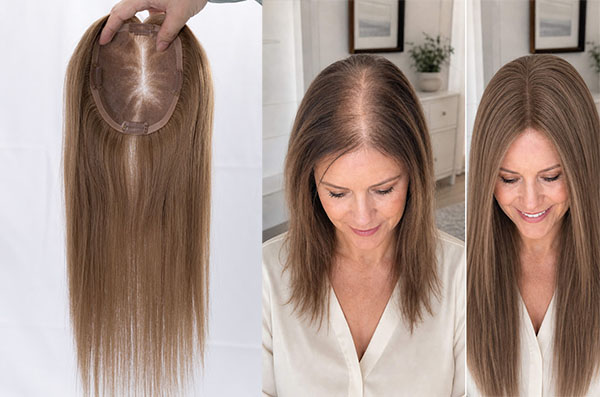
Where the edge shows most
When I first started, I placed my topper about an inch behind my hairline. I thought this looked safer. In truth, it created a visible ridge of lifted hair at the front. The edge catches light, and it catches eyes. Then I tried the opposite. I sat the topper right on the hairline with no natural hair in front. That looked worse, because the topper hair had no real hair to melt into. The sweet spot is to leave a thin frame of your own hair in front, about half a finger wide. This frame hides the topper edge, and the topper fills the thinning behind it. This works best when the thinning is at the crown or mid-scalp. When your hair loss[1] starts at the front hairline, you need a different trick, like a lace front or a forward placement. The goal is simple. No visible line, no visible edge, and no one looks twice.
| Placement | Best for | Main risk |
|---|---|---|
| Slightly behind the hairline | Crown and mid-scalp thinning | Visible edge if front hair is thin |
| On the hairline | Strong natural front, minor thinning | Bulky look if the topper is too dense |
| Over the front hairline | Frontal thinning | Needs a lace front or careful cutting |
Do I Need Bangs to Hide a Topper Edge?
Many women think bangs are the only answer. They cut heavy fringe, hide everything, and lose their face shape. You do not have to make that trade.
No, you do not need bangs to hide a topper edge. Side-swept fringe, a deeper side part, or a soft front wave can hide the edge just as well. Bangs help when the front hairline is thin, but they are a choice, not a requirement.

Styling tricks that hide the front edge
Here is what I tell beginners. Start with a deep side part, then sweep the topper hair forward and down over the edge. That small forward motion covers the seam without bangs. Add a light layer of dry shampoo or texture spray at the front. Texture breaks up the straight line that makes edges visible. You can also backcomb the first inch of the topper hair very lightly. This gives it lift, and lifted hair casts a shadow that hides the edge. Some women use a tiny bit of concealer powder that matches their scalp color, dusted along the base. Others wear a lace front wig[2] for the same reason. A flat iron helps, but only in short strokes at the very front. Never press the edge flat, because a hard straight line is exactly what gives a topper away.
| Method | Difficulty | Best when |
|---|---|---|
| Deep side part | Easy | Long hair with natural density |
| Side-swept fringe | Medium | Thin front hairline |
| Full bangs | Easy | Severe frontal thinning |
| Texture spray | Easy | Straight, fine topper hair |
Is a Lace-Front Topper Better for Frontal Thinning?
Frontal thinning is the hardest area to cover. The hairline is right there in plain sight. A lace front topper was made for exactly this problem.
Yes, a lace-front topper is better for frontal thinning. The sheer lace base blends into your skin and looks like a natural hairline. You can wear it without bangs, and the front edge disappears even in bright light.

How a lace front works
A lace front topper uses a sheer mesh at the front edge. Each hair is hand-tied to the lace, one strand at a time. Because the base is see-through, it sits against your scalp the way your own skin does. This creates the illusion of a real hairline, even when you have hair thinning[3] at the front. Compare that with a standard weft topper. A weft topper has a thick band at the front, so the edge is easier to spot. That is why so many women with frontal loss reach for lace. Dermatologists at the hair loss resource center[4] also warn that heavy toppers can pull on fragile front hairs, so a light lace base is a safer choice. The trade-off is care. Lace needs gentle handling, and it can tear if you are rough with it. But for frontal thinning, the natural look is worth it. Most women tell me the same thing after their first lace topper. They stop checking mirrors, and that is the whole point.
| Feature | Lace front | Weft front |
|---|---|---|
| Edge visibility | Very low | Can be visible |
| Hairline realism | High | Medium |
| Care level | Gentle, can tear | More durable |
| Best for | Frontal thinning | Crown thinning |
Conclusion
The front edge of a hair topper only shows when the topper fights your hair. Match your shade, place it with care, and style the front forward. If your hairline is thin, pick a lace front. That is the whole secret.
References
MedlinePlus — Hair Loss — A government health overview of hair loss causes and treatments. ↑ Back
Wikipedia — Lace wig — Explains how lace front wigs create a natural-looking hairline. ↑ Back
Wikipedia — Hair loss — A broad overview of hair loss types, causes, and treatments. ↑ Back
American Academy of Dermatology — Hair Loss Resource Center — Dermatologist-reviewed guidance on hair loss and hairpiece care. ↑ Back