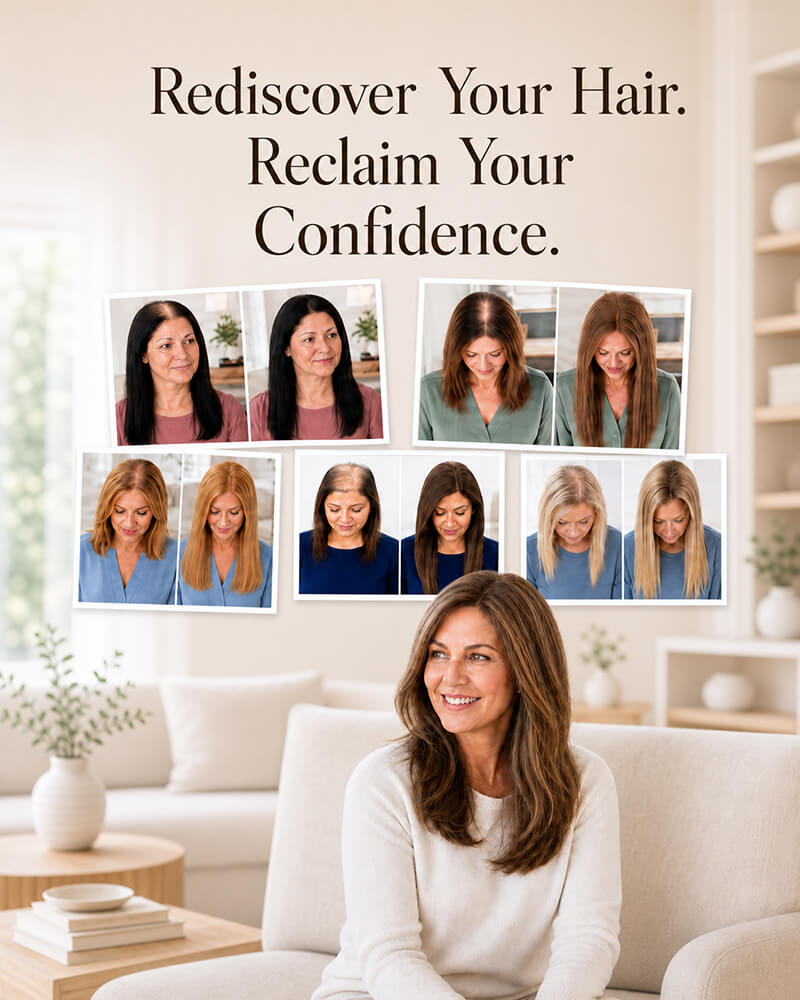

You found the right topper size. Then it arrived. The color looked off, the ends stuck out, and the top looked like a helmet. Matching matters.
To match a hair topper, choose the same color family as your roots, the same or slightly longer length than your hair, a texture close to your natural pattern, and a density that mirrors your own hair. When all four match, the topper disappears into your style.
Length is only the first problem. Color, texture, and density cause the same trouble. I have guided hundreds of women through these four choices at Findingdream, and the same simple rules keep coming up. So let me walk you through each one.
Should a Hair Topper Be Longer or Shorter Than Your Hair?
You ordered a 16-inch topper for your 10-inch bob. The ends hung six inches past your hair. Everyone could see where your hair stopped and the topper started.
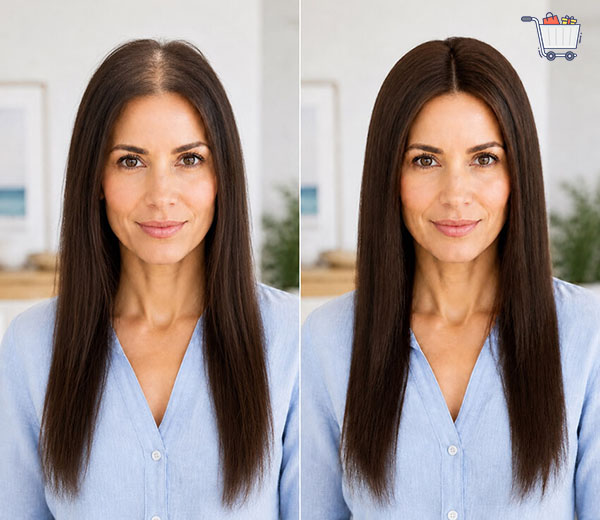
A hair topper should sit at the same length as your hair or one to two inches longer. The extra inch gives your stylist room to trim and layer it. Longer toppers can blend with long hair, but short hair needs a short topper.
The two-inch rule
I learned the two-inch rule from a customer named Dana. She has a 10-inch bob, and she first ordered an 18-inch topper for extra length. Her own hair could not support those long ends. The topper hair hung past her shoulders, and her bob stopped at her chin. The gap between them showed from across the room.
A topper works like the top half of hair extensions[1]. It adds strands above your own hair, and it needs your real lengths to catch and blend those strands. Long hair blends almost any topper, because the lengths run together. Short hair is less forgiving. If your hair is short, keep the topper within one or two inches of your own length. The ends then tuck into your cut, and nothing floats alone. Extra length is fine, but only when a stylist trims the topper after you clip it in.
| Your hair length | Best topper length | Why it works |
|---|---|---|
| Short (8–10 in) | Same length or +1 in | Ends hide inside your own layers |
| Medium (12–14 in) | +1 to 2 in | Trim room for a clean blend |
| Long (16 in and up) | Same length | Long hair merges with topper lengths |
How Do Hair Toppers Stay Hidden in Layered Haircuts?
Layers move. Toppers sit still. A blunt topper edge over feathered hair looks like a hat line across the back of your head.
Hair toppers stay hidden in layered haircuts when a stylist cuts the topper to match your layers. The stylist trims the topper while you wear it, so the ends fall inside your own layers. Blunt topper edges create a visible line, but layered ends dissolve into the cut.
Cut it while you wear it
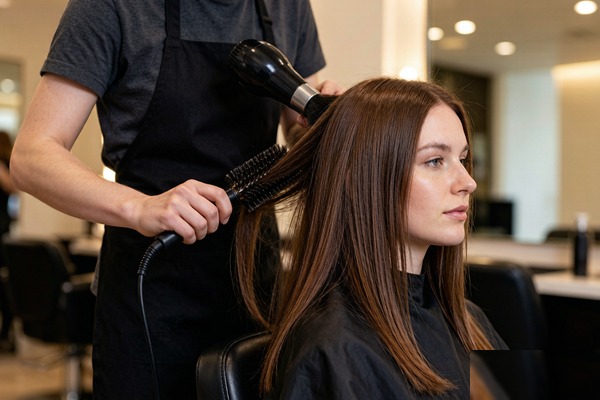
My own stylist cuts every topper on my head, and I ask every customer to do the same. A topper worn dry and clipped in shows its true fall. Scissors can then follow your existing layers. The stylist removes weight from the underside, softens the bottom edge, and adds a few face-framing pieces. The whole service takes about twenty minutes at a normal salon.
This trick has old roots. Barbers have blended a toupee[2] into a client’s cut for decades, and the same logic applies here. Layers create shadow lines, and shadow lines hide borders. Blunt edges reflect light, so the eye catches them at once. Ask for point cutting instead of a straight line. Also ask the stylist to leave the topper slightly longer than your top layer. That extra hair gives your own layers something to rest on, and the whole cut reads as one head of hair.
| Haircut type | Blending tip |
|---|---|
| Blunt one-length cut | Point-cut the topper edge and add invisible layers |
| Long layers | Trim the topper one inch longer than the shortest layer |
| Short pixie or bob | Keep the topper short and let the stylist razor the ends |
| Face-framing layers | Cut matching face-framing pieces into the topper |
How Do I Color Match a Hair Topper?
You matched your topper to your ends. Your ends are three shades lighter than your roots. Now the topper glows like a spotlight on top of your head.
To color match a hair topper, compare the topper with your roots in natural daylight. A topper should match your roots, because the roots sit closest to where the topper lands. Grey and blonde toppers work well, because makers blend several tones into one natural shade.
Roots, ends, grey, and blonde
Your natural hair color[3] is rarely one flat tone. Sun, heat, and age lighten the ends, so the roots and the ends often differ by two or three shades. A topper sits right on top of your roots. So the roots win. Match the roots first, and then check the mid-lengths. If the topper runs slightly darker, a stylist can add a few highlights to close the gap.
Grey toppers are absolutely suitable, and I sell more of them every year. Silver and steel shades look natural when the maker blends darker strands through the base, because real grey hair grows in mixed. Blonde toppers are our best sellers for white women. Shade 60 gives a soft snow-blonde, shade 613 gives bright platinum, and rooted blonde adds a darker root so the topper mimics grown-out blond hair[4]. If you cannot decide between two shades, choose the lighter one. A toner can warm a light topper, but color rarely lifts a dark one.
| Your color situation | Match strategy |
|---|---|
| Roots and ends differ | Match the roots, then tone the mid-lengths |
| Salty grey regrowth | Choose a blended grey mix, not a flat silver |
| Highlighted blonde | Pick a rooted blonde with mixed tones |
| Colored or fantasy hair | Send a daylight photo to the seller before ordering |
How Do I Match a Hair Topper to Wavy or Curly Hair?
Your waves spiral in soft S-shapes. Your topper came bone straight. The top of your head now tells a different hair story than the bottom.
To match a hair topper to wavy or curly hair, pick a topper with the same curl pattern, or buy a straight topper and restyle it. You can wear a straight topper with wavy hair. You just need a hair iron to sync both textures.
Can you wear a straight topper with wavy hair?
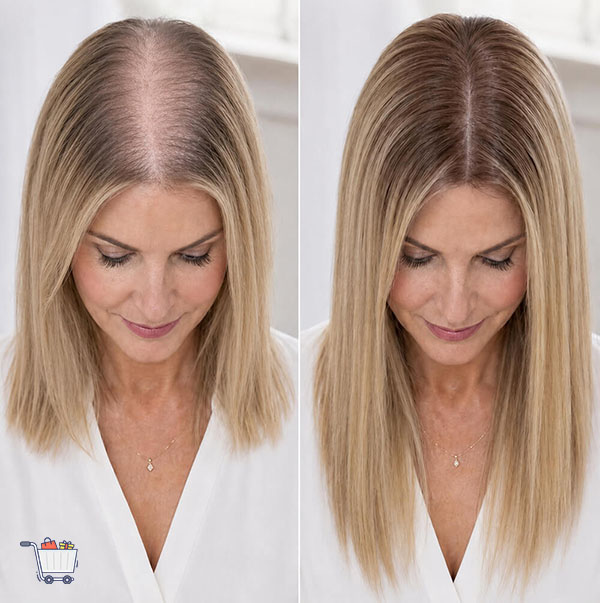
Yes, you can, and I do it often. A straight human hair topper acts like a blank canvas. You can curl it to your pattern, or you can smooth your own hair and wear everything straight. The tool that saves the day is a hair iron[5]. I clamp the topper and my own hair together in one pass, and the two textures lock into the same wave.
Curl size matters more than curl type. A tight spiral topper over loose beach waves will not blend, because the ringlets clump differently. Match the diameter of the curl first. If your waves fall between two topper textures, choose the looser one, because you can always tighten a wave with heat. Body wave is the safest middle choice, and it styles both ways. One caution: heat-style the topper on a low setting. High heat dries the cuticle, and dry hair loses its shine after a few weeks.
| Your natural texture | Best topper texture |
|---|---|
| Straight | Straight or slight body wave |
| Loose beach waves | Body wave |
| Defined S-waves | Deep wave or water wave |
| Tight curls | Curly topper with matched curl size |
How Much Density Should a Hair Topper Have?
Your topper matched your color perfectly. But it arrived thick and heavy. Your fine hair now hides under a dense carpet that no one believes.
A hair topper should match your own hair density. Fine hair suits 100–110% density, medium hair suits 120–130%, and thick hair carries 150%. Most women look natural at 120% to 130% density, because it adds fullness without a heavy, helmet-like top.
Match density before you add volume
Density means how much hair the topper holds per square inch. Your own density comes from your hair follicles[6], and each follicle grows one strand. Fine-haired women have fewer or thinner strands, so a 150% topper towers over their bio hair and creates a step at the blend line. The eye reads that step instantly.
I always tell customers to buy the density that matches their hair today, not the hair they wish they had. A 110% topper on fine hair looks like a fuller version of you. A 150% topper on fine hair looks like a wig, and no amount of cutting fixes it. The reverse also holds. Thick-haired women need 150% or the topper looks thin against their own sides. One more tip: density and base size work together. A small 5×5 topper at 130% adds less total hair than a large 7×7 at the same density, so check both numbers together.
| Topper density | Best for | Result |
|---|---|---|
| 100–110% | Fine or thinning hair | Natural, light coverage |
| 120–130% | Medium hair | Full but believable (most popular) |
| 150% and up | Thick hair | Balanced blend with heavy bio hair |
Conclusion
Color, texture, length, and density form one system. Match your roots in daylight, stay within two inches of your length, mirror your wave pattern, and keep density near your own. Do these four things, and your topper stops being a product. It just becomes your hair.
References
Wikipedia — Artificial hair integrations — Overview of how hair extensions and toppers attach and blend. ↑ Back
Wikipedia — Toupee — History of partial hairpieces and how barbers blend them into a haircut. ↑ Back
Wikipedia — Human hair color — How natural pigments, sun, and age change hair color from roots to ends. ↑ Back
Wikipedia — Blond — Background on blonde shades and toned blonde hair. ↑ Back
Wikipedia — Hair iron — How flat irons and curling irons restyle human hair. ↑ Back
Wikipedia — Hair follicle — How follicles determine hair density and strand count. ↑ Back