

Your topper looks perfect at the mirror. But your life does not stop at the mirror. Sleep, workouts, beach days, and sudden rain all test it.
Yes, you can sleep, exercise, and even swim in a hair topper, but each activity needs a different approach. Take it off for sleep, secure it well for workouts, and protect it from water. Your routine decides what your topper can handle.
I sell hair toppers for thinning hair at Findingdream, and these are the questions customers ask me the most. Some women are afraid to move with their topper on. Others treat it like a helmet and never take it off. The truth sits in the middle. Let me walk you through sleep, exercise, and water one by one, so you know exactly what is safe and what is not.
Can You Sleep in a Hair Topper?
You are exhausted, and the bed is calling. Removing the topper feels like extra work. But sleeping in it costs more than the two minutes you save.
You can sleep in a hair topper, but it is not recommended. Sleeping in it overnight rubs your scalp, pulls your hairline, and shortens the piece’s life. Take it off and store it on a stand for the best results.

The honest answer about overnight wear
Think about eight hours of pressure. Your head presses into the pillow, and the clips dig into the same spot all night. Repeated pulling along the hairline risks traction alopecia[1], hair loss caused by tight styles. Many women already wear toppers for female pattern hair loss[2], so extra stress is the last thing they need. Overnight friction also tangles strands, and the base soaks up sweat and oil. Traveling? Loosen the clips and use a silk pillowcase. As a habit, take it off.
| Situation | Can you sleep in it? | What to do instead |
|---|---|---|
| Every night | No | Take it off and store on a stand |
| Travel, one night | Rarely | Loosen clips, use a silk pillowcase |
| Nap, under an hour | Sometimes | Remove if it feels tight |
Can You Work Out or Run in a Hair Topper?
You hit the gym three times a week. You run, jump, and sweat. Your hair topper needs to keep up, and you worry it will not.
Yes, you can work out in a hair topper, and it will stay on if you secure it well. Clips hold through running, jumping, and most workouts. Sweat needs quick care, and heavy cardio is safer with extra pins or a band.

Will a hair topper come off when running?
A properly fitted topper with four or five clips will not fly off when you run. The clips grip real hair underneath, and that grip holds through bouncing and sudden turns. What fails is a wrong-sized base or clips not snapped fully closed, so fit matters more than the activity. Sweat is the second problem. A sweaty scalp gets damp and itchy, and the base traps heat. Sweat itself does not cause hair loss[3], but a hot, damp scalp invites irritation. Dry everything soon after.
| Workout | Does it stay on? | Watch out for |
|---|---|---|
| Walking, yoga | Yes, easily | Low risk, light sweat |
| Running, HIIT | Yes, with good fit | Add pins, use a headband |
| Swimming, diving | No | Water ruins the piece |
Can You Swim or Shower in a Hair Topper?
Beach vacations, pool parties, and quick showers all put your topper near water. Water is one of the toughest tests for any hair piece.
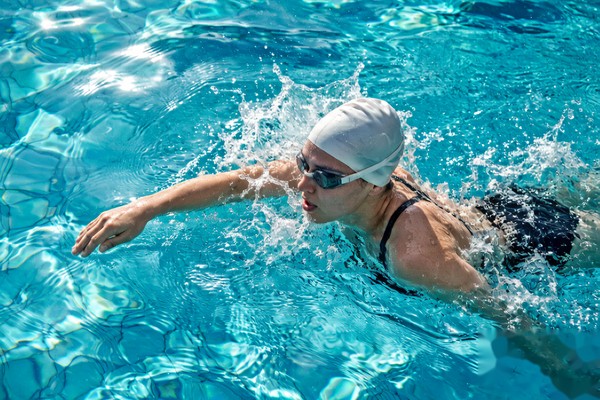
You can swim in a hair topper only with a swim cap, and showering with one on is not recommended. Water ruins the style, and chlorine or salt water damages the fibers. A silk topper resists water better, but it still needs a cap.
What happens if a hair topper gets wet in the rain?
Each strand has a protective outer layer, and water makes it swell and stand up, so wet hair is weaker than dry hair. Human hair toppers react exactly like your own hair to this hair structure[4]. A soaked piece absorbs water, gets heavy, loses its style, and can tangle. A silk topper resists water better and survives light rain, but fibers still knot after a soak. Chlorine and salt water are worse, stripping both types of softness. For a shower, take it off, because steam alone flattens the style.
| Water situation | Human hair topper | Silk topper |
|---|---|---|
| Light rain | Fine with a hood | Fine with a hood |
| Heavy rain | Use an umbrella | Use an umbrella |
| Shower | Take it off | Take it off |
| Pool or ocean | Swim cap or remove | Swim cap or remove |
How Do You Secure a Topper for an Active Lifestyle?
You decided to wear it through life, not just through photos. But four small clips do not feel like enough, and you want real security.
Secure a topper for an active lifestyle with more than clips. Add extra clips or pins, use a wig band or grip base, and test the fit before every workout. A well-fitted base does the real work, and the extras add confidence.
Extra security tricks that actually work
Nothing beats a correct fit. A topper that sits flat uses clips the way clip-in hair extensions[5] work, gripping a small section of your own hair underneath, so the anchor stays hidden. If your topper has room, add two extra clips at the back, the spot that lifts during cardio. A wig band adds friction without pressure, and a grip base sticks better than a plain net one. Before any workout, do the shake test: bend over and jump. If nothing moves, you are ready.
| Security method | Best for | Hold level |
|---|---|---|
| Extra back clips | Cardio, running | Strong |
| Wig band | Daily wear | Medium |
| Bobby pins | High-impact sport | Strongest |
| Grip base | Slippery hair | Strong |
Conclusion
Take the topper off for sleep, secure it well for exercise, and keep it out of water. Match the activity to the right habit, and your topper will keep up with your whole life.
References
American Academy of Dermatology — hair loss types and causes, including traction alopecia from pulling. ↑ Back
Cleveland Clinic — female pattern hair loss causes and treatment options. ↑ Back
MedlinePlus — hair loss overview, causes, and when to see a doctor. ↑ Back
Wikipedia — Hair — the structure of a hair strand and how water affects it. ↑ Back
Wikipedia — Hair extension — how clip-in extensions attach and hold. ↑ Back