

A topper can lose its natural look after one careless cut, color service, or hot-tool session. I inspect it before making any permanent change.
Yes, most hair toppers can be cut, suitable human-hair toppers may be colored, and human hair or approved heat-friendly fiber can be heat-styled. I strand-test first, follow the manufacturer’s limits, avoid bleaching pre-colored pieces, and use an alternative-hair stylist for irreversible work.
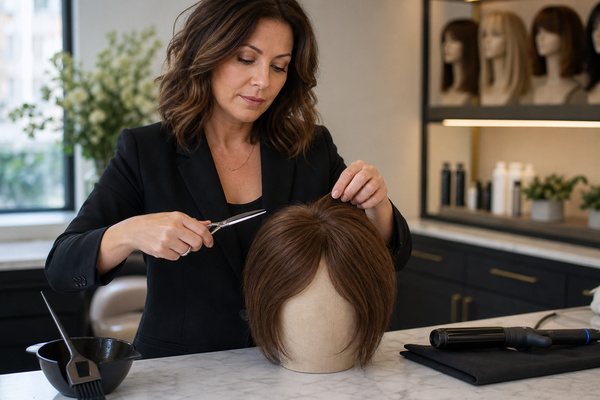
I treat a topper as a finished hair system rather than a loose bundle of biological hair. The visible hair may already have been lightened, toned, coated, or otherwise processed before it was attached to lace, silk, polyurethane, or another base. That history affects how the strands accept color and tolerate heat. The knots, clips, adhesives, base edge, density, and replacement cost also change what is safe. Before cutting or styling, I identify the fiber and find the manufacturer’s care instructions. Before coloring, I confirm whether alteration is permitted and test a hidden section through the complete process, including rinsing and drying. This slower approach protects both the appearance of the hair and the construction that keeps the topper wearable.
Can You Cut a Hair Topper?
An uncut topper may look heavy or disconnected from your natural hair. A rushed cut can remove coverage or length that cannot be restored.
Yes, both human-hair and synthetic toppers can be cut. I fit the topper in its final wearing position, confirm the daily part and blend, and remove small amounts at a time. I preserve density near the base and avoid thinning around delicate knots, lace, or silk.
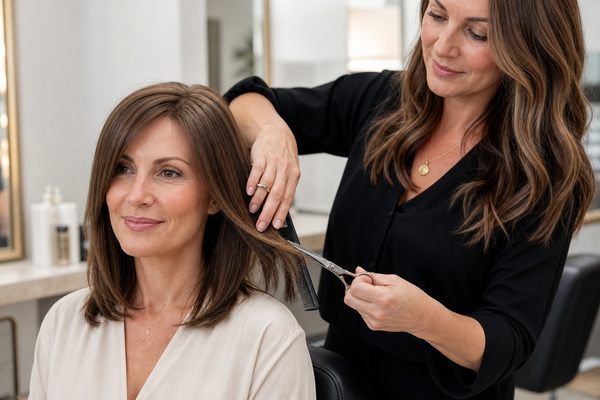
I cut for the finished position
I never cut a new topper while holding it in my hand. I first place it where the wearer intends to position it every day, because even a one-inch shift changes where the fringe, layers, and perimeter fall. I check crown coverage, part direction, face shape, natural length, and density before picking up scissors. Dry cutting is often useful because I can see the actual movement of the topper and the wearer’s hair together. I retain extra length around the front and sides until the blend is confirmed, then soften the transition gradually. Synthetic fiber and human hair can both be shaped, but neither grows back after a mistake. I also keep thinning shears away from delicate knots and base edges. The goal is not to make the topper look impressive by itself; it is to make both layers read as one believable haircut.
| Cutting goal | My approach | What I avoid |
|---|---|---|
| Blend the ends | Point-cut small sections with natural hair visible | A heavy straight line across both layers |
| Soften the face | Add conservative face-framing pieces | Cutting a short fringe before fitting |
| Reduce bulk | Remove weight from the mid-lengths and ends | Thinning close to knots, lace, or base edges |
| Match a part | Confirm the daily part before shaping | Cutting for a temporary or incorrect position |
Can You Dye a Human Hair Topper?
A close shade can still blend poorly when the tone is wrong. Processed topper hair may also absorb color unevenly or become unexpectedly dark.
Some human-hair toppers can be dyed, but only when the manufacturer permits alteration. Depositing a similar or darker shade is usually more predictable than lifting. I test a hidden strand, protect the base and knots, and stop if the sample becomes patchy, muddy, dry, or weak.
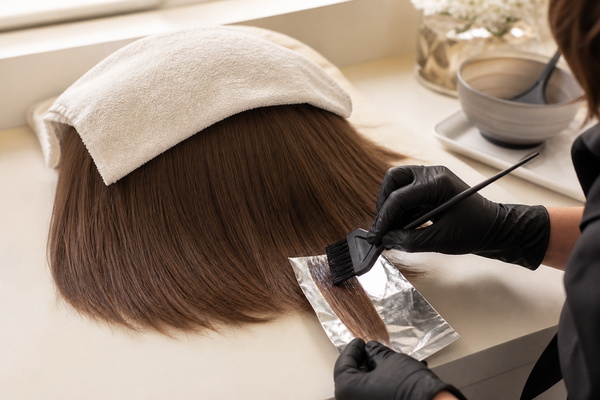
Why a strand test matters
I begin with the topper’s label, fiber information, original color, and processing history. Many human-hair toppers have already undergone substantial lightening and toning, so the same formula can develop differently on the roots, mid-lengths, and ends. Research on oxidative dyeing1 describes cuticle swelling, dye-precursor penetration, and oxidation within the hair cortex; those chemical steps can also reduce structural strength. I therefore test a small hidden section and judge it only after it has been rinsed, conditioned, and dried. When the goal allows it, I prefer a controlled deposit or demi-permanent adjustment instead of a major color change. I keep chemicals and heavy conditioner away from the base unless its maker expressly approves contact, because knots, adhesives, and delicate materials need separate protection. I record the formula, timing, and result rather than trying to correct an unsuitable test across the entire topper.
| Color change | Relative risk | My usual decision |
|---|---|---|
| Add a similar toner | Lower | Strand-test and use a gentle deposit formula |
| Go one level darker | Moderate | Check absorption and watch porous ends closely |
| Add lowlights | Moderate | Use controlled foils with an alternative-hair colorist |
| Change several levels | High | Request a professional test and consultation |
Can You Lighten or Bleach a Hair Topper?
Lightening may appear to solve a dark color match. In practice, unknown factory dyes and earlier processing can produce warmth, dryness, or breakage.
I do not recommend bleaching a standard pre-colored human-hair topper at home. I consider lightening only when the manufacturer identifies the piece as suitable and an experienced specialist approves the strand test. Buying the correct lighter shade is usually safer than lifting a finished topper.
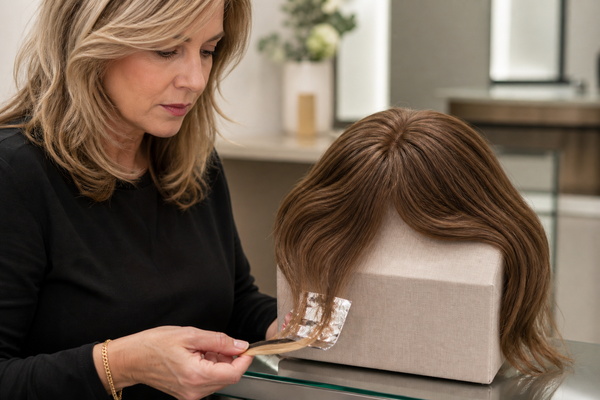
Lightening is not the same as depositing color
I treat bleach as the highest-risk color service in this guide. Bleaching lightens hair by oxidizing melanin in the cortex, but the reaction can also damage the cuticle and partially break keratin’s disulfide bonds2. Microscopic research on excessively bleached hair found broken or detached cuticle scales, pores in the cortex, reduced structural integrity, and greater risk of breakage. A topper has no new growth to replace compromised lengths, and its prior factory processing may be unknown. If a manufacturer offers natural, uncolored, or professionally alterable hair, a specialist may be able to lift it within that product’s stated limit. Even then, I expect warmth, staged tests, possible toning, and a conservative endpoint. I never let lightener contact lace, silk material, polyurethane, knots, clips, or adhesive areas. When a topper is several levels too dark, an exchange or a lighter starting shade is usually the more reliable investment.
| Situation | My recommendation | Main reason |
|---|---|---|
| Pre-colored standard topper | Do not bleach | Factory color may lift unevenly |
| Maker-approved natural color | Specialist strand test only | The safe lifting range is product-specific |
| Topper is slightly too warm | Consider a deposit-only toner | Tone correction may not require lift |
| Topper is several levels too dark | Exchange or choose a lighter shade | Major lifting risks permanent damage |
Can You Curl or Straighten a Human Hair Topper?
Human hair offers styling freedom, but repeated passes can dry the strands and stress the base. Efficient technique matters more than maximum temperature.
Yes, you can curl or straighten a human-hair topper when its care instructions permit heat. I work on completely dry, detangled hair, apply heat protectant, use small sections and minimal passes, and keep the tool away from the base, knots, clips, and adhesives.
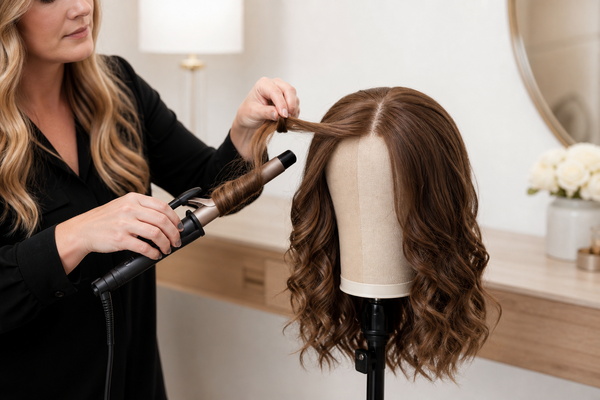
My controlled styling routine
I detangle the topper before applying heat and confirm that every section is fully dry. I secure the piece on a correctly sized canvas block using safe anchor points rather than pushing pins through delicate lace or silk. I then divide the hair into small sections so one controlled pass can do the work. Research on thermal styling3 found that the onset of damage is strongly temperature-dependent, which is why I do not keep increasing heat for speed. For curls, I release the section and let it cool in shape before brushing. For straightening, I use one smooth downward pass without clamping near the base. I style the wearer’s biological hair separately and apply the topper afterward, reducing pulling and preventing the tool from touching the scalp or attachment points. A brush or wide-tooth comb should finish the blend; I do not reheat every strand simply because it moved during application.
| Styling step | What I do | What I avoid |
|---|---|---|
| Preparation | Detangle and dry completely | Heating damp or tangled hair |
| Protection | Apply a light heat protectant to the lengths | Saturating the base or knots |
| Curling | Heat briefly, release, and cool in shape | Reheating a curl before it sets |
| Straightening | Use one smooth pass on small sections | Clamping the root or base material |
What Heat Setting Is Safe for a Hair Topper?
A temperature that works for one topper can damage another. “Human hair” and “heat-friendly” are not universal temperature ratings.
The manufacturer’s limit is the only reliable ceiling. For approved human hair, I usually test around 250–300°F and increase only if necessary. I never assume 350°F is safe. Traditional synthetic fiber receives no hot tools, while heat-friendly synthetic must follow its exact product instructions.
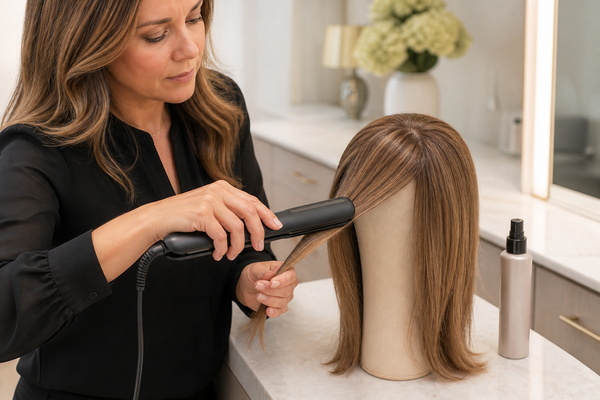
Temperature is a ceiling, not a target
I use the lowest setting that creates the result in one or two passes. Fine, lightened, dry, or repeatedly colored hair deserves more caution than strong, minimally processed hair. A controlled study of hair shaft damage4 found progressively greater surface damage as blow-drying temperature increased. Although a dryer study cannot define an iron setting for every topper, it supports the practical rule that more heat creates more risk. I begin low, test an inconspicuous section, and inspect the strand after it cools. I stop if it becomes stiff, unusually shiny, rough, discolored, melted, or prone to breakage. Heat-friendly synthetic also varies by product: one commercial topper made with VersaFiber®5 states a 350°F limit, but that number applies to that named fiber rather than to every synthetic topper. Direct heat never belongs on lace, silk material, polyurethane, adhesives, or clips.
| Fiber or condition | Conservative test range | Hard rule |
|---|---|---|
| Maker-approved human hair | About 250–300°F | Stay below the product’s stated maximum |
| Lightened or fragile human hair | About 230–270°F | Test first and minimize passes |
| Heat-friendly synthetic | Product-specific | Use only its written temperature range |
| Traditional synthetic | No hot tool | Use approved non-heat methods only |
Should a Hair Topper Be Customized by a Stylist?
A valuable topper can be permanently changed by one incorrect cut or chemical service. I use specialist help whenever the result is difficult to reverse.
I recommend an alternative-hair stylist for the first blend cut, fringe, density reduction, root color, lowlights, color correction, or any approved lightening. Daily restyling can be done at home, but a specialist understands processed hair, placement, knots, and delicate base materials.
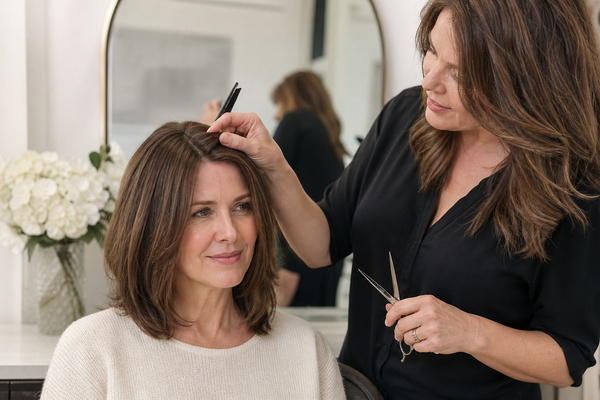
When specialist experience matters
I look for a stylist who regularly works with toppers and wigs, not only hair growing from the scalp. The chemistry, attachment method, base protection, and cutting position require different habits. The National Alopecia Areata Foundation’s explanation of cap construction6 distinguishes wefted, monofilament, lace-front, and hand-tied designs, each with different materials and hair-attachment methods. That is why a stylist should inspect the actual base before thinning, coloring, pinning, or applying heat near it. I bring the product label, color history, and clear daylight photos of the wearer’s natural hair and desired result. For mail-in work, I ask how the stylist will verify the match without the wearer present and whether the quote includes a strand test. I request written approval before bleach or another permanent change. A responsible specialist may recommend a smaller adjustment, temporary root color, a different starting shade, or an exchange instead of accepting a risky correction.
| Service | Home or specialist? | Why |
|---|---|---|
| Basic brushing and gentle restyling | Home | Reversible and easy to control |
| First blend haircut | Specialist | Placement and natural hair must be assessed together |
| Toner, rooting, or lowlights | Specialist | Processed hair may absorb color unevenly |
| Bleach or major color correction | Specialist only, if maker-approved | Damage and color results can be permanent |
What Is the Average Cost to Have a Hair Topper Toned and Lowlights Added?
Topper-color quotes vary because some menus separate toner and foils while others include consultation, washing, styling, products, or shipping. Compare the exact scope.
There is no reliable national average, but a practical U.S. budget is about $250–$350 or more for toner plus lowlights from an alternative-hair specialist. Ask for a written topper-specific quote because length, density, correction work, haircut, styling, and shipping can increase the total.
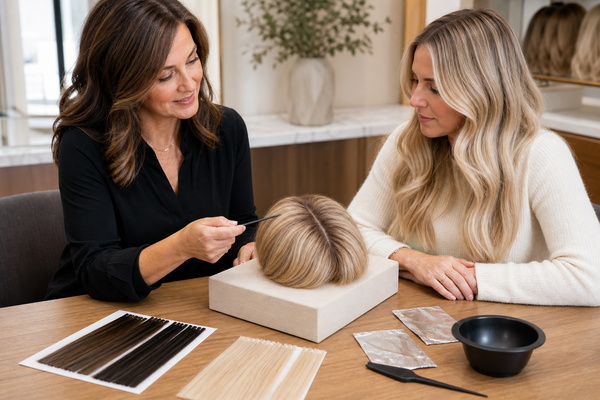
A planning range, not a national fixed price
There is no authoritative nationwide average for topper toning and lowlights, and posted prices can change. I therefore use current alternative-hair service menus only as planning examples. Hair by Sarah Mascara lists topper color prices7 of $100–$150 for gloss or toner and $150–$200 for lowlights, an itemized total of $250–$350 before extras. Guiltless Glamour lists wig/topper color8 starting at $200 and specifically includes toning and lowlighting among the possible services, showing why the final scope must be confirmed. These examples are not a promise of what another stylist will charge. I request a quote based on photos, length, base size, current shade, target shade, and color history, then confirm whether testing, washing, conditioning, blow-drying, cutting, styling, correction, and return shipping are included.
| Cost item | Published planning examples | Question I ask |
|---|---|---|
| Toner or gloss | $100–$150 on the itemized example menu | Are washing and styling included? |
| Lowlights | $150–$200+ | How many foils and colors are included? |
| Combined itemized service | About $250–$350+ | Is toner charged separately? |
| General wig/topper color | Starts at $200 on a second example menu | Which services are included? |
| Cut, correction, or shipping | Additional | What is the complete written total? |
Conclusion
I customize a topper only after identifying its fiber, previous processing, base construction, and manufacturer’s limits. Cutting and controlled heat are often possible; depositing color requires a complete strand test; and bleaching carries the greatest risk. When a change is chemical, major, costly, or irreversible, an experienced alternative-hair stylist is the safer choice.
References
Dye mechanisms explains cuticle swelling, dye penetration, oxidation, and structural effects. ↩
Bleach damage documents changes to melanin, disulfide bonds, cuticle, and cortex. ↩
Thermal styling reports that heat-damage onset is strongly temperature-dependent. ↩
Heat study found greater hair-surface damage at higher drying temperatures. ↩
Fiber limit gives the product-specific 350°F rating for VersaFiber®. ↩
Cap construction defines wefted, monofilament, lace-front, and hand-tied bases. ↩
Topper pricing lists current gloss, toner, and lowlight service ranges. ↩
Color service lists wig/topper coloring from $200, including toning and lowlighting options. ↩