

Topper myths can make early thinning feel harder to manage and turn a practical choice into an unnecessary source of worry.
Human hair toppers are not only for advanced hair loss, and they do not automatically look bulky or damage natural hair. The result depends on fit, density, base construction, attachment, hair quality, color, cut, and daily care.

When women ask me about toppers, they often begin with a fear rather than a product question: “Will everyone know?” That fear usually comes from an obvious, poorly matched piece they once saw online—or from advice that treats every topper as if it were built and worn in the same way. I want to separate the product from the outcome. A topper is a partial hairpiece, but its appearance and comfort are shaped by many small decisions. Let’s correct the five myths that cause the most confusion.
Myth 1: Hair Toppers Are Only for Women With Advanced Hair Loss
Waiting for severe loss can leave women struggling with a widening part long before they feel “qualified” to seek coverage.
A topper can help with early or moderate thinning, not just advanced hair loss. Small bases and lighter densities can add targeted coverage or volume while allowing plenty of natural hair to remain visible.

Early Thinning Can Be Enough Reason to Consider a Topper
Many women first notice a wider part or a ponytail that feels less full. The American Academy of Dermatology lists both among the signs of early hair loss1. A woman does not need to wait for a large bald area before trying cosmetic coverage. I see a topper as one option for solving a visible styling problem today; it is not a diagnosis or a hair-loss treatment. A small, low-density piece may support a widening part, a sparse crown, or reduced volume. Some women also use toppers for cosmetic fullness even when hair loss is not the reason. DermNet notes that hairpieces and wigs2 can be added to existing hair and are used for cosmetic as well as medical reasons. The right time is when the coverage helps you—not when your thinning reaches someone else’s definition of “serious.”
Match the Coverage Area Instead of Buying the Largest Base
The base should cover the area that needs help and reach stable hair where the clips or other attachment points will sit. Bigger is not automatically better. If your concern is limited to the part, a compact base with light density may blend more naturally than a large, dense piece. If thinning extends across the crown, a broader base may distribute weight more comfortably and avoid attaching clips to the weakest strands. I recommend measuring the thinning area from front to back and side to side, then adding enough room to reach stronger hair. Also check whether your natural front hairline can remain exposed or whether you need a lace-front design. This approach keeps the topper proportionate to the problem and prevents the “helmet” effect that can happen when too much hair is placed over a small area.
| What you notice | What it may mean for topper selection |
|---|---|
| Slightly widening part | Small base, light density, matched part direction |
| Reduced crown volume | Medium coverage with gradual density |
| Broad diffuse thinning | Larger base that reaches stronger attachment areas |
| Sparse or difficult front hairline | Consider a lace front or another front-edge solution |
Myth 2: All Hair Toppers Look Obvious or Bulky
One visibly dense topper can convince a shopper that every partial hairpiece will sit high, show an edge, or move unnaturally.
A topper looks obvious when its density, base, placement, color, part, or haircut conflicts with the wearer’s own hair. A well-fitted piece with appropriate construction can sit flatter and blend naturally.
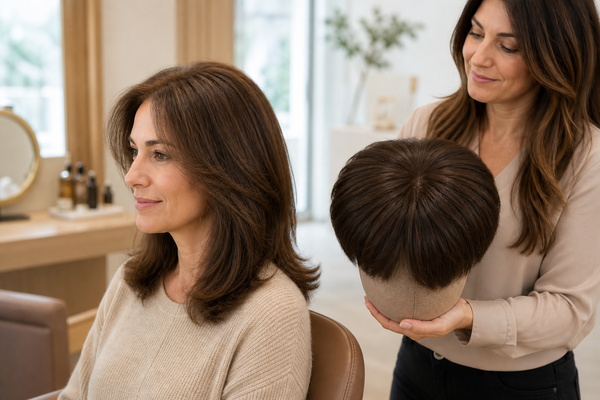
Bulk Usually Comes From a Mismatch, Not the Idea of a Topper
Several issues can create a bulky result: a base that is too small for the thinning area, excessive density, thick return hairs near the base, clips sitting on an uneven surface, or a topper placed too far forward. A stiff piece with one heavy layer can also form a shelf instead of falling into the wearer’s natural hair. I start by checking the silhouette from the front and both sides, not just the top view. The crown should not suddenly rise, and the topper’s hair should not form a separate curtain over the ends. Color matters too, but a technically correct shade can still look wrong if the root depth, warmth, highlights, or texture do not match. A stylist can often improve the result by adjusting the perimeter, adding face-framing layers, refining the density, and blending the topper while it is on the client’s head.
Base Construction Changes How Flat and Realistic a Topper Can Look
Not all bases have the same thickness, opacity, durability, or scalp effect. A peer-reviewed review of hair prosthetic construction3 explains that a two-layer silk base can look thicker and more opaque, while lace-based options are generally thinner; it also notes trade-offs between realistic appearance, adaptability, and durability. This does not mean that silk is “bad” or lace is always best. An opaque top can hide knots and imitate a clean scalp, while delicate lace may lie flatter but require gentler handling. Monofilament, lace, silk, skin, and hybrid bases each solve different problems. The most natural choice is the one that suits your coverage needs, scalp visibility, attachment method, lifestyle, and tolerance for maintenance—not the thinnest material on a product page.
| Factor | What can look obvious | A more natural approach |
|---|---|---|
| Density | Too much hair beside fine natural hair | Match the wearer’s real density and add only needed fullness |
| Base | Edge sits on weak or uneven hair | Size the base to reach a stable, flatter area |
| Color | Flat single shade against dimensional hair | Match root, tone, highlights, and ends |
| Cut | Topper remains one separate length | Blend the perimeter and add compatible layers |
| Placement | Front edge sits too low or too high | Position it to follow the natural part and hairline |
Myth 3: Every Hair Topper Damages Natural Hair
Fear of clips and tension sometimes leads women to believe that wearing any topper must make thinning worse.
A topper does not automatically damage natural hair. Risk increases when a heavy or poorly fitted piece repeatedly pulls the same fragile area, feels tight, rubs the scalp, or is removed carelessly.
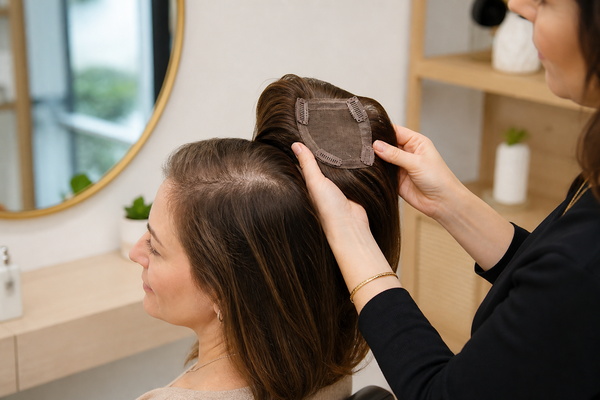
The Main Concern Is Repeated Tension on Vulnerable Hair
The important question is not simply, “Does it have clips?” It is, “Where is the force going, and how often?” The American Academy of Dermatology explains that repeated pulling can cause traction alopecia4, and it identifies pain, stinging, crusting, tenting, broken hairs, and recession as warning signs. A topper clip attached to strong hair with little tension is different from a heavy piece anchored every day to a sparse, fragile patch. Damage can also come from snapping clips shut while they pull, placing the front edge under strain, sleeping in a clip-in topper, or dragging the base during removal. I would never tell someone to tolerate discomfort in order to keep the style in place. Pain is information. Remove the topper, reassess the fit, and discuss persistent scalp symptoms or continuing loss with a qualified clinician.
Daily Habits Can Reduce Pulling and Friction
Begin with the lightest coverage that does the job, and make sure the attachment points sit beyond the most fragile area. Open every clip before lifting the topper away; never pull a closed clip through the hair. If the design allows it, vary the clip position slightly rather than stressing exactly the same strands every day. Keep the natural hair underneath clean, dry, and free from tight tangles before attachment. Give your scalp regular breaks, especially if you wear a topper for long hours, and do not sleep or exercise intensely in a piece that was not designed for that use. Women with very fragile hair may need a larger base that distributes pressure, a different clip layout, a grip, tape, an integration method, or professional customization. The goal is secure wear without tension, pinching, headache, or irritation.
| Warning sign | What to do |
|---|---|
| Pain, stinging, or headache | Remove the topper and check tension and attachment immediately |
| Clips sit inside the thinnest area | Resize, reposition, or change the attachment layout |
| New short broken hairs near clips | Reduce repeated stress and seek fitting advice |
| Front edge lifts unless pulled tight | Correct the base fit or front attachment; do not force it flat |
| Ongoing redness, scaling, sores, or worsening loss | Stop wear and consult a qualified clinician |
Myth 4: All Human Hair Toppers Are the Same Quality
The words “100% human hair” can sound like a complete quality grade, even though they reveal very little about processing or workmanship.
Human hair toppers can differ greatly in fiber condition, processing history, strand consistency, color work, direction, density, ventilation, knotting, base materials, and quality control. The label alone cannot predict performance.
Processing History Affects Feel, Movement, and Longevity
Human hair is a natural material, but collected hair can be sorted, colored, lightened, straightened, textured, coated, or mixed before it reaches a topper. Those choices affect how it feels after the first wash and how consistently it behaves over time. A scientific review of hair care describes how chemical processing5 can disrupt the protective cuticle and leave fibers more porous, brittle, and vulnerable to further damage. That evidence concerns human hair fibers generally, so I use it to explain why two products carrying the same “human hair” label may not perform alike after different processing histories. It does not prove quality from a marketing term. Before buying, ask whether the hair has been heavily lightened, how its texture was created, whether the color is stable, and what happens after washing. A sample, clear return policy, and real post-wash photos can be more useful than an impressive label.
Base Workmanship Matters as Much as the Hair Fiber
Excellent hair on a poorly made base can still produce shedding, visible knots, lift, or an unnatural part. I examine how evenly the hair is ventilated, whether the density changes gradually around the perimeter, how secure the knots are, whether the front edge lies flat, and whether clips are placed where the base can carry tension. I also look for clean stitching, comfortable seams, consistent hair direction, and enough strength for the intended frequency of wear. Very delicate lace may create a beautiful edge but require more careful handling, while a more structured base may suit everyday durability. Customization has value when it solves a real mismatch—base size, part location, color, density, curl pattern, gray percentage, or attachment—not merely because the product is called premium. A good topper is a balanced system: fiber, base, fit, finishing, and support must work together.
| Quality question | Why it matters |
|---|---|
| How has the hair been colored or textured? | Heavy processing can affect softness, porosity, and strength |
| Does the piece look consistent after washing? | Coatings can temporarily hide dryness or roughness |
| Is density graduated at the edge? | A softer transition is easier to blend |
| Are knots, seams, and clips secure and comfortable? | Workmanship affects shedding, lift, comfort, and repairability |
| Can the color, base, density, or part be customized? | Specific customization can prevent a visible mismatch |
What Should You Believe About Hair Toppers?
The myths sound simple because they ignore fit, construction, attachment, and the individual wearer.
A human hair topper can be useful at different stages of thinning and can look natural without automatically damaging hair. Choose by coverage, fit, density, base, fiber condition, and workmanship—not by fear or a label.
Judge a topper on your scalp, in natural daylight, after proper blending. Pain, unusual height, or strong tension signals a fitting problem, not a universal failure. If loss is new, rapid, painful, inflamed, or unexplained, seek medical evaluation; cosmetic coverage does not identify the cause.
References
- American Academy of Dermatology Association. “Hair Loss: Signs and Symptoms.” Explains that women may first notice a widening part or reduced ponytail fullness and lists other gradual and sudden patterns that deserve attention. ↩
- DermNet. “Hair Pieces and Wigs.” Summarizes medical and cosmetic uses of hairpieces, notes that they can be added to existing hair, and describes their role as immediate camouflage for different hair-loss conditions. ↩
- Ewulu, A., et al. “Review of Hair Prosthetic Options for Patients With Alopecia.” Journal of Cosmetic Dermatology. Compares coverage designs, attachment materials, silk and lace bases, human and synthetic fibers, durability, and appearance trade-offs. ↩
- American Academy of Dermatology Association. “Hairstyles That Pull Can Lead to Hair Loss.” Defines traction alopecia, identifies repeated tension as a cause, and lists pain, stinging, breakage, recession, and scalp changes as warnings. ↩
- Fernandes, M. M., et al. “On Hair Care Physicochemistry: From Structure and Degradation to Novel Biobased Conditioning Agents.” Reviews cuticle protection, chemical and physical weathering, porosity, loss of strength, and breakage in human hair fibers. ↩