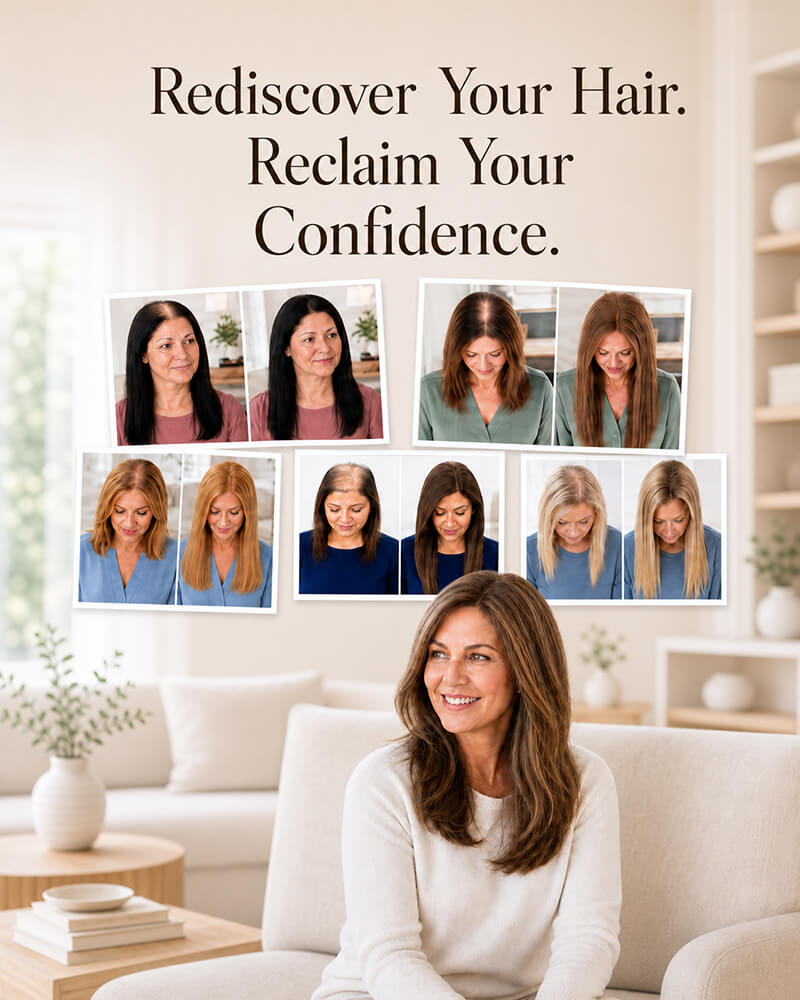

Hair Topper vs. Hair Extensions: Which Is Better for Thinning Hair?
When thinning appears on top, choosing the wrong add-on can add length while leaving the visible scalp unchanged—or place more strain on fragile hair.
I usually recommend a hair topper for crown or part-line thinning and extensions for length or fullness through the sides and ends. The better choice depends on where coverage is needed, how strong the anchor hair is, and how much daily maintenance feels realistic.
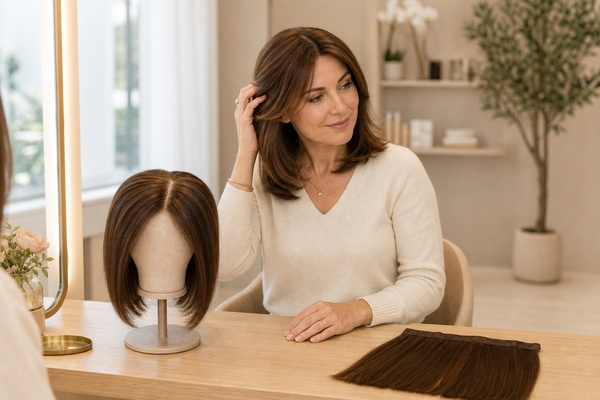
I do not think of this as a contest between two similar products. Toppers and extensions solve different problems. A topper sits over a selected area on the top of the head and adds coverage where the scalp may show. Extensions attach to existing hair and add hair below or around their attachment points. Once I identify the real concern—visible scalp, a widening part, flat sides, short length, or several concerns together—the choice becomes much easier.
What Is the Difference Between Hair Toppers and Hair Extensions?
The names can sound interchangeable, so shoppers sometimes buy extra hair without getting coverage where they actually need it.
I use a topper to cover thinning on the crown, part, or upper scalp. I use extensions mainly to add length and density through the mid-lengths and ends. A topper creates top coverage; extensions depend on existing hair for attachment and generally sit below the visible part.
Coverage and attachment solve different problems
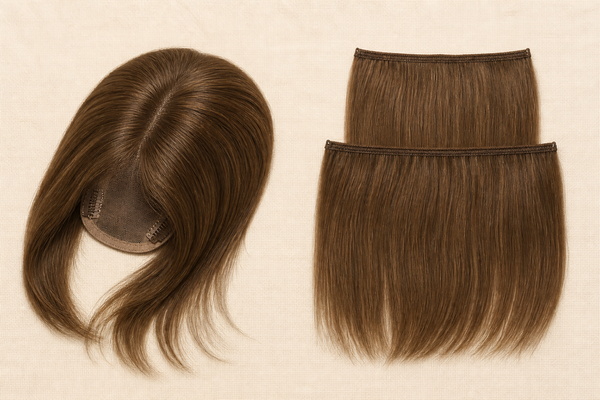
I start with the location of the concern, not the product name. A topper is a partial hairpiece with a base that can span a small part area or a broader section of the crown. Hair is attached across that base, so the piece can place density directly over sparse areas. Depending on the design, it may secure with pressure-sensitive clips, tape, adhesive, an integration method, or another professionally selected attachment. Dermatology guidance describes hairpieces1 as devices that may be added to existing hair or directly to the scalp to create a fuller appearance. Extensions work differently. A clinical review defines hair extensions2 as human or synthetic strands attached to existing hair with methods such as glue, braids, sewing, or clips. I therefore do not expect extensions placed around the sides or back to manufacture a new-looking scalp or part on top.
I choose by goal, not by a favorite product
When someone asks whether I like hair extensions or women’s toppers better, my honest answer is that I like the option that matches the job. If the natural part looks wide, the crown catches light, or scalp contrast is the main worry, I begin with a topper. If the top already looks sufficiently dense but the ponytail feels thin, the haircut lacks body, or more length is wanted, I consider extensions. If both areas need help, a carefully planned combination may work. I also consider removal habits. A daily removable topper may suit someone who wants flexibility, while certain extension methods stay installed and require salon repositioning. Neither format is automatically more natural: believable results come from correct density, color, texture, placement, and styling.
| Comparison | Hair topper | Hair extensions |
|---|---|---|
| Main purpose | Covers visible thinning on the part, crown, or upper scalp | Adds length or fullness to existing hair |
| Where added hair begins | Across a base placed over the thinning area | At rows, bonds, rings, tapes, braids, or clips anchored to natural hair |
| Can create a new-looking part? | Yes, with a suitable lace, mono, or skin-style top | Usually no; the natural top and part remain visible |
| Best starting point | Widening part, crown thinning, localized upper-scalp coverage | Thin ends, short length, or low density below the crown |
| Typical removal pattern | Often removable daily, depending on attachment | May be temporary, daily clip-in, or semi-permanent |
Are Hair Toppers Better Than Extensions for Crown Thinning?
Adding more hair underneath can make the ends fuller while the part and crown still reveal the same thinning pattern.
For visible crown or part-line thinning, I usually find a topper more effective because it places hair and a scalp-like base directly over the area. Extensions can support surrounding volume, but they normally cannot cover exposed scalp above their attachment rows.
Why extensions rarely solve visible scalp on top
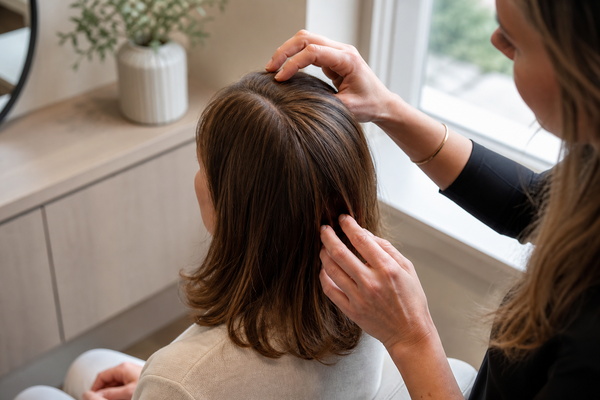
I separate “not enough hair overall” from “not enough coverage on top.” Extensions can make a ponytail larger and can add fullness around the sides and back. With good placement, they may help long natural hair look denser. However, if the eye is drawn to a widening part or a bright patch at the crown, the extension attachments usually must remain hidden beneath natural hair. Placing them too high can make tracks, tapes, bonds, or clips visible, and those attachment points still do not imitate a scalp. The American Academy of Dermatology notes that a widening part3 is a common early sign women notice with hair loss. I treat that pattern as a coverage problem first. A topper is designed to bridge over the sparse area rather than ask weakened hair inside it to hide extension hardware.
How I size a topper for crown coverage
I do not choose a base that merely matches the exact visible patch. I want its perimeter to reach stable hair around the thinning area, while keeping the base no larger or heavier than necessary. A base that is too small can perch inside weak hair, create a raised profile, or leave the edges of the thinning area exposed when the wearer moves. A needlessly large, dense piece can feel hot or bulky and may be harder to blend with fine natural ends. I measure the width and length of the area that needs coverage, check where healthy attachment hair begins, and consider whether the front edge must reach the hairline. I also match density to the wearer’s remaining hair. A light-density topper that covers the correct zone often looks more convincing than a very full piece sitting in the wrong place.
| What I see | What I usually consider first | Why |
|---|---|---|
| Widening center or side part | Small-to-medium topper | Places parting coverage directly over the concern |
| Diffuse crown thinning | Broader, lightweight topper | Spans the whole visible area and reaches stronger perimeter hair |
| Dense crown but thin, wispy ends | Extensions | Adds fullness below the top without covering an already-dense scalp |
| Crown thinning plus thin ends | Lightweight topper, then carefully planned extensions if needed | Separates scalp coverage from length and lower-hair fullness |
What Is the Difference Between a U-Shaped Extension and a Topper?
“U-shaped extension” is not a standardized label, so two sellers may use it for products with very different coverage and attachment.
I first check whether the seller means a U-part hairpiece with a top opening or a U-shaped extension weft worn lower on the head. A U-part system leaves natural hair out through the opening; a topper covers the thinning area with a base and added hair.
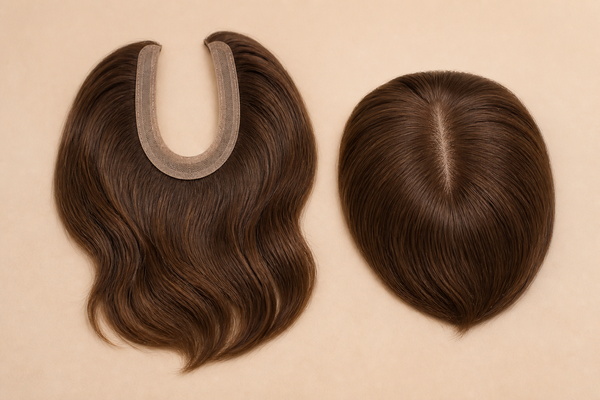
The term “U-shaped extension” needs clarification
I ask for an underside photo before comparing products. Some shops use “U-shaped extension” for a curved or halo-like weft that adds length around the back and sides. That product remains an extension because it relies on the natural top hair to cover or blend over it. Other shops mean a U-part wig or partial-coverage prosthesis. A peer-reviewed review describes a U-shaped prosthesis4 with an opening through which a section of natural hair is left out; the opening can be shifted for a center or side part. That is closer to a partial wig than to a standard topper. By contrast, a topper covers the target scalp area instead of requiring hair from the sparse area to remain visible through a large opening.
Leave-out can blend beautifully—but it needs enough hair
I consider a U-part design only when the leave-out hair is dense and strong enough to hide the opening and match the added hair. The natural part, front, or crown remains responsible for the final illusion. If that is exactly where thinning or breakage is happening, the design may highlight the problem instead of solving it. Frequent straightening, curling, coloring, or chemical processing to match two textures can also make fragile leave-out harder to maintain. A topper is usually more forgiving when the part itself needs coverage because its base can create the appearance of a part and carry the added density. Still, a topper must be matched well: too much density, the wrong base size, or a hard color break can make it look separate. I compare both options in natural daylight and look from above, not only from the front mirror.
| Feature | U-part or U-shaped coverage piece | U-shaped weft or halo-style extension | Hair topper |
|---|---|---|---|
| Natural hair left visible on top | Required through the opening | Required to cover the weft | Optional; some natural hair may blend around or over edges |
| Covers a thinning part | Usually not ideal if leave-out is sparse | No | Yes, with the right base |
| Main visual effect | Added volume/length with natural leave-out | Added length and lower-head fullness | Upper-scalp coverage and localized density |
| Key fitting question | Is the leave-out strong and dense enough? | Can natural hair conceal the weft? | Does the base cover the full thinning zone and reach stable attachment hair? |
Which Is Safer for Fine Hair, and Can I Wear Both?
Fine hair may not show discomfort immediately, yet repeated weight or tight attachment can concentrate force on a small number of strands.
Neither option is automatically safest. For fine, crown-thinning hair, I often prefer a lightweight, correctly fitted topper with attachment points on stable hair. Extensions require enough healthy anchor hair and low-tension installation. I combine both only when their attachments do not overlap or overload the same strands.
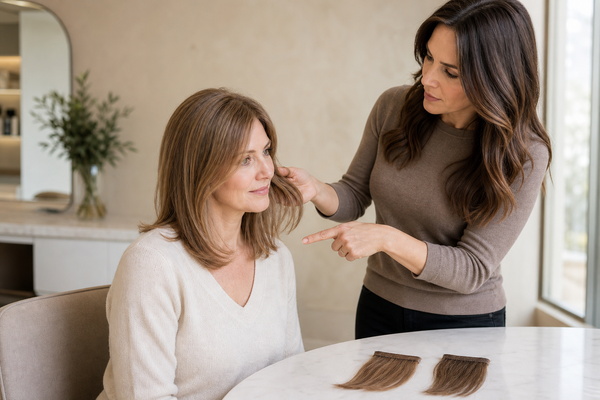
Fine-hair safety depends on tension, weight, and placement
I never judge safety only by whether a product has clips, tape, rings, bonds, or a base. I look at the force placed on each anchor area, how long that force continues, and whether the same hairs are used repeatedly. Extensions can be risky when a heavy bundle is attached to a small section of fine or chemically weakened hair. The British Association of Dermatologists explains that constant pulling can cause traction alopecia5 and specifically lists weaves or extensions among associated practices. A topper can also pull if it is too heavy, too small, clipped onto sparse hair, or removed roughly. I want attachment to feel secure but never painful. Stinging, soreness, scalp tenting, broken hairs, irritation, or a piece that must be tightened constantly are reasons to stop and reassess the fit.
How I combine a topper with existing extensions
Yes, I can use a topper with existing extensions, but I plan the two systems as separate zones. The topper covers the crown or part, while extension rows stay lower at the sides and back to add length or fullness. I make sure extension bonds, tapes, rings, braids, or clips do not sit beneath the topper’s pressure points. I also check that the combined density still matches the wearer’s face and natural ends; adding two systems can easily create more hair than expected. Color and texture should be matched as one finished style, not as two independent purchases. I prefer a stylist or hair-replacement professional to map the first installation, especially when natural hair is very fine, actively shedding, painful, inflamed, or already damaged. Cosmetic coverage can improve appearance, but it does not diagnose or treat the cause of thinning.
| Combination check | My practical rule |
|---|---|
| Attachment zones | Keep topper clips or tape away from extension bonds, rings, tapes, or braids |
| Total weight | Use the lightest density and length that achieves the goal |
| Scalp comfort | Remove or loosen the system if there is pain, stinging, redness, or persistent irritation |
| Blending | Match topper, extensions, and natural hair together in daylight |
| Active hair loss | Ask a dermatologist about sudden, patchy, painful, inflamed, or rapidly worsening loss |
Conclusion
One product cannot solve every thinning pattern, and choosing by length alone can leave the main concern uncovered.
I choose a topper for visible crown or part coverage, extensions for fuller lengths and ends, and a carefully mapped combination when both are needed. Comfort, stable anchor hair, low tension, and a believable density matter more than the product label.
References
DermNet explains that hairpieces and wigs come in different forms and may be added to existing hair or directly to the scalp to create a fuller appearance. ↩
International Journal of Women’s Dermatology defines extensions as human or synthetic strands attached to existing hair and reviews the traction risk created by constant tension at attachment sites. ↩
American Academy of Dermatology lists a widening part, gradual thinning, a thinner ponytail, and slowly growing bald spots among signs that may be noticed with hair loss. ↩
Journal of Cosmetic Dermatology describes U-shaped partial-coverage prostheses, their leave-out opening, parting flexibility, and limitations when frontal density is reduced or natural hair requires frequent manipulation. ↩
British Association of Dermatologists explains how repeated pulling can cause traction alopecia, identifies extensions and weaves as possible contributors, and advises stopping tight styles early. ↩