

I know that a long strand in the shower can feel alarming, especially when a full brush makes every shed hair look larger than life.
No-long or thick hair does not automatically make a person shed more. Hair length changes how noticeable each strand is, while fullness changes the visual amount collected. I focus on sudden changes, visible thinning, and painful tension instead of judging the pile alone.

I find that these questions are easy to mix together. One person is asking whether long hair causes hair loss. Another person is asking whether the shower drain looks fuller because the hair is long. A third person has thick hair and wonders whether a larger-looking bundle means a problem. I separate those questions before I decide what the shedding may mean.
Does Long Hair Cause Hair Loss or Shed More?
I understand why long hair can make normal shedding feel much more serious than it is. One long strand can cover a hand, a brush, or a shower wall.
Long hair does not usually cause hair loss or make follicles shed more on its own. I expect long shed strands to look more dramatic because each strand is physically longer. I pay attention to tight styling, sudden shedding, and visible thinning rather than length alone.
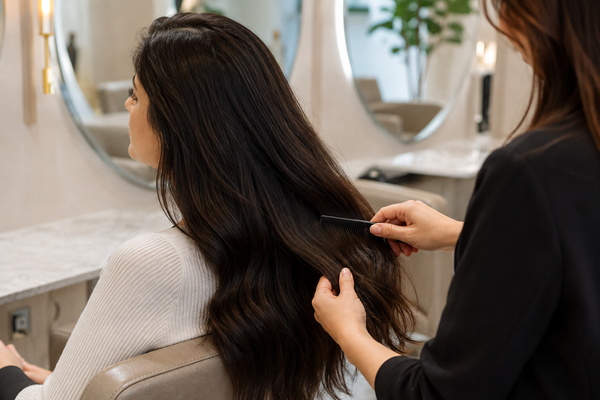
Why a small number of long strands can look like a large loss
I start with the difference between what I see and what is happening at the follicle. A scalp hair grows through a repeating hair cycle1, and old hairs are released as new growth takes their place. The American Academy of Dermatology says that losing about 50 to 100 hairs a day can be normal hair shedding2. A long hair does not occupy more follicle space just because it extends farther down the back. It does, however, create a larger-looking loop in a brush or on a bathroom floor. I therefore avoid estimating a problem by the physical size of the shed bundle. I look for a clear change from the person’s usual amount, a widening part, a thinner ponytail, or new scalp visibility.
| What I notice | What it may mean | What I do next |
|---|---|---|
| A few very long strands after washing | The length can make a normal amount look larger | I compare the pattern over several washes rather than one day |
| Many hairs coming out evenly after illness, stress, or weight loss | A temporary shedding change may be possible | I note timing and seek clinical advice if it continues or worries me |
| Short broken pieces rather than full strands | This may be breakage from styling, heat, or damage | I reduce rough handling and review the hair-care routine |
| A widening part, bald patch, or scalp pain | This is more than a simple length question | I arrange an assessment with a qualified clinician or dermatologist |
When long hair can become part of the problem
I do make one important distinction: long hair itself is not the same as long hair under constant tension. A very tight ponytail, braid, bun, extension installation, or other style can repeatedly pull at the roots. This type of repeated tension can lead to traction alopecia3, especially when the hairstyle stays tight for long periods. I do not assume that every long-haired person has this risk. I do encourage people to notice soreness, headaches from tight styles, broken hairs around the hairline, or thinning where the hair is pulled. I choose looser styling, vary the position of a ponytail or part, and avoid treating pain as normal. That approach protects comfort as well as the hair that is already there.
Does Thick Hair Shed More?
I know that thick hair can make the brush, drain cover, and floor look more dramatic. The sight can be worrying even when the scalp still looks healthy.
Thick hair does not automatically shed more than fine hair. I see a bigger-looking collection because fuller hair may have more strands, wider strands, or both. I judge change by scalp coverage and a person’s usual pattern, not by the volume of hair in one brush.

Hair volume is not the same thing as shedding rate
I use the word “thick” carefully because people often mean different things by it. One person may mean many hairs per square centimetre. Another may mean a larger diameter for each individual hair. A third may simply mean that their waves or curls create more visible volume. Research on women’s perception of hair amount4 combines density and shaft diameter because both change how full the hair appears. That is useful context, but it does not mean that thick hair independently causes excess shedding. I would expect a dense head of hair to produce a larger visual collection when several hairs release during washing, especially if those hairs are also long. I still compare that collection with the person’s baseline. I also check whether the part is widening, whether the ponytail feels smaller, and whether the amount keeps rising over weeks rather than appearing once after a delayed wash day.
How I make the comparison more useful
I do not ask someone to count every hair, because that can make an already stressful situation feel worse. I suggest that they use the same wash interval, the same brush, and roughly the same lighting when they compare changes. I also remind them that a wash day can release hairs that would otherwise have come out gradually during the day. I find that photographs of the part line and hairline taken once a month are often more useful than one photo of a brush. If the change is dramatic, patchy, or confusing, I would not rely on an online guess. The NHS notes that hair loss can have many causes, including illness, stress, weight loss, and iron deficiency, and it advises seeking medical guidance when hair loss is a concern hair loss5. I see that step as practical information, not a reason to panic.
Conclusion
I do not blame long or thick hair for shedding by default. I look at changes over time, scalp coverage, tension from styling, and any sudden or patchy loss. I think that approach gives me a calmer and more useful answer than judging one alarming-looking brushful.
References
NCBI Bookshelf describes the scalp hair cycle as growth, regression, rest, and shedding. It notes that old hairs are released during exogen as part of normal renewal. ↩
AAD explains normal hair shedding and states that 50 to 100 shed hairs per day can be typical. It distinguishes excess shedding from hair loss. ↩
DermNet defines traction alopecia as hair loss from prolonged or repetitive tension. It lists tight styles and the weight of excessively long hair among potential contributors. ↩
PubMed summarizes research that measures perceived hair amount through both hair density and shaft diameter. It shows why visible fullness is not one simple measure. ↩
NHS lists several possible causes of hair loss, including illness, stress, weight loss, and iron deficiency. It advises speaking to a clinician when hair loss is worrying. ↩