

You saved ten topper pages, and every seller tells you something different. The confusion itself is the problem. There is one fixed order that ends it.
Choosing a hair topper takes seven decisions in order: size, base, density, color, material, price, and seller. Each decision narrows your options until the right topper is the only piece left on the list.
I have fitted toppers for ten years, and I watch the same scene every month. A woman arrives with twenty browser tabs open, more confused than when she started searching. She does not need more information. She needs an order. When you make these seven decisions one at a time, each one becomes easy, and the wrong options fall away by themselves. Here is that order.
What Size Hair Topper Do I Need?
Nobody warns you about this, but wrong size is the number one reason first toppers get returned. A piece too small shows scalp at the edges. A piece too big sits heavy and obvious.
Your hair topper size is the size of the thin area you need to cover, measured at its widest point and from front to back. Match that measurement to a base size between 3×5 and 8×8 inches.
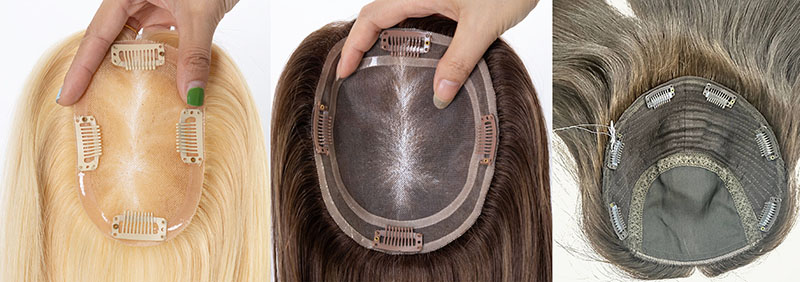
How to measure in two minutes
Thinning from female pattern hair loss[1] follows a predictable map. The part widens first, then the crown thins, and the hairline goes last. So measure the thin zone itself, not your whole head. Lay a soft tape across the widest point of thinning, then measure from the healthy hair in front to the healthy hair behind. Add half an inch on each side, because clips must bite into strong hair, not sparse hair.
| Base size | What it covers | Best for |
|---|---|---|
| 3×5 | One small crown spot | Early thinning, first topper |
| 5×5 / 5×6 | Crown plus part line | A part that keeps widening |
| 6×6 / 7×7 | Crown and most of the top | Visible scalp across the top |
| 8×8 | Nearly the whole top | Advanced thinning, strong sides |
The two-finger quick check
No tape measure handy? Use your fingers. If your visible part is wider than two fingers at any point, you need 5×5 or larger. If you can see scalp at the crown when you look up, start at 6×6. Between sizes? Always choose the larger one, because hair loss keeps moving and a small topper cannot grow with you.
Two honest warnings. First, if your thinning spreads fast or comes in patches, see a dermatologist before you buy anything, because some types of hair loss[2] need treatment first, and no hair piece fixes those. Second, never guess alone. A good seller will look at your photos and confirm your size before you pay — remember this for later, because it becomes the test of a good seller in section seven. If you are still new to how these pieces attach and blend, our beginner guide explains how toppers work in plain words.
Which Hair Topper Base Looks Most Natural?
Nobody explains the base at checkout. But this hidden mesh decides how your part looks, how long the piece lasts, and how much you pay.
Silk top and lace bases look the most natural because they mimic a real scalp at the part. Mono bases trade a little realism for durability. Skin bases suit visible hairlines. For daily wear, mono or silk top is the safest first choice.
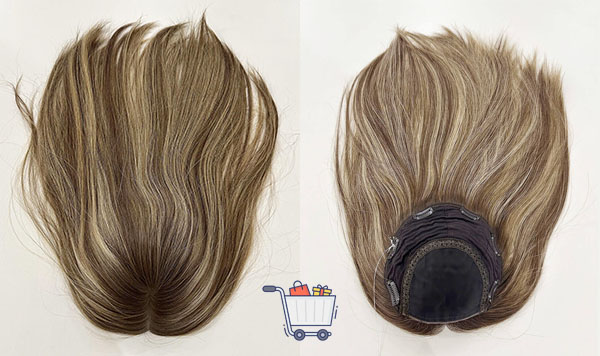
Where realism actually shows
Here is the insight that saves people the most money. The base is only visible at your part line, a strip about the width of your finger. If you wear your hair swept to the side or pulled back softly, nobody sees a center part, and paying extra for a full silk top buys realism you will never display. But if you love a crisp middle part, the base is everything, because that strip is where every eye lands first.
| Base | Realism | Durability | Price | Best for |
|---|---|---|---|---|
| Swiss lace | Excellent | Moderate | Mid-high | A part that must pass close inspection |
| Mono (monofilament) | Very good | Excellent | Mid | Daily wear, best value overall |
| Silk top | Excellent | Moderate | High | Part lines under bright light and photos |
| Skin (PU) | Very good at the roots | Excellent | Mid | Defined parts and taped front edges |
One more connection worth knowing. Bases with a PU edge can also be worn with tape or adhesive instead of clips, which matters if your hair is too fine to hold clips well. We cover those options in depth in our guide to topper bases compared.
What Density Should a Hair Topper Be?
The listing photo shows a full, gorgeous topper. It arrives and sits on your head like a helmet. Density is usually the reason, and most buyers never check it.
Choose a density that matches the hair at the back of your head, usually 100 to 120 percent. Going denser than your own hair is the fastest way to make a topper look like a topper.
Read your own hair first
Density is the amount of hair knotted into the base, written as a percentage of a full head of hair. Fine or thin hair looks most natural at 100 to 110 percent. Average hair suits 110 to 120. Only genuinely thick hair can carry 120 to 130 without looking staged. The test takes five seconds: gather your hair at the back of your head like a low ponytail and feel the thickness. Your topper should match that feeling, not exceed it.
| Your hair at the back | Density to order | Why |
|---|---|---|
| Fine, slips through a clip | 100–110% | Higher density exposes the mismatch at the blend line |
| Average thickness | 110–120% | Disappears into your own hair |
| Thick or coarse | 120–130% | Anything lighter looks sparse against your sides |
The trap is emotional, and I understand it. You miss your old volume, so you order the fullest piece. But hair that is too dense creates a shelf where the topper meets your own hair, and that shelf reads as fake from across a room. If you want help judging what looks most natural on fine hair, we answer that question in detail in our density guide.
How Do I Match a Hair Topper to My Hair?
A topper can be right in size, base, and density, yet fail in five seconds. One wrong tone at the part, and every eye in the room finds it.
Hair color is three colors: root, mid-length, and ends. Match your topper to your mid-length, where the piece blends, not to your root. Send sellers three natural-light photos — root, mid-length, ends — before you order.

Why the middle matters most
Most hair is darker at the root and lighter at the ends from years of sun and washing. A topper matched to your root will look like a dark cap sitting on lighter hair. A topper matched to your mid-length melts into the blend zone, because that is where the piece meets your own hair every single day. Indoor lighting lies about color, so take your three photos by a window in daylight, with no filter and no flash.
| Your situation | What to order |
|---|---|
| One solid tone | A shade matched to your mid-length |
| Highlights | A blended highlight shade, not a flat color |
| Gray coming in | A blend with silver strands woven in |
| Wavy or curly hair | The same curl pattern — do not plan to restyle it straight |
| Any texture | A topper 2–4 inches longer than your own hair, so layers fall naturally |
Length works opposite to instinct too. The same length as your own hair creates a hard step where the piece ends. Two to four extra inches let the topper hair layer over your own, and any stylist can trim the difference. Texture is even less forgiving: a curl pattern half a level off will separate at the part line. We walk through swatches, tone numbers, and length choices in our full color and length guide.
Human Hair or Synthetic: Which Is Better for a Topper?
Synthetic tempts at a third of the price. Then summer heat frizzes the fibers, and you cannot color or restyle it. The money saved becomes money lost.
Human hair is better for a daily topper. It styles with heat, colors gradually, and lasts one to three years. Synthetic suits occasional wear only: it cannot be colored, dulls with heat, and wears out within months.
The honest trade-off
The human hair pieces[3] used in quality toppers behave like the hair growing from your head. You can curl them for a wedding, straighten them for work, and darken them a shade when your own color changes. Synthetic fiber holds one factory shape forever, and heat from an oven door or a summer car can permanently frizz it.
| What matters | Human hair | Synthetic |
|---|---|---|
| Heat styling | Yes, like your own hair | No, heat damages the fiber |
| Coloring | Yes, gradually | Never |
| Lifespan | 1–3 years with care | 3–6 months of regular wear |
| Daily natural look | Passes close inspection | Reads slightly glossy up close |
| Price | Higher | Much lower |
Within human hair, one word matters most: Remy. Remy hair has every strand running root-to-tip in the same direction, so the cuticles never tangle against each other. Non-Remy hair is cheaper because mixed-direction hair gets an acid bath that strips the cuticle — soft at first, dry and matted within months. We explain how to spot real Remy before you pay, including four tests you can run at home, in our Remy hair toppers guide.
How Much Should I Spend on a Hair Topper?
Prices run from $40 to $800 online. The cheapest listings say 100% human hair with photos too perfect to be real. Something in that range is a lie.
A good human hair topper costs roughly $100 to $400. Paying less usually buys mixed or synthetic hair that fails within months. Paying far more often buys the same hair with a middleman’s markup added.
What you are actually paying for
Three things move the price: the hair itself, the base construction, and the size. Real Remy hair costs more because sorting root-aligned hair is slow, skilled work. Hand-knotted bases cost more than machine-made ones. Larger bases simply need more hair. When a listing offers all three at a shockingly low price, one of the three has been quietly downgraded, and you will discover which one around month three.
| Tier | Typical price | What you really get |
|---|---|---|
| Synthetic | $30–80 | One preset style, months of life |
| Human hair, non-Remy | $80–150 | Soft at first, often matted within months |
| Remy human hair | $150–400 | Years of daily natural wear — the sweet spot |
| Custom high-end | $400+ | Made to your measurements and color specs |
Here is the part most sellers will not say out loud: a large share of that $400+ price is markup, not hair. The same workshops supply boutiques and factory-direct brands alike. We are the workshop — if you want to see what the toppers we make in our factory cost without the boutique layer, the link shows real pieces at real prices. Decide size, base, and material first, and then let your budget tell you which tier you are shopping in. Never buy a cheaper tier and hope it passes — it will not, and you will buy twice.
Where Is the Safest Place to Buy a Hair Topper?
A beautiful website proves nothing. Anyone can rent product photos and write premium quality a hundred times. A safe seller shows behavior before you pay, not promises after.
The safest hair topper seller shows real photos, answers your sizing and color questions before payment, publishes a clear return policy, and displays photo reviews from real customers. Everything else is marketing.
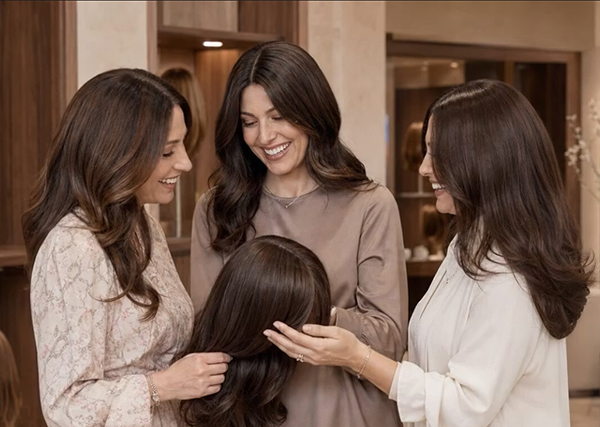
The five questions that expose everything
Ask these before any payment. A trustworthy seller answers all five without hesitation, because real workshops do this work every day.
| # | Ask this | A safe answer sounds like |
|---|---|---|
| 1 | May I see real photos of this exact piece? | Yes, here are today’s workshop photos or videos |
| 2 | Can you confirm my size from my photos? | Send three daylight photos, we will measure with you |
| 3 | What is your return policy? | Clear terms in writing, no conditions hidden in fine print |
| 4 | May I see customer reviews with photos? | Real customer gallery, imperfect lighting and all |
| 5 | Can I see progress photos for custom orders? | Yes, at cutting, knotting, and before shipping |
Notice what question two does. It closes the loop we opened in section one: a seller who judges your size before taking your money is selling the right piece, not just any piece. Local salons offer touching and trying, but their selection is small and their prices carry rent. Online sellers offer choice and factory pricing, and the five questions above replace the missing fitting room. Walk away from prices that make no sense, sellers who refuse video calls, and review walls made entirely of words with no photos. We compare where to buy in more depth in our guide to judging topper quality.
Your 60-Second Decision Checklist
Screenshot this. When you are ready to shop, answer these seven lines in order, and take the answers with you.
| Step | Decision | Your answer |
|---|---|---|
| 1 | Size: measure the thin area, widest point and front-to-back | x inches |
| 2 | Base: mono or silk top for daily wear | Mono / Silk top |
| 3 | Density: match the back of your head | 100–120% |
| 4 | Color: three daylight photos, matched to mid-length | Shade #___ |
| 5 | Material: human hair, Remy preferred | Remy human hair |
| 6 | Budget: $100–400 buys years, not months | $___ |
| 7 | Seller: passed all five questions above | Yes / Not yet |
Seven small decisions, and the right piece announces itself. When your answers are ready, browse our human hair topper collection and send us your photos — we will confirm the last details with you before anything is charged.
References
Cleveland Clinic — Overview of female pattern hair loss and where it thins first. ↑ Back
American Academy of Dermatology — Types of hair loss and when to see a dermatologist. ↑ Back
Wikipedia — Hairpiece construction and materials. ↑ Back