

Hair-regrowth promises can turn a widening part into an expensive experiment. A realistic plan begins by identifying the cause, the remaining follicles, and the desired timeline.
I separate two goals from the beginning. Medical care aims to protect or improve natural hair when possible. A topper changes the visible result now, without pretending to reactivate a follicle.
Can Thinning Hair Regrow?
The question sounds simple, but “thinning hair” can describe shedding, breakage, miniaturization, inflammation, or permanent follicle damage. Those conditions do not share one outcome.
Thinning hair can regrow when follicles remain capable of producing hair and the cause is temporary, treatable, or responsive to therapy. Regrowth is less likely after long-standing follicle miniaturization and is not expected from follicles destroyed by scarring. An accurate diagnosis is the first step toward a realistic answer.
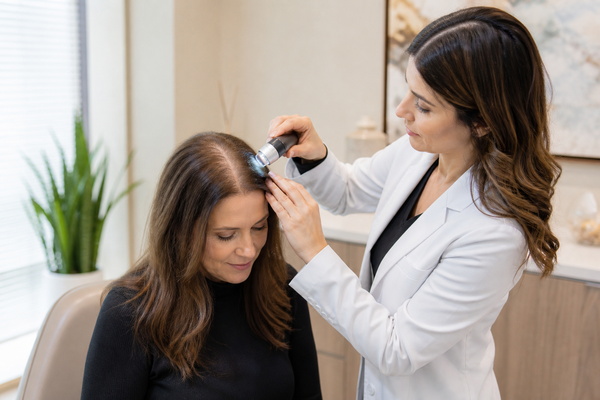
The condition of the follicle matters more than the marketing claim
I first ask whether hair is shedding from an active follicle, growing progressively finer, breaking along the shaft, or disappearing from an inflamed area. Acute temporary shedding1 may resolve after a trigger such as illness, stress, a medication, or another physical change is identified and addressed. The visible recovery still takes time because new hair must grow long enough to affect density. Pattern loss is different. The follicles gradually produce finer, shorter hair, so treatment may preserve hair and improve some density without restoring every strand. Scarring alopecia2 can permanently destroy follicles, which means hair cannot regrow from those destroyed structures. I do not try to decide among these causes from one photograph. I look for timing, pattern, scalp symptoms, recent health changes, family history, and professional examination. Sudden patches, fast progression, burning, pain, scale, redness, or loss of follicle openings deserve prompt clinical attention.
| Hair-Loss Pattern | Regrowth Possibility | Practical Expectation |
|---|---|---|
| Temporary diffuse shedding | Often possible after the trigger ends | Density returns gradually, not overnight |
| Early pattern thinning | Partial improvement may be possible | Treatment usually needs continuing use |
| Hair breakage | Length and appearance may recover | Damage control matters more than follicle stimulation |
| Alopecia areata | Regrowth may occur but can be unpredictable | Diagnosis and treatment plan are important |
| Scarring hair loss | Destroyed follicles do not regrow | Early care aims to stop further loss |
I avoid calling every short hair “new growth.” Broken strands, miniaturized hairs, and genuine regrowth can look similar without closer examination.
How Can Women Regrow Thinning Hair?
Women often try supplements, oils, or salon products before knowing why their part is widening. That delay can hide a progressive condition without treating it.
Women can support hair regrowth by getting the cause diagnosed and following a treatment suited to that diagnosis. Temporary shedding may improve after its trigger resolves. Female pattern hair loss may respond to topical minoxidil or clinician-directed treatment, but results vary, take months, and usually require continued use.
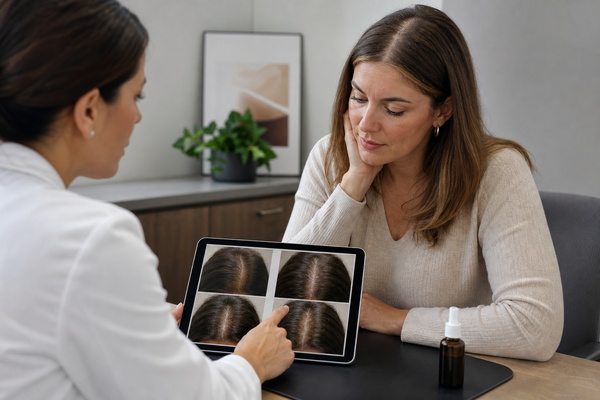
Start with the cause instead of a universal routine
I treat a widening part as useful information, not proof of one diagnosis. Female pattern loss3 commonly appears as a widening part or broader thinning over the top, and earlier treatment tends to offer a better chance of preserving density. But childbirth, illness, rapid weight change, nutritional deficiency, thyroid problems, medication changes, traction, and inflammatory scalp conditions can create different patterns or overlap with hereditary thinning. A clinician may use history, scalp examination, photographs, blood tests, or a biopsy when needed. For confirmed female pattern loss, minoxidil evidence4 supports better regrowth outcomes than placebo for some women, but the evidence does not promise complete restoration. I also remember that pregnancy, breastfeeding, other health conditions, and possible side effects can change which treatments are appropriate. I do not recommend prescription drugs or high-dose supplements without qualified guidance.
| Step | What It Clarifies | Realistic Role |
|---|---|---|
| Review timing and triggers | Temporary shedding versus gradual progression | Prevents treating every case as hereditary loss |
| Examine the scalp and pattern | Inflammation, widening part, breakage, or patches | Guides whether further testing is needed |
| Check relevant health factors | Possible deficiency, hormonal issue, illness, or medication effect | Supports cause-specific care |
| Follow evidence-based treatment | Whether density stabilizes or improves | Requires patience and consistent use |
| Use a topper if desired | Immediate visual coverage during the process | Does not replace diagnosis or treatment |
I judge progress with standardized photographs every few months. Daily mirror checks make normal styling, lighting, and wash-day changes look more meaningful than they are.
How Can Men Regrow Thinning Hair?
Men may assume a receding hairline or crown must either be accepted or surgically replaced. That overlooks non-surgical treatment, but it also encourages unrealistic regrowth claims.
Men may regrow some thinning hair or slow loss when treatment begins while follicles remain active. Minoxidil and prescription finasteride are established options for male pattern hair loss, but neither works for everyone. Benefits take months, continued use is usually required, and a clinician should review suitability and side effects.
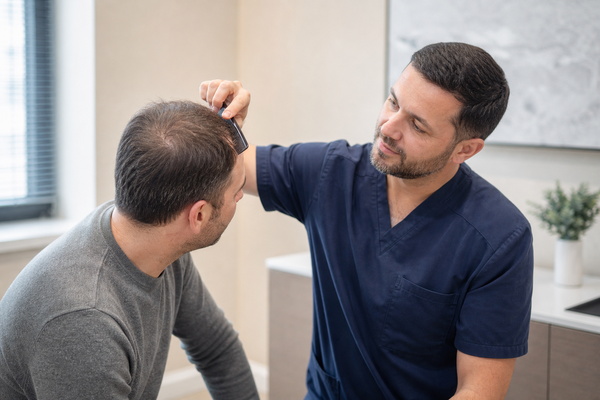
Preservation can be a successful result
I define success before starting. A man with early crown thinning may hope for thicker coverage, while a man with a long-standing smooth bald area may be better served by preventing further loss and choosing cosmetic coverage. MedlinePlus explains that male pattern loss5 usually follows a receding hairline and crown pattern as follicles shrink and produce shorter, finer hair. It also notes that minoxidil slows loss for many men and produces new hair for some, while finasteride can slow loss through a different mechanism. Hair gained or maintained with these treatments may be lost after treatment stops. That makes consistency part of the decision. Prescription treatment also requires a careful discussion of risks, personal health, fertility concerns, and side effects. If the loss is rapid, patchy, painful, scaly, or accompanied by heavy shedding, I do not assume it is ordinary male pattern baldness. I seek an examination before choosing a routine.
| Male Hair-Loss Situation | Possible Goal | What I Do Not Promise |
|---|---|---|
| Early crown thinning | Preserve hair and improve some density | Full return to teenage density |
| Receding hairline | Slow progression and assess response | Complete rebuilding of a low hairline |
| Long-standing smooth bald area | Protect remaining hair and consider coverage | Reliable regrowth from inactive-looking areas |
| Sudden patches or heavy shedding | Identify a different cause | Self-treatment based only on age or family history |
| Treatment-responsive loss | Maintain gains with continued care | Permanent benefit after stopping treatment |
I consider stabilization a meaningful outcome. Keeping existing hair for longer may matter more than a small change in the hair count shown in an advertisement.
What Hair-Regrowth Results Are Realistic?
Hair grows slowly, while advertising moves quickly. Without a baseline and enough time, normal variation can look like either a miracle or a failure.
Realistic hair-regrowth results include slower shedding, stabilization, thicker existing strands, partial density improvement, or gradual return after temporary loss. Complete restoration is uncommon, and no treatment works for everyone. I assess results over months with consistent photographs, while remembering that many benefits fade when an effective treatment is stopped.

Measure change without moving the goalposts
I use the same room, camera distance, part, hairstyle, wash interval, and lighting for each progress photograph. Otherwise, wet roots, fresh color, fibers, a different part, or a brighter ceiling light can create a false comparison. The NHS states that treatment limits6 matter: no hair-loss treatment is completely effective, pattern-loss medicines do not work for everyone, and their benefits generally last only while treatment continues. I also keep condition-specific uncertainty in view. The National Alopecia Areata Foundation describes alopecia areata7 as unpredictable and cyclical, even though follicles remain alive and regrowth is possible. That is very different from a guaranteed linear timeline. I discuss when a treatment should be evaluated with a clinician instead of inventing my own deadline. I also separate cosmetic fullness from biological regrowth. A cut, fiber, root spray, topper, or color change may improve appearance immediately without changing the follicles.
| Claim or Observation | More Realistic Interpretation | Better Check |
|---|---|---|
| “New growth in two weeks” | Hair-cycle change is unlikely to be visible that quickly | Compare over a clinician-recommended timeline |
| Less hair in the shower | Shedding may fluctuate naturally | Review a longer trend and standardized photos |
| Thicker-looking crown | Styling or fiber may improve coverage | Photograph clean, dry hair without camouflage |
| Fine short hairs | Could be regrowth, breakage, or miniaturization | Ask for professional examination if uncertain |
| Improvement after treatment | Benefit may depend on continued use | Discuss maintenance before stopping |
I do not wait forever for a product to prove itself. I agree on a review point, watch for side effects, and change course with qualified advice when the evidence is not convincing.
When Does Thinning Hair Need a Topper Instead?
Regrowth can take months and may remain incomplete. Waiting for a perfect biological result can leave a woman hiding from photographs, work, or everyday social life.
Thinning hair may benefit from a topper when immediate crown or part coverage matters, treatment is still in progress, regrowth is incomplete, follicles are permanently damaged, or medical treatment is unsuitable. A topper adds visible density without claiming to regrow hair, and it can be worn temporarily or long term.

A topper solves the appearance problem on a different timeline
I do not view a topper as surrendering on natural hair. It answers a different question: “How do I want my hair to look today?” The American Cancer Society describes hair toppers8 as top pieces that add coverage and volume to thinning hair on the top of the head. I choose a base that extends beyond the complete thinning area and attaches only to stable, comfortable hair. I then match the root color, density, part, texture, and movement before blending the cut. A base that is too small can place clips inside weak hair. A piece that is too dense can look bulky even when its color is correct. If the scalp is sore, inflamed, healing, or unable to support clips, I pause and ask a clinician or experienced fitter about safer attachment or fuller-coverage options. Treatment and a topper can often coexist, but scalp access, medication application, cleaning, and wear time should fit the individual plan.
| Situation | Why a Topper May Help | Fitting Priority |
|---|---|---|
| Waiting for possible regrowth | Gives immediate visual density | Lightweight, removable design |
| Partial response to treatment | Covers the remaining visible scalp | Density that matches the sides and back |
| Stable female pattern thinning | Restores part and crown coverage | Base extends beyond the full thinning area |
| Permanent localized loss | Replaces appearance where regrowth is unlikely | Secure support without pulling weak hair |
| Treatment is unsuitable or unwanted | Offers a non-medical appearance option | Comfort, color, part, and realistic movement |
I can pursue better scalp health and enjoy fuller-looking hair at the same time. Confidence does not need to wait for a treatment result that may be months away or may never become complete.
Conclusion
Thinning hair can regrow when the cause and follicle condition allow it, but results vary and usually take months. I use diagnosis and evidence-based care for natural hair, while a well-fitted topper provides immediate, realistic coverage when regrowth is slow, incomplete, uncertain, or impossible.
References
DermNet explains that acute telogen effluvium can resolve within three to six months after continuing triggers or causative medicines are identified and discontinued. ↩
Cleveland Clinic clearly distinguishes scarring from nonscarring alopecia and explains that destroyed follicles cannot produce new hair, making some hair loss permanent. ↩
AAD describes widening of the part as a common female pattern hair-loss sign and notes that earlier diagnosis and treatment can help limit progression and support regrowth. ↩
Cochrane found that women using minoxidil were more likely to report moderate hair regrowth than women using placebo, while rating much of the wider treatment evidence moderate or low quality. ↩
MedlinePlus explains follicle miniaturization in male pattern baldness and notes that minoxidil and finasteride can slow loss, although treatment benefits are lost after stopping. ↩
NHS states that no hair-loss treatment is completely effective and that finasteride and minoxidil do not work for everyone or retain their benefits after use ends. ↩
NAAF explains that alopecia areata leaves follicles alive, so regrowth remains possible, but hair loss and regrowth can be unpredictable and cyclical. ↩
American Cancer Society defines a hair topper or top piece as an option that adds coverage and volume to thinning hair on the top of the head. ↩