

Clips tug on your thinnest zones every single day. Some mornings your scalp aches before breakfast. You can wear a topper without them.
Yes, clipless hair toppers exist. You can attach one with wig tape, liquid adhesive, an integration base anchored into a braid, or a sewn-in system. Each method holds the topper without pressing clips onto sparse areas, and each one fits a different hair type, budget, and wear schedule.
I wore clip toppers for three years. My crown hair got thinner where the clips sat, so I started hunting for alternatives. After testing tape, glue, and an integration piece, I learned that clipless is not one method. It is a family of methods, and picking the right one changes everything.
Can you attach a hair topper without clips?
Clips look like the only attachment system on the market. Then they drag at your part line all day. Good news: they are not the only system.
Yes, you can attach a hair topper without clips. The four main clipless methods are wig tape, liquid adhesive, integration bases that anchor into your own hair, and semi-permanent sewn-in systems. Every one of them skips the clip pressure that irritates thin or sensitive scalps.
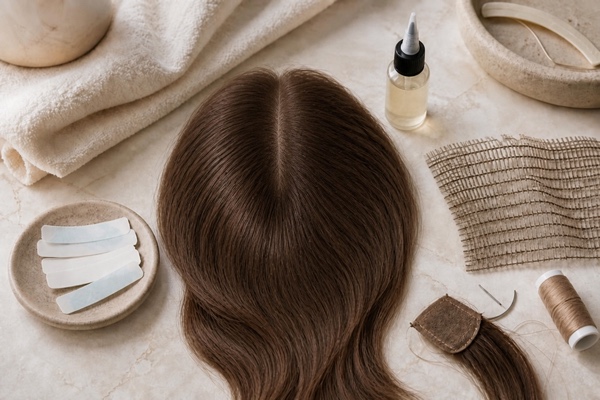
Four ways to go clipless
Tape and adhesive bond the base edge directly to your skin, so they hold tight even on windy days. Integration toppers work the opposite way: they anchor into a loose braid of your own hair, and your natural strands thread through the base mesh. Sewn-in systems loop the topper onto cornrows and last weeks between salon visits. All four methods avoid the constant tension that clips place on fragile hair, the same pressure behind traction alopecia[1]. That alone makes clipless worth a look.
| Clipless method | Hold strength | Best for | Main caution |
|---|---|---|---|
| Wig tape | Strong | Oily scalps, workouts | Remove slowly with solvent |
| Liquid adhesive | Very strong | Events, humid climates | Needs a clean scalp to bond |
| Integration base | Strong | Some hair to thread through | Not for total hair loss |
| Sewn-in system | Very strong | Long-term daily wear | Salon visits every 4–6 weeks |
Can I use wig tape or adhesive on a hair topper?
You saw a wig taped down at a salon. You wonder if your topper can do the same thing. It can, with the right base.
Yes, you can use wig tape or adhesive on a hair topper. Look for a base with a polyurethane edge, because tape sticks to PU and not to lace mesh. Wig tape holds for 1 to 3 days, and liquid adhesive holds for 2 to 4 weeks. Both need a skin-safe remover to take off.
Taping and gluing basics
Start with tape if you are new, because it peels off in seconds and holds a full day. Clean the hairline with alcohol first, press the tape onto the PU edge, then press the base firmly onto your skin for ten seconds. Liquid adhesive takes more practice: you brush a thin layer on skin, wait until it turns clear, then set the base. Adhesives can irritate skin and trigger contact dermatitis[2], so patch-test for 24 hours before your first full application. Never rip the base off dry, because that yanks out hair along the hairline, a known cause of hair breakage[3].
| Adhesive type | Wear time | Skill level | Skin patch test |
|---|---|---|---|
| Wig tape strips | 1–3 days | Beginner | Yes, 24 hours |
| Liquid adhesive | 2–4 weeks | Advanced | Yes, 24 hours |
| Tape + adhesive combo | Up to 4 weeks | Advanced | Yes, 24 hours |
What is an integration hair topper?
Some days you want hold without glue, clips, or pins on your scalp at all. An integration topper was built exactly for that day.
An integration hair topper is a base with a mesh window in the middle. You pull your own hair up through the mesh, blend it over the topper, and the piece stays anchored because your hair is threaded through the base itself. No clips, no glue, no pins are needed.
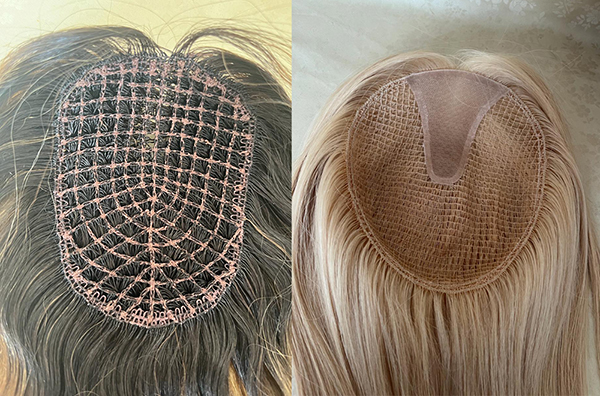
How integration anchors without clips or glue
The base sits flat on your head, and the mesh opening sits over the area where your own hair still grows. You use a tail comb to pull strands through the mesh, then style everything together as one head of hair. Your own hair gives the hold, so the topper cannot slide or shift. Integration works best for diffused thinning from hair loss[4], including the gradual widening part caused by androgenetic alopecia[5]. You need enough hair to thread through, so it does not suit complete baldness. For hold with nothing touching your skin, nothing beats it.
| Integration detail | What it means |
|---|---|
| Base design | Mesh window in the center of the cap |
| Attachment | Your own hair pulled through the mesh |
| Skin contact | None beyond the resting base |
| Best candidate | Diffused thinning with hair left to thread |
| Maintenance | Blend and trim every 6–8 weeks |
Are permanent hair toppers really permanent?
The word permanent sounds comforting. No more morning routines. But your scalp and your hair keep growing, so nothing attached stays perfect forever.
No, permanent hair toppers are not truly permanent. A bonded or sewn-in topper stays on for 2 to 6 weeks at a time, then it must be removed, cleaned, and reattached. The hair itself lasts 12 to 24 months of these cycles. Permanent really means long-wear, not lifelong.
What permanent really means
A bonded topper uses adhesive at the perimeter, and a sewn-in topper loops onto braids. Both stay on through showers, sleep, and workouts, which is why sellers call them permanent. But your natural hair grows about half an inch a month, so the bond loosens and the braids slip within weeks. You then return to a stylist for a refresh, the same routine behind long-term wig[6] and hair system wear. Sweat and oil also break down adhesive over time. Plan for maintenance appointments, a gentle remover, and a backup topper for refresh days.
| Wear type | Time between services | Total hair lifespan |
|---|---|---|
| Clip-in topper | Removed daily | 12–24 months |
| Taped topper | 1–3 days | 12–24 months |
| Bonded topper | 2–4 weeks | 12–24 months |
| Sewn-in topper | 4–6 weeks | 12–24 months |
Conclusion
Clips are one option, not the only one. Tape and adhesive bond the base to your skin, integration pieces anchor through your own hair, and sewn-in systems carry you for weeks. Match the method to your hair amount, your skin, and your routine, and clipless wear becomes simple.
References
Wikipedia — Traction alopecia: hair loss caused by constant pulling tension on fragile hair. ↑ Back
Cleveland Clinic — Contact dermatitis: itchy rash triggered by irritants or allergens touching the skin. ↑ Back
American Academy of Dermatology — How to stop damaging your hair: habits that cause breakage at the hairline. ↑ Back
Mayo Clinic — Hair loss: symptoms and causes of diffuse thinning in women. ↑ Back
MedlinePlus Genetics — Androgenetic alopecia: the most common progressive cause of a widening part. ↑ Back
Wikipedia — Wig: history and attachment methods of hair replacements worn over the scalp. ↑ Back