

A topper can look beautiful in the morning and become distracting by lunch. I solve that frustration by finding the cause before changing the product.
Common hair topper problems usually come from fit, placement, color, texture, care, or construction. I fix the cause instead of adding more clips or products. A secure base, flat front, compatible density, careful detangling, and realistic repair plan solve most daily struggles.
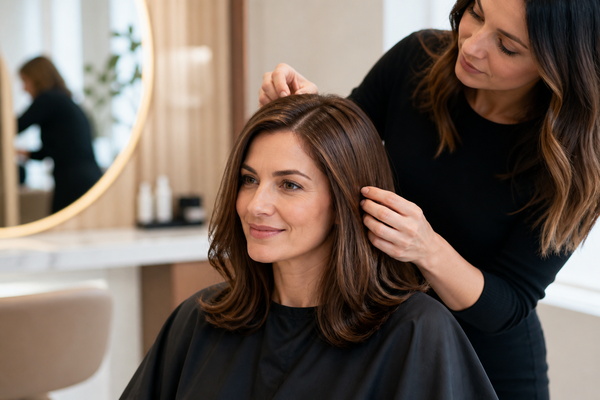
I do not judge a topper by one symptom alone. Slipping may look like a clip problem but begin with the wrong base size. Poor blending may look like a color problem but actually come from excess density. I use the guide below to separate these issues and choose the smallest effective fix.
What Is the Biggest Daily Hair Topper Struggle, and Which Mistakes Should I Avoid?
Daily wear should create confidence, but repeated adjusting makes the topper feel obvious. I start with a consistent fitting routine instead of chasing each symptom.
The biggest daily hair topper struggle is keeping the piece secure, comfortable, and natural for several hours at once. I avoid clipping onto weak hair, placing the base too far forward, choosing excess density, skipping color checks, brushing roughly, and using heavy product near the roots.

I use the same placement test every morning
I first identify the front edge, center the part, and set the hair topper on the coverage area without pulling it tight. I attach clips only where the natural hair feels strong enough to support them. Then I press lightly around the perimeter and move my head from side to side. I expect the piece to stay stable without pain, pinching, or a stretched feeling. A topper should never depend on painful tension. Repeated pulling on natural hair is the concern behind traction alopecia1, so I change the clip position or attachment method when one area feels stressed. I also check the result in a phone video, because movement can reveal a bulky edge or density step that a still mirror hides.
| Mistake I see | What it causes | What I do instead |
|---|---|---|
| I clip into the same tiny area every day | Tenderness and concentrated pull | I rotate safe clip positions and stop if I feel pain |
| I place the front too low | A visible edge and unnatural hairline | I move the topper back to the intended coverage area |
| I choose density for maximum coverage only | Bulk and a clear shelf over my own hair | I match density to my sides and ends |
| I judge color in one room | A match indoors but a mismatch outside | I compare the piece in daylight and indoor light |
| I brush from the roots through a knot | Tension, breakage, and shedding | I support the base and work from the ends upward |
| I add oil at the base | Flat roots and loosened knots or bonds | I keep light conditioning products on mid-lengths and ends |
Do Hair Toppers Come Off Easily, Lift at the Front, or Feel Bulky?
Slipping, front lift, and bulk can make a wearer add more clips. I check size, placement, and density before increasing attachment pressure.
Hair toppers should not come off easily when the base fits and the attachment points are secure. Slipping often means poor placement or weak clip support. Front lift often means the edge is positioned or shaped incorrectly. Bulk usually comes from excess base size, density, or trapped natural hair.
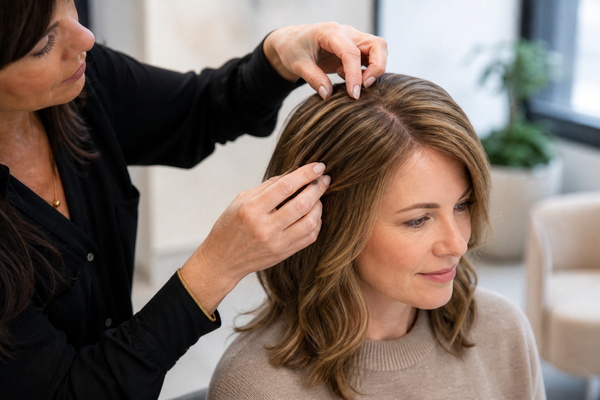
I diagnose security, lift, and bulk as three different problems
I test slipping by holding the topper gently and checking whether the whole base shifts. If it does, I review clip direction, the amount of strong natural hair inside each clip, and whether the coverage area suits the base. I test front lift separately. I look for a rigid edge sitting across a curved part of the head, hair trapped under the front, or a part line that forces the base sideways. I test bulk by feeling for folded natural hair, overlapping wefts, extra density, or a base that extends beyond the intended thinning area. I never assume more clips will solve all three. More clips can create more tension without correcting the geometry. I want even contact, balanced anchoring, and a front edge that follows the head rather than fighting it.
| Symptom | My first check | Likely next step |
|---|---|---|
| The whole topper moves | Base position and clip support | Reposition it or change the attachment layout |
| Only the front rises | Front contour, part alignment, trapped hair | Reset the front or ask for professional edge adjustment |
| The crown looks high | Natural hair underneath and topper density | Flatten the bio hair or reduce density professionally |
| One clip hurts | Tension and hair strength at that point | Stop, move the clip, or use another attachment option |
Can I resize a base that feels too small?
I treat a too-small base as a coverage and anchoring problem, not a simple tailoring job. A small base may place clips inside sparse or fragile hair, and enlarging it usually requires new base material, new ventilation, and a new clip layout. Some makers can rebuild or add a limited section, but the result depends on lace type, seam position, hair direction, and remaining material. A larger base can sometimes be reduced more easily, but cutting lace or moving wefts can still damage the construction. I do not cut, stretch, or glue the base at home. I photograph the topper on my head, mark where coverage is missing, measure the target area, and ask the original maker or an experienced hair-replacement technician whether an alteration will stay flat and durable. Sometimes a correctly sized replacement is safer and more natural than a major rebuild.
What Happens When a Hair Topper Color Does Not Match or Blend?
A near match can still create a visible line in motion. I compare more than one swatch because color, depth, warmth, and distribution all matter.
When a hair topper does not match, the top can look separate from the wearer’s lengths. A different root depth, warm or cool tone, highlight pattern, density, or texture can expose the transition. I compare the topper beside the mid-lengths and ends in daylight before choosing a correction.
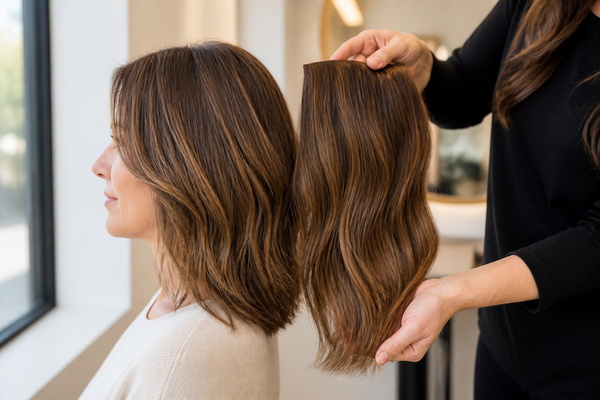
I match the whole visual pattern, not one shade number
I begin with the hair that will sit next to the topper, which is often the mid-length area rather than the root. I compare depth first, then warmth or coolness, then highlights, lowlights, and root effect. I check the fibers side by side instead of holding the topper several inches away. Lighting matters because two colors can appear to match under one light and separate under another. NIST defines this effect as metamerism2. I therefore check window light, normal indoor light, and a phone video before altering the color. If the color is close, a stylist may add a root, lowlights, highlights, or a toner after confirming that the hair and base can tolerate the service. If the mismatch is large, I prefer an exchange or a better starting color. Repeated correction can damage hair and still leave an uneven result.
Why does my topper still fail to blend after the color matches?
I look at density, length, texture, and cut when color is no longer the main problem. A dense topper can sit like a cap over fine sides. A blunt perimeter can create a step against layered natural hair. Straight topper hair can separate from a wavy or curly pattern, and a very smooth finish can look different beside weathered natural lengths. I ask a stylist to blend the piece while it is on my head because the fall and perimeter change in the worn position. I avoid aggressive thinning near the base. Short internal hairs can stand up and make the top look bulkier. I also style the topper and natural hair together in small sections. That shared direction often makes the transition look more natural than styling each part separately.
Why Is My Hair Topper Tangling?
Tangles can turn a quick styling routine into a shedding cycle. I reduce friction and remove small knots before they become tight mats.
A hair topper tangles because dry or damaged fibers, friction, mixed hair direction, product buildup, rough washing, and rubbing at the nape make strands catch. I support the base, divide the hair into sections, detangle from the ends upward, and use light conditioner away from knots and attachment points.
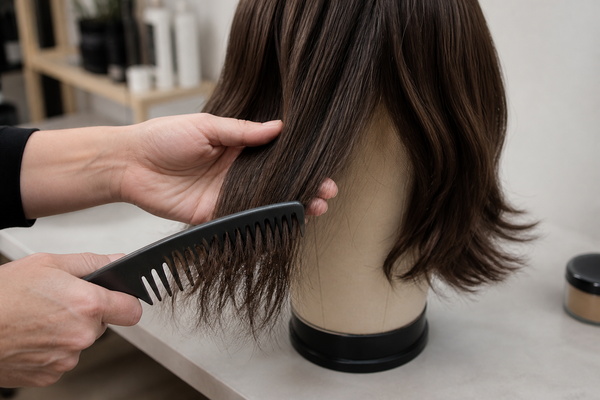
I separate a maintenance tangle from a construction problem
I expect long hair to develop small tangles where it rubs against collars, scarves, shoulders, and natural hair. I do not expect a premium topper to form tight mats soon after careful detangling. Hair research shows that weathering and cuticle changes can increase hair friction3. A 2024 study also used loop tests to model the mechanical environment of combing tangles4. That evidence supports a simple rule: I reduce friction before I pull harder. I mist the lengths lightly if the care instructions allow it, hold the hair above the knot, and work with a wide-tooth comb or suitable brush from the ends upward. I keep conditioner and oils away from ventilated knots, tape, and bonded areas. If the topper tangles severely from the root area, reverses direction, or mats after every gentle wash, I stop. Those signs can point to cuticle misalignment, chemical damage, or a construction issue that routine care cannot fix.
| Tangle location | What I suspect | What I try |
|---|---|---|
| Ends | Dryness, wear, or split fibers | A small trim and light conditioning |
| Nape or underside | Clothing friction and movement | Frequent gentle detangling and smoother collars |
| Near the base | Product buildup or mixed direction | Professional cleaning and construction review |
| Whole piece after washing | Rough handling or damaged hair | Correct wash method, then supplier assessment |
I also follow a careful wig care5 routine. The American Cancer Society recommends removing tangles before washing and starting at the ends when brushing long straight hairpieces. I apply that gentle principle to toppers while following the maker’s specific instructions for fiber type and base construction.
Why Is My Hair Topper Shedding, and Can It Be Resized or Repaired?
A few loose strands and rapid density loss are not the same problem. I track where the hair leaves before choosing a repair.
A hair topper may shed from loose processing hairs, normal wear, rough brushing, product on knots, broken fibers, or failing ventilation. Light gradual loss may be manageable. Fast shedding, bare patches, torn lace, open seams, or broken clips need professional assessment before more washing or styling.
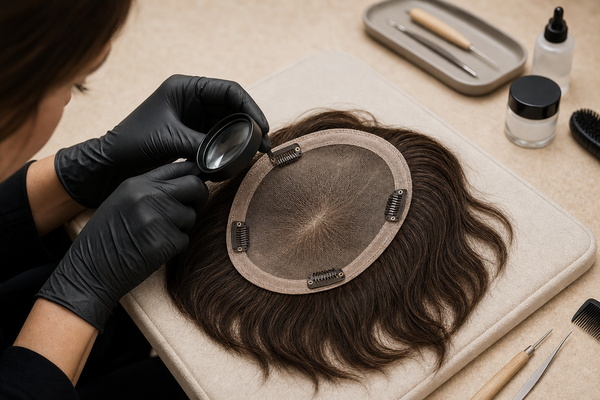
I identify shedding, breakage, and base failure before repairing anything
I examine the strands first. A full-length strand leaving the base suggests release at a knot, bond, weft, or seam. Short pieces suggest breakage along the fiber. A widening thin patch suggests local construction loss, while hair appearing on a brush may come from both the topper and my natural hair. I place a white towel under the piece, detangle gently, and take clear photos of the base before and after one normal wear. I do not tug the hair to create a dramatic test because that can make the damage worse. I also stop putting conditioner, oil, or alcohol-heavy styling product near the base until I know the cause. If a seam is opening or lace is torn, I avoid home sewing and glue. A misplaced stitch or rigid adhesive can distort the base, catch hair, and make a professional repair harder.
| What I find | Can it often be repaired? | What the repair may involve |
|---|---|---|
| Broken or weak clip | Yes | Clip replacement in a suitable reinforced area |
| Small lace tear | Sometimes | Professional reinforcement before the tear spreads |
| Local thin patch | Often | Re-ventilation or adding hair if the base is sound |
| Open weft or seam | Often | Restitching and checking nearby construction |
| Base slightly too large | Sometimes | Careful reduction, reseaming, and clip repositioning |
| Base too small | Limited | Rebuilding or adding base material, if construction allows |
| Severe widespread shedding | Not always economical | Major re-ventilation or replacement |
Can a hair topper be resized or repaired safely?
I believe a topper for thin hair can be resized or repaired only after the technician identifies the base material and the direction of the hair. Lace, monofilament, silk-top, skin, and wefted designs do not tolerate the same alteration. A minor perimeter reduction, clip replacement, seam repair, or small re-ventilation job may be practical. A major size change can move the part, change the contour, interrupt ventilation direction, or create bulk around a new seam. I send the technician the purchase details, base measurements, photos of the underside, photos while worn, and a description of every product used. I ask what will change, where a seam may be visible, how much density can be restored, and whether the repair has a service guarantee. If the base no longer fits the coverage area or the hair is already heavily damaged, I compare repair cost and expected life with a correctly sized replacement.
Conclusion
I solve topper problems by diagnosing fit, color, texture, care, and construction separately. I stop when I feel pain, avoid forceful home alterations, document rapid changes, and use a qualified stylist or technician when the base, ventilation, or seams need work.
References
AAD explains that repeated pulling can cause traction alopecia. It also identifies pain, stinging, broken hairs, a receding hairline, and pulled areas of hair loss as warning signs. ↩
NIST defines metamerism as colors that appear to match despite different spectral profiles. It notes that those differences can become visible under different lighting conditions. ↩
PubMed indexes a review showing how weathering, cuticle edges, chemical services, heat, brushing, humidity, and cleanliness can affect hair friction. It also explains how conditioners can temporarily reduce friction. ↩
PubMed summarizes a 2024 study that used loop tests to reproduce the mechanical environment of hair tangles during combing. The study connects this stress with microcracks and splitting behavior. ↩
ACS gives practical care instructions for wigs and hairpieces. Its guidance includes removing tangles before washing, starting at the ends when brushing long pieces, using wig-formulated products, and avoiding unsuitable heat. ↩