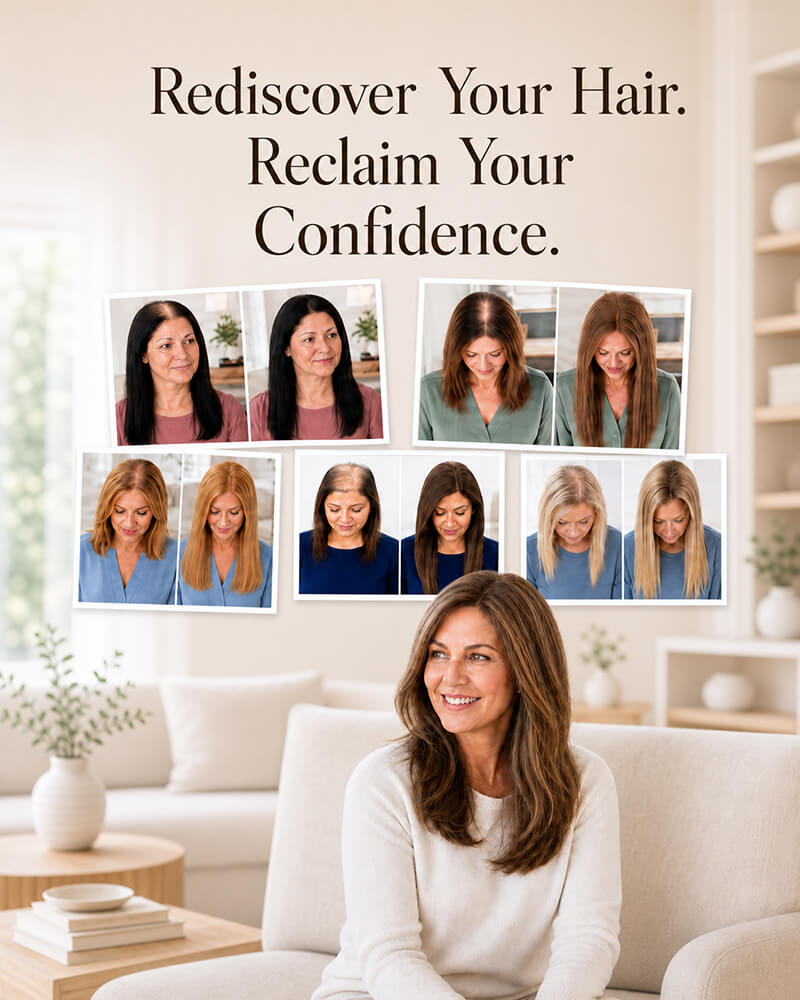

Thinning at the part or crown can change how every hairstyle feels. A well-chosen topper can restore coverage without creating an unrealistic transformation.
A hair topper before and after should show fuller-looking coverage, a narrower-looking part, and balanced volume. It can transform the appearance of thinning hair within minutes, but it will not regrow hair or hide every type of loss. The most natural result depends on correct size, density, color, and blending.
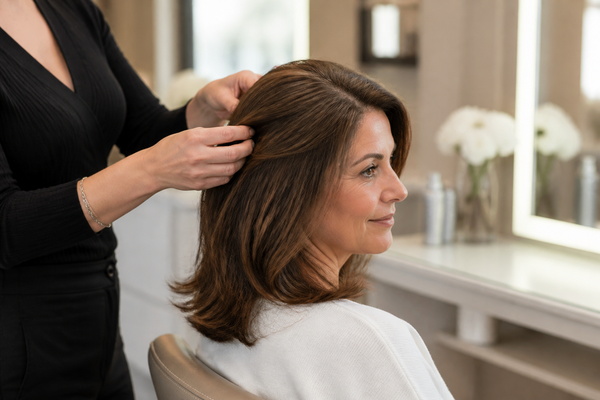
I often tell first-time wearers to expect refinement, not a new identity. The best hair topper should still look like their own hair, only fuller and easier to style.
What Does a Hair Topper Look Like Before and After Blending?
An unblended topper may show a visible edge, uneven density, or a color break. Proper placement and styling turn those clues into one continuous hairstyle.
Before blending, a hair topper can look separate from the natural hair. After blending, the part follows a believable direction, the perimeter disappears, and the lengths move together. The change can be immediate, but a trim, light styling, or small color adjustment may be needed for the most realistic finish.
What changes in the first few minutes?
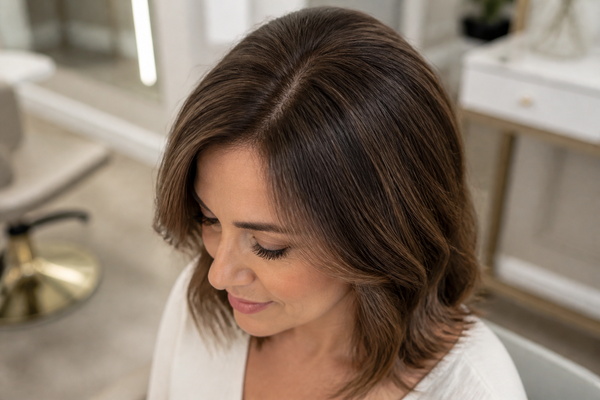
I see the biggest visual change as soon as the base is placed over the area that needs coverage. A widening part can look narrower, visible scalp can become less noticeable, and the crown can gain structure. female-pattern hair loss1 often appears as diffuse thinning over the top with a more visible mid-part, so a hair topper made for part-and-crown coverage may suit that visual pattern. The topper itself gives the fast change. Blending creates the believable result. I place the part where it works with the wearer’s face and remaining hair. Then I blend the front, sides, and ends. If the topper is human hair, I may use a low, appropriate heat setting and style the topper with the natural hair. I never promise that every topper will look perfect straight from the box. A small professional trim often makes a larger difference than adding more hair.
| Stage | What You May See | What Improves It |
|---|---|---|
| Before placement | Visible scalp, flat crown, or widening part | A base sized for the actual thinning area |
| Just placed | Better coverage but a separate-looking piece | Correct position and secure, comfortable attachment |
| After blending | Softer perimeter and unified movement | Part alignment, gentle styling, and an optional trim |
| Final check | A natural result from most angles | Daylight review and photos from the front, side, and back |
I also recommend checking the result in indirect daylight. Bright bathroom lighting can exaggerate scalp contrast, while dim indoor lighting can hide a poor color match. A phone photo from several angles is often more honest than one close mirror view.
Why Wear a Hair Topper for Thinning Hair?
Hair thinning can affect more than a hairstyle. It can also make ordinary routines, photographs, and social plans feel harder than they should.
Women wear hair toppers to add targeted coverage and volume without covering the entire head. A topper can create a fuller-looking crown, reduce visible scalp, support familiar hairstyles, and offer an immediate, removable option. I recommend one when its coverage, comfort, upkeep, and attachment method fit the wearer’s needs.

Benefits that go beyond visible volume
I do not treat confidence as a guaranteed product result, because every woman experiences hair loss differently. Still, research shows that female pattern hair loss can affect emotions and quality of life. Psychosocial impact2 is one reason an immediate cosmetic choice can matter. A topper lets a wearer keep much of her natural hair visible. She can also remove the piece at home and change the amount of coverage as her needs change. In my experience, this control is a major benefit. I recommend toppers to women who want targeted top coverage and are willing to learn placement and care. I do not recommend buying only from a beautiful model photo. I first compare the thinning area with the base dimensions. Then I check density, fiber type, color, length, part style, and attachment comfort. A topper should solve the wearer’s main concern without creating a new problem such as excess weight or an obvious density jump.
| Benefit | Best-Fit Situation | Important Limit |
|---|---|---|
| Targeted coverage | Thinning at the part, top, or crown | The base must extend beyond the area needing coverage |
| Added volume | Flat or reduced density on top | Too much density can look bulky |
| Immediate change | Events, work, photos, or daily wear | Blending may still require practice or a trim |
| Removable use | Wearers who want flexibility | Clips, tape, or other attachment methods must feel secure and comfortable |
| Style support | Familiar cuts, waves, or soft updos | The topper must have enough length and hair distribution for the style |
The best reason to wear a topper is personal. Some women want coverage every day. Others use one only for work, photographs, or special events. Both choices are valid.
Can a Hair Topper Add Both Volume and Length?
A topper can look too short, too thick, or disconnected when its length and density are chosen separately from the wearer’s natural hair.
A hair topper can add volume and length, but its main job is top coverage. Longer topper hair can blend into the wearer’s lengths and create a fuller silhouette. It cannot replace the length or density of a full extension system when the lower sections are very sparse.
Match the result to the base, density, and ends
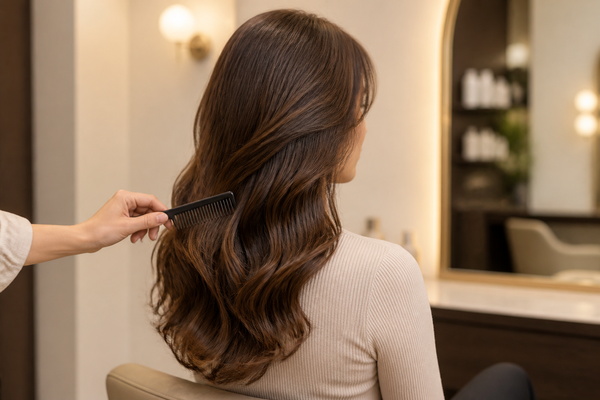
I set realistic expectations by separating three ideas: scalp coverage, top volume, and total length. Base size controls how much thinning the topper can cover. Density controls how full the top appears. Hair length controls where the topper ends and how far it can blend into the natural hair. A longer topper can make the overall hairstyle appear longer when its ends merge with the wearer’s own hair. But it does not add hair evenly around the nape and sides. If those lower areas also need much more density, a topper may need to be paired with another suitable solution. Color matching also affects the before-and-after result. A near-perfect root match with slightly different ends may be workable because a stylist can blend or tone human hair. A strong mismatch at the part is harder to hide. I also watch the texture. Straight topper hair over tight waves can separate even when the color is correct. The goal is not the most hair. The goal is enough compatible hair to create one balanced shape.
| Goal | What a Topper Can Realistically Do | When Expectations Need Adjusting |
|---|---|---|
| Cover a widening part | Reduce visible scalp inside the base area | The base is smaller than the thinning area |
| Add crown volume | Lift the silhouette and support styling | The chosen density is much heavier than the natural sides |
| Add visible length | Extend and thicken the upper layers | The natural lower hair is too sparse to support a continuous blend |
| Improve color dimension | Add highlights or lowlights through the top | The root shade or color temperature strongly conflicts |
| Create a natural hairline | Offer a soft front with the right base and placement | The front edge is too dense, too low, or poorly matched |
I ask wearers to judge success from normal conversation distance, not only from a magnifying mirror. Real hair has flyaways, changing part lines, and uneven movement. A realistic topper should look convincing, comfortable, and proportional rather than digitally perfect.
Are Hair Toppers a Long-Term Solution for Thinning Hair?
An instant cosmetic result can feel like a complete answer, but thinning may continue or signal a condition that deserves professional assessment.
Hair toppers can be a long-term cosmetic solution for thinning hair if they stay comfortable, cover the needed area, and receive proper care. They are not a medical treatment and do not stop hair loss. A wearer can use one while seeking diagnosis and discussing treatment with a qualified clinician.
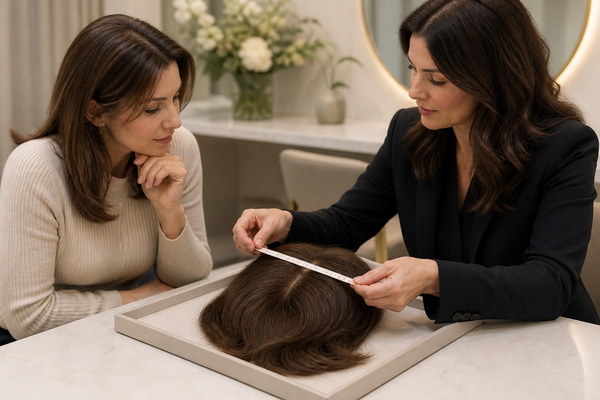
A wearable solution and a medical plan can exist together
I use a topper as a hairpiece3 that disguises thinning, not as a promise of regrowth. It can remain useful for years, but the same piece may not meet every future need. The thinning area can change. The wearer’s color, hairstyle, comfort, or attachment needs can also change. I suggest reviewing the fit whenever the topper starts missing the edges of the area, pulling on fragile hair, lifting, or feeling harder to blend. Repeated tension from tight hairstyles can contribute to traction alopecia4, so pain and persistent pulling are not signs to tolerate. I would stop, reposition, or refit the piece. I also encourage a clinical assessment for sudden, patchy, painful, inflamed, or unexplained loss. Hair loss has many causes, and an accurate hair-loss diagnosis5 guides whether treatment or testing is appropriate. Coverage and care can support each other. A woman does not have to postpone looking like herself while she investigates the cause.
| Long-Term Question | Practical Answer |
|---|---|
| Will the topper regrow my hair? | No. It changes appearance while worn. |
| Can I keep using one for years? | Yes, if the fit stays comfortable and the base continues to cover the needed area. |
| Will one topper last forever? | No. Hair fibers, base material, color, and attachment parts wear with use and care. |
| Should I ignore changing hair loss because coverage looks good? | No. New or worsening loss may deserve assessment by a qualified clinician. |
| What should make me review the fit? | Pain, pulling, slipping, lifting, exposed edges, or an area that has grown beyond the base. |
Conclusion
A realistic hair topper before and after shows targeted coverage, balanced volume, and a blend that still looks like the wearer. I recommend choosing for fit and proportion, checking comfort regularly, and treating the topper as a flexible cosmetic partner rather than a medical cure.
References
DermNet describes female-pattern hair loss as diffuse scalp thinning caused by increased shedding, reduced hair volume, or both, and distinguishes it from the usual male pattern. ↩
JAMA Dermatology reviews 41 studies involving 7,995 patients and reports an association between androgenetic alopecia and moderate impairment of quality of life and emotions. ↩
BAD explains that wigs, hairpieces, toupees, and extensions can help disguise female-pattern hair loss, and notes that real-hair pieces can be styled with low heat. ↩
AAD explains that repeated pulling can cause traction alopecia and advises changing a painful hairstyle promptly because ongoing tension can lead to permanent hair loss. ↩
AAD Diagnosis explains that dermatologists examine the scalp and history, and may use blood tests or a biopsy when disease, deficiency, hormonal imbalance, or infection is suspected. ↩