

A visible bald spot can turn a quick styling routine into daily camouflage. The wrong product may look convincing indoors but obvious outside.
Hair fibers and root sprays work best for mild thinning where hair still grows through the area. A hair topper is usually the better long-term cosmetic solution when a spot has little anchor hair, the part keeps widening, or daily application no longer provides reliable, natural-looking coverage.
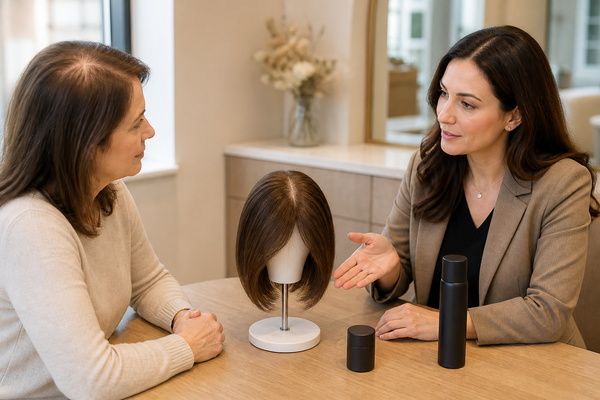
When I compare these options, I do not start with the size of the bottle or the price per use. I look at what each product can physically do. Fibers make existing strands look denser. Root sprays reduce the color contrast between visible scalp and hair. A topper supplies actual additional hair over the area. That difference explains most of the results people see.
None of these products diagnoses or treats the cause of a bald spot. Cosmetic coverage and medical assessment serve different purposes.
Are Hair Toppers Better Than Hair Fibers or Root Sprays for Bald Spots?
Temporary camouflage feels easy until it needs constant checking and reapplication. A larger or barer spot can expose the limits of fibers and pigment quickly.
Hair toppers are generally better for larger or long-term bald-spot coverage because they add real hair and do not depend on fibers attaching throughout the spot. Fibers and root sprays remain useful for small, mild areas, fast touch-ups, and people who want low-cost, wash-out camouflage.
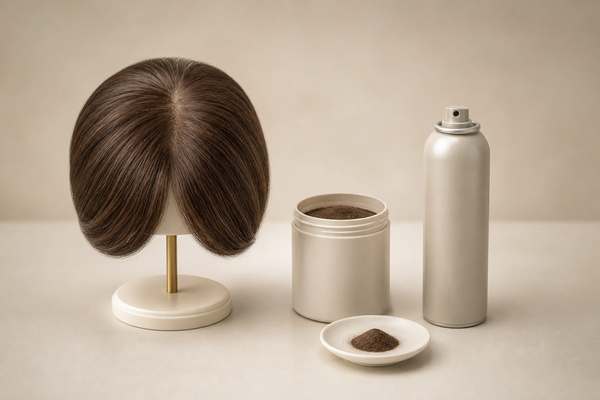
What does each product actually add?
I think of hair fibers as density enhancers, not replacement hair. A peer-reviewed review explains that topical fibers carry a charge that lets them cling to existing hair1. They make fine or separated strands appear thicker, but they become ineffective where no hair remains for them to bind to. Root sprays work differently. They deposit temporary color over roots, fine hair, and sometimes visible scalp, so the contrast looks softer. They do not create strand movement or actual density. A topper covers the area with a base carrying additional hair. It can therefore bridge a thin or bare zone, create a new part, and add shape that moves more like a hairstyle than a layer of pigment.
Which option is the better long-term solution?
I would call a topper the more dependable long-term cosmetic system, but not a medical cure. Once it is fitted and blended, the same piece can be worn repeatedly instead of rebuilding coverage with powder or spray each morning. It still needs washing, conditioning, detangling, storage, and occasional repair or replacement. Fibers and sprays cost less at first and let the wearer change shades easily, but they are consumable products. They also require dry application, careful blending, and shampoo removal. The better value depends on the size and stability of the area. If a small amount of fiber takes one minute and looks natural, a topper may be unnecessary. If several products are needed to hide a bare center every day, a properly sized topper may simplify the routine.
| Feature | Hair fibers | Root spray | Hair topper |
|---|---|---|---|
| What it adds | Apparent thickness around existing strands | Temporary pigment and lower scalp contrast | Actual wearable hair over a base |
| Best use | Mild thinning with hair throughout the area | Visible roots, gray regrowth, or scalp contrast | Wider thinning, sparse zones, or a bald spot |
| Daily work | Shake, blend, and often set | Spray, dry, and check overspray | Position, secure, blend, and remove |
| Removal | Shampoo | Shampoo | Remove the piece; wash only as needed |
| Long-term role | Repeat temporary camouflage | Repeat temporary camouflage | Reusable cosmetic coverage system |
Which Option Works Better for a Widening Part or Larger Bald Spot?
A widening part can change slowly, so an old routine may fail before the wearer notices why. More product cannot replace missing anchor hair.
Fibers usually work best for an early widening part with natural hair still crossing the visible scalp. Root spray can soften color contrast. A topper works better when the part is broad, density is uneven, or a bald spot contains too little hair to hold fibers naturally.
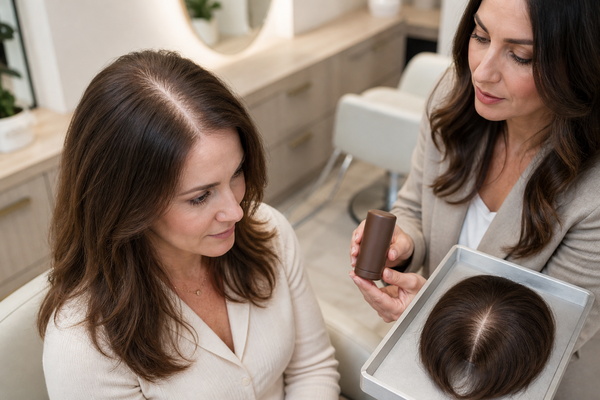
How should I judge a widening part?
The AAD lists a widening part2 as a common early sign of hair loss in women. For cosmetic coverage, I examine the whole line rather than its widest point. If short and long hairs still run through the part, a light layer of color-matched fibers can reduce the visible gaps. A controlled root spray can also make a pale scalp less noticeable beneath darker hair. As the part widens, the wearer may start drawing an unnaturally straight, dark stripe or piling fibers directly onto skin. That is usually the moment to compare a small part topper. A well-chosen topper creates a believable part with hair emerging across the base instead of relying on pigment to imitate missing density.
When is a bald spot too large for fibers or root spray?
I do not use a fixed centimeter rule because a small smooth spot can be harder to camouflage than a larger area that still contains fine hair. The practical test is anchor density. If fibers fall onto bare skin instead of interlocking with hair, the area is beyond their main strength. If root spray creates a flat painted circle that lacks texture, movement, and broken-up scalp visibility, pigment alone is no longer enough. A review of hair camouflage describes fibers as limited in complete baldness3 because they require hair to bind. I would also move toward a topper when coverage changes under overhead light, needs several thick layers, transfers around the spot, or takes longer to rebuild than the wearer can comfortably manage.
| What you see | Fibers or spray may still work | Consider a topper |
|---|---|---|
| Hair remains throughout the area | Yes, especially with light application | Optional |
| Scalp shows mainly along a narrow part | Often | If the part continues widening |
| Fine hair exists only around the edge | Fibers may collect unevenly | Usually more reliable |
| Smooth or shiny skin fills the center | Root spray only changes color | Usually better for realistic density |
| Several heavy layers are needed | Finish may become powdery or flat | More repeatable coverage |
Do Hair Fibers Stay in Place in Rain, Sweat, or Wind?
Weather can turn confidence into constant checking. “Resistant” sounds reassuring, but it does not mean waterproof under every condition or every product formula.
Many hair fibers resist light rain, normal perspiration, and wind when applied to dry hair and finished with a compatible holding spray. Heavy rain, swimming, soaked hair, towels, hats, or rubbing can still disturb coverage. Root sprays vary, so check the exact product’s water-resistance claim.

What does weather-resistant really mean?
Toppik states that its fibers provide weather resistance4 through wind, rain, and perspiration, and the company recommends its holding spray for longer wear. I treat that as a product-specific claim, not a promise for every fiber brand or every situation. A light shower on a fixed, untouched style is different from saturated hair. Sweat also varies. Mild warmth around the hairline is different from a hard workout followed by towel drying. Wind may not remove bonded fibers, but it can separate natural hair and reveal an area that looked covered when the hairstyle was still. I recommend testing the complete routine at home, then checking it near a window, under overhead light, and after gentle movement before relying on it for an important day.
Do root sprays handle water better?
Some temporary root sprays are marketed as water-resistant. For example, Clairol describes its temporary spray as a water-resistant formula5 that lasts until shampoo. That claim applies to that formula and its intended root-color use. It does not mean every colored aerosol is waterproof, transfer-proof, or designed to fill a bald spot. Root spray may remain visually stable through humidity, but rubbing, sweat at the scalp, heavy rain, or contact with pale fabric can reveal the product’s limits. I would let the spray dry completely, use the smallest amount that reduces contrast, and test transfer with a clean tissue. I would not introduce a new spray immediately before rain, exercise, travel, or wearing a light-colored hat.
| Condition | Hair fibers | Root spray | Hair topper |
|---|---|---|---|
| Normal indoor day | Usually stable when applied correctly | Usually stable after complete drying | Stable when fitted and secured correctly |
| Light wind | Fibers may hold, but hair movement can expose gaps | Pigment usually remains, but hairstyle can shift | Secure fit and perimeter blend matter |
| Light rain or mild sweat | Product-specific resistance; avoid rubbing | Depends on the exact formula | Human hair and styling may react to moisture |
| Heavy rain or swimming | High risk of distortion or runoff | High risk unless specifically designed otherwise | Protect the piece and follow its care instructions |
| Towel, hat, or hand friction | Possible transfer or displacement | Possible transfer | Friction can disturb the style or attachment |
Can Hair Fibers and Root Sprays Be Used With a Hair Topper?
A topper can cover the main area while a small gap remains at the perimeter. Adding product carelessly can stain the base or weaken the attachment.
Hair fibers can be used with a topper in small amounts on exposed natural hair, the perimeter, or a minor blending gap. Apply the topper first, keep fibers and root spray away from clips, lace, silk, tape, and adhesive, and test any pigment on a hidden area before regular use.
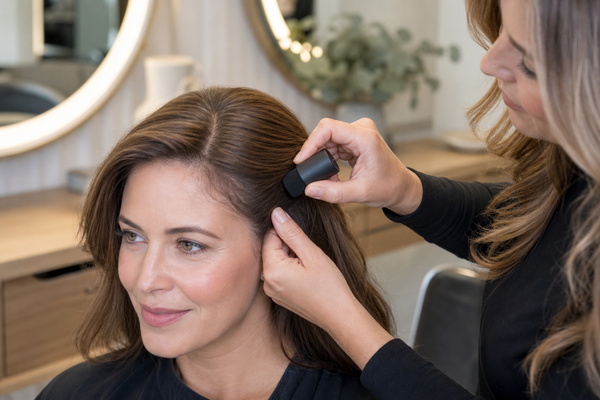
What is the safest order of application?
I would start with clean, completely dry natural hair. I would then place and secure the topper exactly as it will be worn, blend the surrounding hair, and inspect the result before adding anything. If a narrow transition still looks sparse, I would apply a very small amount of fiber only to the natural hair that remains visible. This order prevents loose product from coating the clip teeth or sitting between the base and the attachment hair. It also shows whether fibers are needed at all. A clinical review notes that people sometimes combine camouflage agents6 to reduce scalp-to-hair contrast. With a topper, I would keep that combination targeted. More powder is not automatically more natural, and buildup can make the blend darker than both the topper and the wearer’s hair.
Where should root spray never be applied?
I would avoid spraying directly onto lace, monofilament, silk-top material, polyurethane edges, clips, tape, or adhesive. Pigment can stain a pale base, collect in knots, change the sheen of the part, or leave residue where the topper needs clean contact. Aerosol also travels farther than the visible stream, so I would shield the topper and work in short, controlled bursts on natural hair only. If the topper itself needs color correction, I would not use scalp concealer as a substitute for professional color work. A hidden-strand test is safer because human hair, synthetic fiber, base materials, and coatings can respond differently. After removal, I would clean the natural scalp and attachment area according to the product instructions rather than letting cosmetic layers build up under the piece.
| Combination step | Recommended approach |
|---|---|
| Prepare | Start with dry, styled natural hair |
| Install | Position and secure the topper before adding camouflage |
| Inspect | Check the part, perimeter, sides, and back in bright light |
| Add fibers | Use a light amount only on exposed natural hair |
| Use root spray | Shield the topper and avoid all base and attachment materials |
| Remove | Take off the topper gently, then cleanse residue as needed |
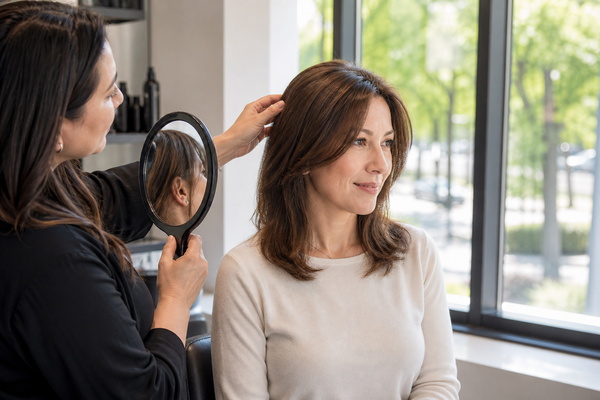
Which Option Looks Most Natural in Daylight?
Bathroom lighting can hide excess pigment, a hard part, or the wrong density. Direct daylight exposes color, texture, shine, and movement at once.
Hair fibers can look most natural for mild thinning when the shade matches and existing hair breaks up the scalp. A well-fitted human-hair topper usually looks more natural over a larger bald spot because it adds strand movement and depth. Root spray is best used lightly to reduce contrast.
Why do fibers and sprays sometimes look obvious outside?
Daylight makes flat color easier to see. Fibers look convincing when they sit among real strands, match the root family, and leave a little natural scalp variation. They look less convincing when too much product forms a fuzzy patch on skin, the chosen shade is too dark, or the application creates a perfectly solid hairline. Root spray can fail for a similar reason. Its job is to lower contrast, but a dense circle of pigment may read as makeup rather than shadow from hair. I prefer to start lighter, build slowly, and inspect from normal conversation distance. I also check from above because overhead sun can reveal a different pattern than a front-facing mirror. If the result needs constant correction from several angles, the coverage method is working too hard.
What makes a topper look natural in daylight?
A topper has more components to match, but it also has more ability to create realistic depth. A review of female-pattern hair loss notes that prostheses made with human hair7 can look natural because individual fibers vary gradually in color and diameter. I also look at base size, part direction, root shade, density, hairline placement, texture, length, and the way the perimeter is cut into the wearer’s own hair. A topper that is too dense can look heavier than fibers, even if it is expensive. A good result does not erase every glimpse of scalp. It creates the same irregularity, softness, and movement that healthy natural hair shows in real light. I always recommend a final check beside a window and outdoors before committing to the cut or color.
| Daylight factor | Hair fibers | Root spray | Hair topper |
|---|---|---|---|
| Color match | Must match roots closely; shades can be mixed | Must avoid a flat or overly dark patch | Match roots, lengths, undertone, and expected fading |
| Texture | Natural when dispersed through existing strands | Adds color but no strand texture | Adds real strand depth and movement |
| Scalp appearance | Works best with some natural scalp variation | Heavy use can look painted | Base and part must imitate a natural scalp |
| Movement | Depends on the wearer’s existing hair | Does not add movement | Moves with the added hair when fitted well |
| Best coverage level | Mild thinning | Minor contrast or root touch-up | Moderate thinning to larger sparse or bald areas |
Conclusion
Fibers and root sprays are useful temporary tools for mild thinning. I would choose a topper when anchor hair, coverage size, weather confidence, daily effort, or daylight realism makes temporary camouflage unreliable. A dermatologist8 can assess a new or changing bald spot.
References
PMC Review explains that charged topical fibers cling to existing terminal and fine hairs, so they can increase apparent density but are ineffective on completely bald areas. ↩
AAD identifies a widening part, gradual thinning, a growing bald spot, and a thinner ponytail as common visible signs of hair loss. ↩
PMC Camouflage describes fibers as most useful for small thinning areas and explains that their dependence on existing hair limits their value in complete baldness. ↩
Toppik states that its keratin fibers resist wind, rain, and perspiration and recommends FiberHold Spray when the wearer wants additional staying power. ↩
Clairol describes its temporary root spray as fast-drying and water-resistant, with color coverage designed to remain until the next shampoo. ↩
UC Review explains that more than one camouflage agent may be combined to reduce contrast and confirms that topical fibers require existing hair for effective binding. ↩
FPHL Review notes that human-hair prostheses can appear natural because real hair fibers show gradual differences in color and diameter. ↩
AAD Guidance explains that dermatologists can distinguish hair loss from excessive shedding, identify its cause, and discuss what patients can expect. ↩