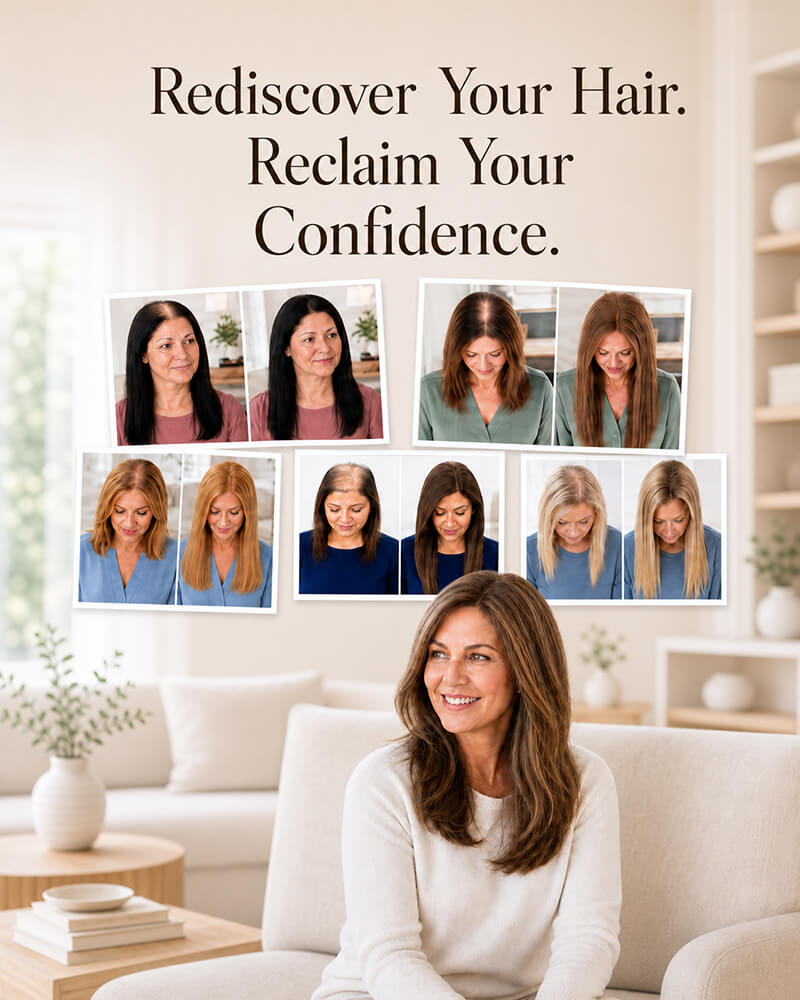

Thinning at the crown can make every mirror check feel bigger than it is. A full wig may feel like too much, so I start with a smaller, focused solution.
Hair toppers are partial hairpieces that add coverage and density where hair is thinning, usually at the crown or along a widening part. I use them when enough natural hair remains to secure and blend the piece, while keeping my own length and hairline visible.
I think of a topper as a bridge between my natural hair and the coverage I want. A good topper should move with me, sit comfortably, and make everyday moments feel less stressful. I explain what I check before I buy, fit, style, and care for one.
What Is a Hair Topper?
Sparse hair at the top can show scalp even when the rest of my hair still has length. If I only need coverage in one area, a full wig can feel unnecessary.
A hair topper is a partial hairpiece designed to sit over a thinning area and blend with existing hair. It usually has a small base and clips underneath, so I can add density at the crown, part, or front without covering my whole head.
I look at the base before I look at the hairstyle
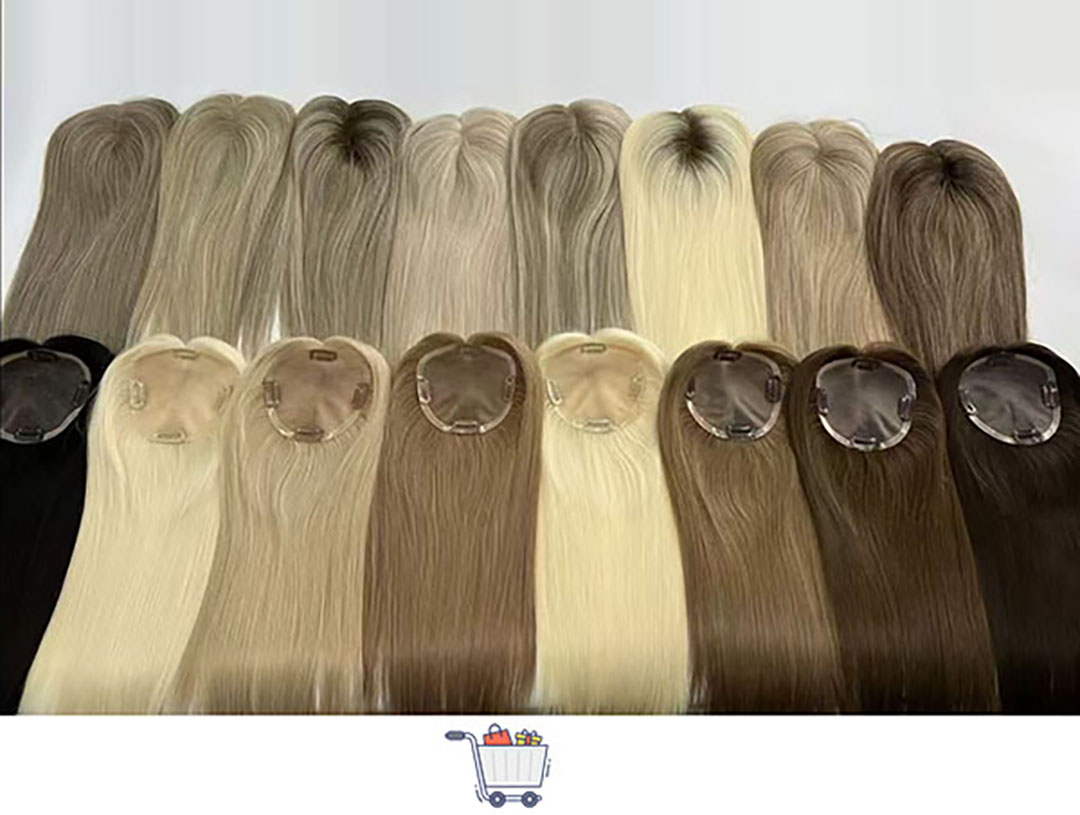
When I shop, I do not begin with length. I begin with the base, the part that rests against my hair and scalp. A smaller base works when thinning is limited and secure hair surrounds it. A larger base spreads coverage over a wider crown or part. A silk-top or lace-top construction can create a more realistic-looking part, but the best choice still depends on the coverage area and attachment hair. I also separate density from length. A topper can make roots look fuller while my own ends remain visible. I do not expect it to cure hair loss1. I use it as a cosmetic choice while I understand what my hair is doing.
| Base feature | What I use it for | What I check first |
|---|---|---|
| Smaller base | A focused part or small crown area | Hair is available around every clip point |
| Medium base | A widening part and early crown thinning | The perimeter can hide under my own hair |
| Larger base | Broad crown coverage | The base does not extend into a visible hairline |
| Silk or lace top | A more natural-looking part | The part direction works with my own growth pattern |
Who Is a Hair Topper Best For?
It is easy to buy a topper because I want more volume. But a topper needs enough nearby hair to hold it and enough surrounding hair to hide its edge.
A hair topper is best for me when I have localized thinning, a widening part, or reduced crown density but still have stable hair around the attachment area. It is less suitable when bare scalp is broad, hair is too fragile for clips, or I need full-head coverage.
I separate a coverage decision from a health decision
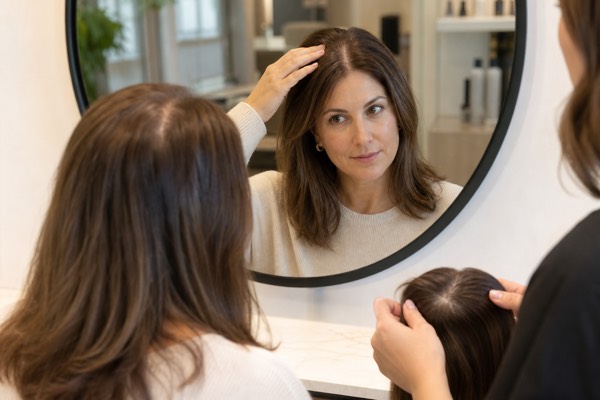
I find a topper most useful when my concern is visual coverage, not when I am trying to ignore a new scalp problem. Men may notice crown thinning or a receding hairline, while women may notice thinning on top and a wider middle part in androgenetic alopecia2. That can help me name a pattern, but it is not a diagnosis. I seek clinical advice if loss is sudden, patchy, painful, itchy, red, scaly, or moving fast. I also pause if clips pull on fine hairs. Comfort matters more than forcing a style to work. I ask for a professional fitting when the attachment plan still feels uncertain.
| My situation | Topper fit | My practical next step |
|---|---|---|
| Widening part with stable surrounding hair | Often a good fit | Measure the thinning area before choosing base size |
| Mild crown thinning with long hair | Often a good fit | Match root color and density first |
| Broad bare scalp with little hair for clips | Usually a poor clip-in fit | Explore a wig, integration system, or professional fitting |
| Sudden patchy loss or scalp symptoms | Do not self-fit first | Speak with a health professional |
How Is a Hair Topper Different From a Wig?
I can confuse a topper with a wig because both add hair. The difference becomes clear when I decide how much of my own hair I want to keep visible.
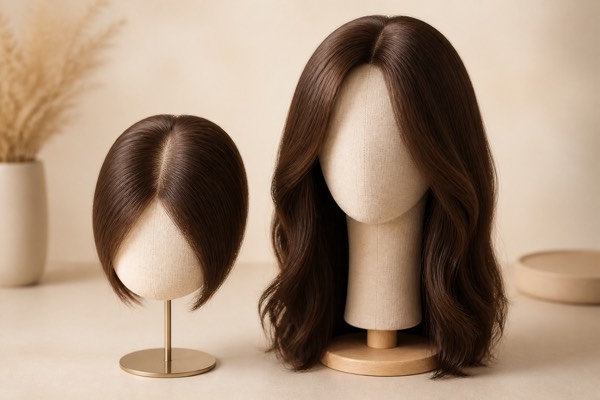
A hair topper covers one thinning zone and blends into my natural hair, while a wig covers most or all of my scalp. I choose a topper for targeted density and a wig when I need broader coverage, have limited attachment hair, or want a complete style change.
I choose coverage based on the area I need to solve
I do not treat a topper as a smaller wig. A topper asks my natural hair to do part of the visual work. My hair hides the perimeter and merges with the topper. A wig does not depend on the same amount of surrounding hair. That makes a wig more practical when the thinning zone is too large to blend, the scalp is exposed from normal angles, or I need coverage that does not rely on clips. A full wig is not a failure or an “extreme” step. The NHS notes that wigs, extensions, scarves, and makeup are all personal options for hair coverings3. I choose the option that feels secure for my actual day.
| Question I ask | Hair topper | Full wig |
|---|---|---|
| How much area needs coverage? | One zone, such as a part or crown | Most or all of the scalp |
| What hair must remain visible? | My own hairline and lengths | The wig provides the complete style |
| What holds it in place? | Usually clips under the base | Cap fit, adjusters, grips, tape, or other methods |
| What is the main visual goal? | Add density and preserve my current look | Create broad coverage or a new complete look |
How Do I Choose the Right Hair Topper?
A beautiful topper can still look wrong if the base is too small, the density is too heavy, or the root shade fights with my natural hair.
I choose the right hair topper by matching coverage area, base size, root color, length, texture, and density to my own hair. I measure the thinning area first, then choose the smallest base that covers it with enough hair outside the base for a soft blend.
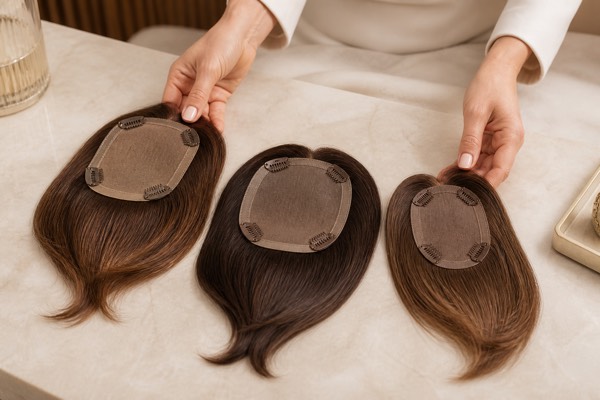
I match the root before I chase the ends
My first color test happens in daylight near the roots, because that is where a mismatch shows fastest. I can often style ends that are slightly lighter, warmer, or cooler, but a dark root against a light part makes the topper look separate. I also match density to my own hair. Extremely dense hair can create a shelf at the perimeter, while a sparse topper can disappear. I wait to cut or texturize a new piece until I know the base fits. I wear it at home, change the part, take photos in window light, and check the crown from above. Those tests tell me more than a product photo.
| Selection step | What I do | Common mistake I avoid |
|---|---|---|
| Map the area | Measure the width and length of visible thinning | Choosing from a photo without measuring |
| Choose base size | Cover the area plus a small blending margin | Buying the largest base “just in case” |
| Match color | Compare roots in indirect daylight | Matching only the bright ends |
| Match texture | Compare straightness, wave pattern, and frizz level | Expecting heat styling to fix a texture mismatch |
| Match density | Choose a gradual transition into my own hair | Selecting maximum density for every situation |
How Do I Put on a Hair Topper Safely?
Clips can feel fast and easy, but I do not want speed to turn into constant tension. A secure topper should not sting, pinch, or leave me counting the hours until I remove it.
I put on a hair topper by aligning it over the thinning area, opening the clips, and closing each clip onto healthy natural hair beneath the base. I stop and reposition it if any point hurts, pulls, or sits on a fragile area of hair.
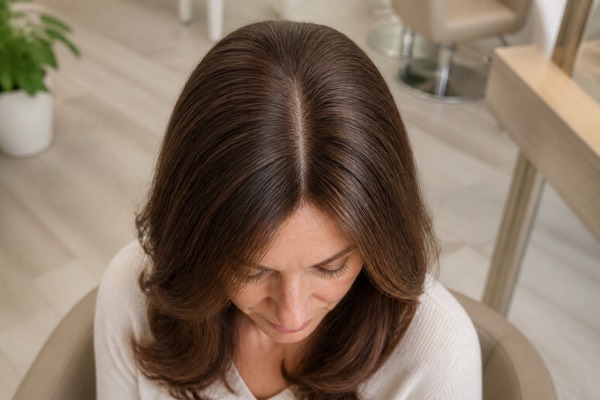
I protect the hairs that make attachment possible
I start with clean, fully dry hair because clip teeth need stable strands, not slippery product buildup. I place the topper slightly forward of the area I want to cover, check the part, then fasten front clips before back clips. Clips belong on the underside of the base, facing down toward natural hair. In the finished look, I should not see clips, base material, or seams on top. I never close a clip over tender scalp or force it onto a sparse edge. Persistent pulling is not something I “break in.” Repeated tension can contribute to traction alopecia4, so pain, stinging, and broken hairs mean I refit or change the attachment plan. I remove a clip-in topper before sleep unless a qualified fitter gives product-specific advice.
| Fitting check | What “right” feels like | What tells me to stop |
|---|---|---|
| Base position | Centered over the thinning zone | It reaches into my exposed hairline |
| Clip placement | Grips hair under the base | Scrapes scalp or catches only a few weak hairs |
| Tension | Secure but forgettable | Pinching, headache, stinging, or soreness |
| Perimeter | Covered by my own hair | A hard visible line around the base |
How Do I Blend and Style a Hair Topper?
The most expensive hair can still look separate if I leave the topper and my own hair in two different visual zones. Blending is where the result becomes believable.
I blend a hair topper by matching the part, root direction, texture, and density to my own hair. I style my natural hair and topper together in small sections, then check the crown and perimeter in daylight instead of relying on one front-facing mirror view.
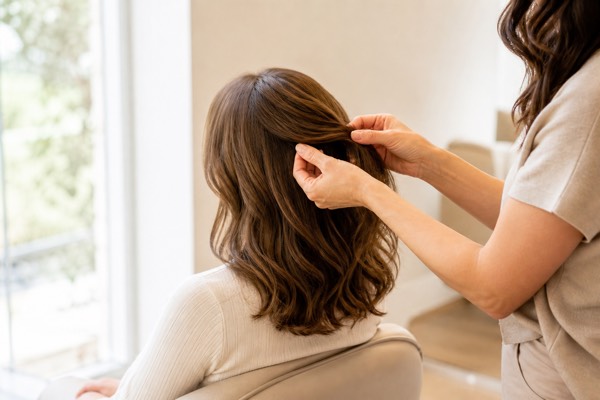
I make the transition gradual, not perfectly identical
I do not try to make every strand match. I aim for a believable transition. First, I decide where my part looks most natural. Then I use low heat, if the piece allows it, to bring the texture closer together. I style a narrow section of my own hair with a narrow section of topper hair. That mixed section prevents a visible horizontal break. I avoid heavy hairspray near the base because it can make hair stiff and hard to separate. Before I leave home, I check both sides and take a photo from above. The camera often reveals a dark band, flat crown, or obvious part before another person does.
| Blending area | My adjustment | Result I want |
|---|---|---|
| Part | Shift or soften it slightly | A natural scalp-like line |
| Crown | Lift roots lightly, without teasing the base | Even height from all angles |
| Perimeter | Pull a thin layer of my own hair over the edge | No hard base outline |
| Ends | Add a soft wave or trim after fitting | One consistent texture |
How Do I Care for a Hair Topper and Know When It Is Time for More Help?
A topper can look natural for a long time, but only if I clean it gently and pay attention to how my own hair and scalp feel underneath it.
I care for a hair topper by detangling gently, washing only when it needs it, drying it carefully, and storing it in its natural shape. I seek professional or medical advice when the fit becomes painful, the scalp changes, or hair loss becomes sudden, patchy, or hard to explain.
I care for the piece and keep watching the scalp
I treat a human-hair topper like fine hair that no longer receives oils from a scalp. I hold the base firmly, brush from the ends upward, and use products sparingly. I wash only when oils, odor, or residue make it necessary. Then I use cool-to-lukewarm water, mild shampoo, and conditioner away from the clips and base where possible. I blot instead of twisting, reshape the part, and dry the topper on a stand or clean towel. I clean the clips and inspect stitching. I also note when shedding changes, my scalp feels tender, or the topper needs constant repositioning. Sudden hair loss5 or patchy loss deserves medical attention. I use a hairpiece for support, not as a reason to overlook a new symptom.
| Care moment | What I do | What I avoid |
|---|---|---|
| Before storage | Detangle and fasten clips closed | Tossing it loose into a drawer |
| Washing | Support the base and use gentle products | Scrubbing, twisting, or soaking clips unnecessarily |
| Drying | Blot and reshape before air drying | High heat on a wet base |
| Reassessment | Check fit, shedding, and scalp comfort | Normalizing pain or a suddenly poor fit |
Conclusion
I see a hair topper as targeted coverage, not a one-size-fits-all answer. I choose the right base, protect my natural attachment hair, blend in daylight, and get advice when the pattern or condition of my scalp changes.
References
AAD defines hair loss as alopecia and explains that hair loss has many causes. It also notes that identifying the cause matters before treatment or prevention decisions. ↩
MedlinePlus describes androgenetic alopecia patterns, including crown thinning in men and a widening middle part in women. It also notes that family history can be a risk factor. ↩
NHS discusses wigs, extensions, scarves, and makeup as personal options for disguising hair loss. It emphasizes finding a product and style that suits the individual. ↩
AAD explains that continual pulling can cause traction alopecia. Pain, stinging, broken hairs, and a receding hairline are signs that a hairstyle or attachment may be too tight. ↩
Mayo Clinic advises speaking with a doctor about sudden or patchy hair loss. It notes that sudden loss can indicate an underlying condition that needs treatment. ↩