

Choosing the wrong hairpiece can add volume in the wrong place, leave thinning visible, or create more weight and maintenance than your hair needs.
Hairline extensions are best for targeted fullness around the temples and sides. Hair toppers are best for covering thinning across the crown, part line, or top of the head. I choose between them by locating the thinning first, then checking the coverage and support required.
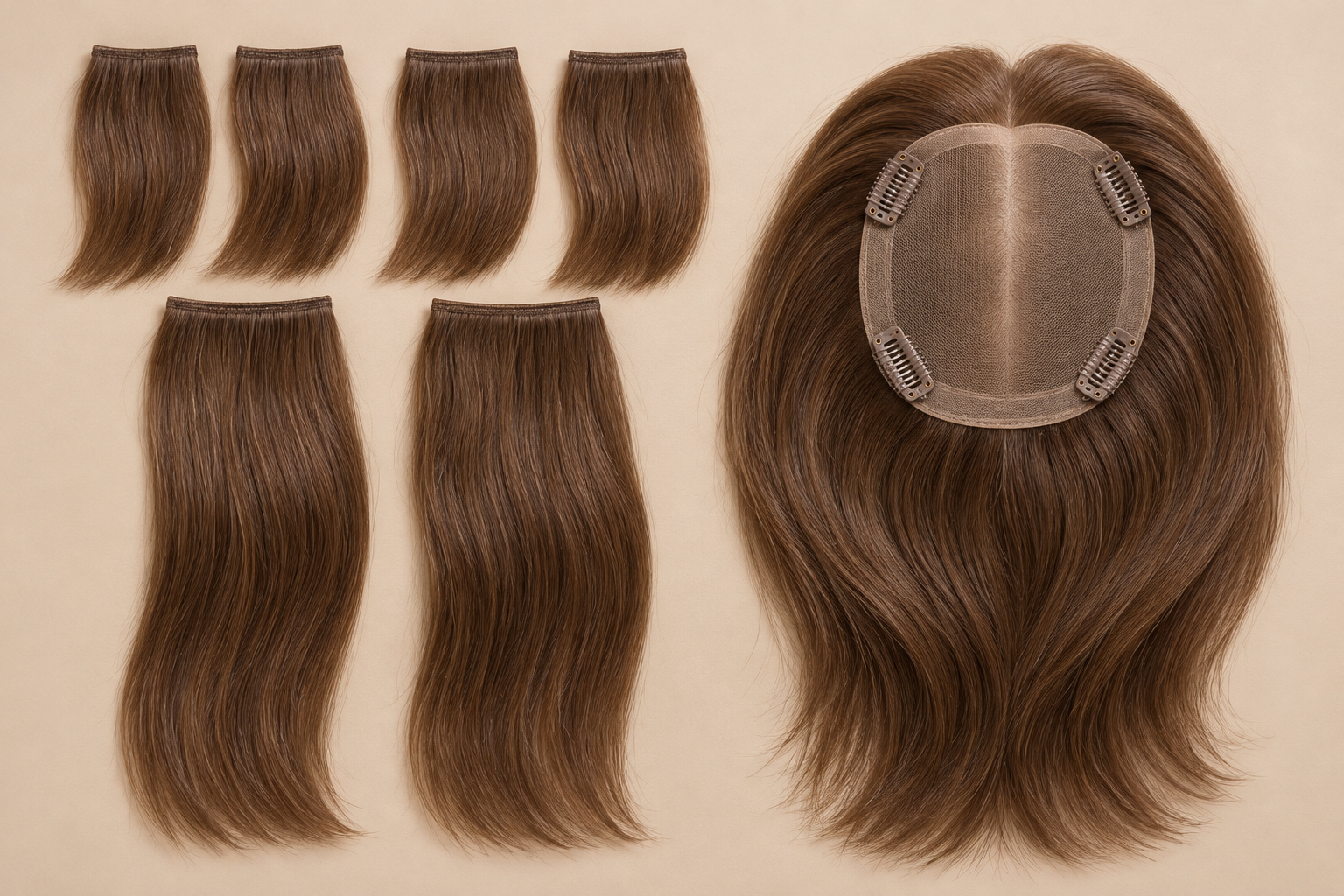
I often meet women who describe every concern as “thin hair,” even though the visible problem may sit in a completely different area. That location matters. A small temple gap, a widening part, and thin ends do not need the same solution. I use this comparison to match the product to the actual concern instead of simply adding more hair.
What Are Hairline Extensions?
Traditional extension sets can overwhelm a small thinning area. A targeted design adds fullness only where the hairline needs more balance.
Hairline extensions are small, lightweight clip-in pieces designed to add targeted volume around the temples, front sides, and areas above the ears. I attach them slightly behind the visible hairline, using healthy natural hair to support and conceal each clip.

I use small pieces to solve a small-area problem
Medical literature describes hair extensions1 as artificial hair integrations used to add length or fullness. Hairline extensions apply that broad idea to a much more specific location.
The Findingdream Hairline Extensions set contains four 1-inch pieces and two 4-inch pieces. I normally begin with a small piece behind each temple. I add a longer piece above each ear only when the sides need more density.
This flexible arrangement lets me use fewer pieces than a full clip-in set. It also lets me adjust the left and right sides separately because natural hairlines are rarely identical. The product adds hair around the perimeter, but it does not create a scalp-like base or cover a widening part at the top.
I view these pieces as targeted volume, not as a treatment for hair loss. They need enough healthy natural hair to hold the clips and enough cover hair to hide the attachment edges. I never place them directly on a bare patch, irritated scalp, soft baby hairs, or severely weakened strands.
What Is a Hair Topper?
A widening part or visible crown cannot be covered effectively by adding hair only at the sides. These concerns need coverage across the top.
A hair topper is a partial hairpiece with a base that sits over the crown, part line, or top of the head. It adds hair and creates coverage across the area beneath the base while blending with the wearer’s remaining natural hair.

I choose the base before I choose the length
The American Cancer Society defines a hair topper2 as a top piece that adds coverage and volume to thinning hair on the top of the head. That coverage comes from the base. Hair is attached to lace, monofilament, silk, or another foundation, and the base spans the area that needs to look fuller.
The National Alopecia Areata Foundation notes that toppers are partial hairpieces, often used for crown loss, and commonly attach to existing hair with combs on the underside of the base. Its topper guide3 also stresses that the best choice depends on the wearer’s hair loss, lifestyle, and styling preferences.
I therefore choose a topper by matching the base to the thinning area before comparing hair length. Findingdream Human Hair Toppers are available in several base sizes. A smaller base can support localized part-line coverage, while a larger base can cover a broader section of the crown.
Length, color, density, and texture still matter, but the wrong base size cannot solve the correct coverage problem.
What Is the Main Difference Between Hairline Extensions and Hair Toppers?
Both products add hair, so their names can sound interchangeable. The key difference is not the amount of hair but where the product works.
The main difference is placement and purpose. Hairline extensions add localized volume around the temples and sides. Hair toppers sit over the crown or part line and provide top coverage, including coverage where the scalp may be visible beneath the base.

I match volume to the correct area
I start by asking whether the wearer needs more hair around an area or coverage over an area. Hairline extensions sit beneath natural hair around the perimeter. They increase density without placing a base over the scalp.
A topper sits above the thinning zone and uses its base to create a fuller-looking top, crown, or part. This construction difference affects weight distribution, blending methods, styling choices, and the amount of natural hair needed for attachment.
I also separate both products from traditional clip-ins. A conventional clip-in set usually adds length and density through the back, mid-lengths, and ends. It may help a thin ponytail, but it does not automatically cover a widening part or solve a small temple gap.
I do not judge a product by how much hair comes in the package. I judge it by whether the attachment and coverage land in the correct place.
| Feature | Hairline Extensions | Hair Toppers |
|---|---|---|
| Main purpose | Add targeted side volume | Cover visible scalp and add top volume |
| Placement | Temples and sides | Crown, part line, and top |
| Coverage | Small, localized areas | A larger area of the scalp |
| Weight | Usually lighter | Depends on base size and hair density |
| Appearance | Blends beneath natural hair | Creates coverage from the base |
| Best for | Mild temple or side thinning | Crown or part-line thinning |
| Application | Several small pieces | One complete hairpiece |
| Styling | Flexible piece placement | More consistent top coverage |
Who Should Choose Hairline Extensions?
Some women buy a large hairpiece when they only need two small areas filled. Extra coverage can create unnecessary density and adjustment work.
Choose hairline extensions when thinning is mild and concentrated around the temples or sides, while the crown and part line still have adequate coverage. They are also useful when you want adjustable local volume without wearing a topper or a complete clip-in set.

I check the location, support, and desired result
I consider hairline extensions when a woman points to the temples, the front sides, or the area just above the ears. The natural hair should still provide a healthy anchor slightly behind the visible edge. It should also provide a thin cover layer above each clip.
This option often suits fine-haired women who find a traditional full set too dense, too heavy, or difficult to conceal. It can also suit someone whose left and right sides need different amounts of fullness because each small piece can be repositioned independently.
I do not choose them when the main concern is a widening part, visible crown, or broad top thinning. I also do not use them directly on a sparse patch that lacks supporting hair.
If thinning is sudden, patchy, or increasing quickly, I pause the cosmetic decision. Mayo Clinic advises medical review for sudden hair loss4 because an underlying condition may require attention.
Hairline extensions may be a good fit when:
- The temples look less full than the crown.
- The wearer wants subtle side density rather than scalp coverage.
- A complete clip-in set adds too much hair.
- The natural hair can support and conceal lightweight clips.
- The wearer does not want to wear a larger topper.
- The left and right sides need different amounts of fullness.
- The wearer wants removable, adjustable pieces for daily or occasional styling.
Hairline extensions should not be clipped into:
- Bare or nearly bare areas.
- Painful or inflamed areas.
- Severely fragile or damaged hair.
- Areas without enough natural hair to conceal the clips.
Who Should Choose a Hair Topper?
Adding side volume cannot hide scalp that remains visible at the crown. A correctly sized base places coverage directly over the top-area concern.
Choose a hair topper when the main concern is a widening part, reduced crown density, visible scalp, or thinning that covers a larger top area. The topper base should span the thinning zone while attaching to stronger hair around it.

I map the thinning area before selecting a base
I ask the wearer to identify every area she wants covered, not just the spot that looks most obvious in the mirror. I then compare that map with the topper base.
The base should extend beyond the visible thinning zone so its clips can reach stronger supporting hair. A base that is too small may sit inside the weakest area. A base that is much larger than necessary may add more weight, warmth, hair, and cost than the wearer wants.
DermNet lists a full wig, a hairpiece attached to existing hair, and mesh integration as different camouflage options5. This distinction reinforces why the wearer’s remaining hair and intended attachment method matter.
I place clips in healthy hair around the thinning area, not in the center of a fragile patch. If no safe attachment points exist, I consider a different base, grip method, larger coverage solution, or professional fitting rather than tightening the clips.
A topper may be the better choice when:
- The part line has become wider.
- The crown or top shows visible scalp.
- The thinning area is larger than the temples.
- The wearer needs scalp coverage rather than only side volume.
- One complete hairpiece feels easier than positioning several pieces.
- The wearer wants more height and a fuller silhouette at the top.
Which Option Looks More Natural?
Human hair alone does not guarantee a natural result. The wrong coverage, density, color, or placement can reveal even a well-made piece.
The more natural option is the one that solves the correct location problem with the least unnecessary hair. Hairline extensions can disappear beneath side hair, while a correctly sized topper can create realistic crown and part-line coverage.

I judge the blend from every angle
I check naturalness by looking at location, density, color, and movement together. Hairline extensions should sit slightly behind the visible hairline, and the wearer’s own hair should cover every edge and clip.
I start with the fewest pieces because too much hair can create a sudden block of density beside fine natural hair. The pieces should move with the natural hair without exposing their attachment points.
A topper needs a base that fully covers the thinning area without extending farther than necessary. Its part, front edge, density, and perimeter should blend with the natural hair.
I check both products in indirect daylight, from both profiles, and during normal movement. I also compare color through the mid-lengths and ends because the roots may not represent the shade that covers the attachment.
If a piece must be overfilled, pulled tightly, or constantly repositioned to look natural, I reconsider the size or product category.
Which Option Is Easier to Apply?
Easy application depends on the number of pieces, the accuracy of placement, and how much blending the wearer must do after clipping the product in.
Hairline extensions require several small placement decisions but allow each side to be adjusted separately. A topper is one complete piece, but its base, part, and front edge must be aligned correctly. The easier choice depends on the wearer’s coverage needs and routine.

Applying Hairline Extensions
I begin by making a clean section slightly behind the visible hairline. I attach one small piece to healthy hair, release a thin cover layer, and check whether the edge disappears. I repeat the process only where more fullness is needed.
The separate pieces make the system flexible because I can use fewer than six, place different numbers on each side, or move one piece higher or lower. That flexibility also means a beginner has more individual decisions to make.
Each piece needs enough anchor hair, and each clip must remain hidden when the wearer turns her head or tucks hair behind an ear. I recommend practicing with one piece per side before adding longer pieces above the ears.
The goal is not to use the entire set. The goal is to use the smallest number of pieces that creates a balanced result.
Applying a Hair Topper
I position a topper as one complete hairpiece, so there are fewer separate pieces to manage. The placement still requires care.
I align the topper’s part with the intended parting, position the front edge naturally, and confirm that the base covers the full thinning area. I then secure the clips into stronger hair around that area rather than inside the weakest section.
A larger topper may require more adjustment because the perimeter, density, and direction of the hair must all blend. A base that is too small may leave thinning visible, while one that is unnecessarily large may feel warm or bulky.
After clipping it in, I blend the topper hair with the natural hair and check the result from the front, both sides, and the back. With the correct base size, many wearers find one-piece placement easier to repeat.
| Application factor | Hairline Extensions | Hair Topper |
|---|---|---|
| Number of placement decisions | Several small pieces can be positioned independently | One complete piece requires accurate overall placement |
| Main blending challenge | Hiding every edge beneath fine side hair | Blending the part, front edge, density, and base perimeter |
| Adjustment flexibility | High; pieces can be added, removed, or moved | Moderate; the entire base moves as one unit |
| Beginner approach | Start with one small piece on each side | Start with the smallest base that fully covers the thinning area |
Which Option Is Better for Fine Hair?
Fine hair needs thoughtful weight distribution. Choosing the lightest product is not enough if its clips still land in weak or overused areas.
For fine hair, the better option is the one that addresses the thinning location with the least necessary weight. Hairline extensions may suit mild temple or side thinning, while a lightweight topper may suit visible crown or part-line thinning.

I protect the natural hair before adding more hair
I do not assume that the smallest piece is automatically safe or that every topper is too heavy for fine hair. I first locate the thinning. Then I check the strength of the possible anchor hair, the number of clips, the base size, the product weight, and how often the same area will carry tension.
Hairline extensions can provide very local fullness with fewer pieces, but their clips still need healthy hair around the temples or sides. A lightweight topper can distribute coverage across a larger base, but its clips must reach stronger hair around the thinning zone.
The American Academy of Dermatology warns that repeated pulling from tight styles, including extensions, can cause traction alopecia6.
I treat pain, pinching, headache, redness, scalp stinging, and new breakage as signals to stop wearing the piece and reassess the attachment.
Can You Wear Hairline Extensions and a Hair Topper Together?
One product may not balance both the top and sides. Adding everything at once, however, can create excess weight, density, and crowded attachment points.
Yes, you can wear hairline extensions and a hair topper together when they solve two separate concerns. The topper can cover the crown or part, while selected hairline pieces add temple or side volume. Use only the pieces you need and keep the clips from crowding one area.

I combine them only when each product has a separate job
I first fit the topper because it provides the larger coverage area and may already add enough side density. After the topper is secure and blended, I reassess the temples. If a visible gap remains, I add one small hairline piece at a time.
I keep each system’s clips on separate sections of healthy hair, and I avoid stacking clips or concentrating weight on a small anchor area. I also check the total density from the front and both sides.
A complete six-piece hairline set is rarely necessary when a topper is already supplying hair across the top. Combination wear should correct two distinct problems, not create the maximum possible volume.
I remove both products gently, change clip positions slightly between wears, and give the natural hair rest when needed. If the combined system causes pulling, pressure, redness, or breakage, I reduce the number of pieces or stop wearing it.
How Do You Choose the Right Option?
Product names and photos can distract from the real decision. A simple location-first process prevents most mismatches before color, length, and price enter the discussion.
Choose the right option by locating the thinning, deciding whether you need volume or scalp coverage, checking for healthy attachment hair, and selecting the smallest product that completely solves the concern. Then match color, length, density, comfort, and maintenance to your routine.

My location-first decision method
I begin with the mirror rather than the product page. First, I identify whether the concern sits at the temples, sides, crown, part line, lengths, or several areas.
Second, I decide whether the wearer needs more hair around the area or actual coverage over visible scalp. Third, I check whether healthy natural hair exists where the clips would sit. Fourth, I select the least extensive product that covers the complete target area.
Only then do I compare shade, hair length, density, texture, base material, and budget. This order keeps the decision practical.
Hairline extensions are usually my first comparison for mild temple and side thinning. A topper becomes the stronger option when the crown or part requires coverage. Traditional clip-ins remain useful for length and fuller ends. A combined approach can work when top and side concerns are genuinely separate.
If the hair cannot support clips, the scalp is irritated, or the loss is sudden or progressing, I stop and recommend professional advice before adding another attachment.
- Find the main thinning area.
- Decide whether visible scalp needs coverage.
- Check for enough healthy hair to support the clips.
- Decide whether you need localized volume or broader coverage.
- Start with the lowest necessary amount of added hair.
- Stop immediately if you feel pain, pulling, or irritation.
Quick Decision Guide
A product page can make every option look suitable. A location-based guide keeps the decision focused on the actual thinning and coverage requirement.
Choose Hairline Extensions for mild temple or side thinning, a Hair Topper for crown or part-line coverage, and traditional clip-ins for length or fuller ends. Combine a topper with a few hairline pieces only when the top and sides need separate help.

I use this guide as a starting point, not a diagnosis
I choose by location first because the same amount of thinning can require a different product in a different area.
Mild temple gaps usually need localized volume rather than a base across the crown. A widening part or visible crown needs coverage over the scalp, which is the role of a topper. Thin ends or a small ponytail point toward traditional clip-ins because those wefts add hair through the lengths rather than the top.
If both the crown and temples need help, I fit the topper first and add only the hairline pieces that remain necessary. I avoid clip-in products when there is not enough healthy supporting hair.
I also separate cosmetic coverage from medical evaluation. Sudden, patchy, painful, or quickly worsening loss deserves professional attention because a hairpiece can change appearance, but it cannot identify or treat the cause.
| Your main concern | My starting option | Why |
|---|---|---|
| Mild thinning at the temples or sides | Hairline Extensions | They add targeted perimeter volume without a top base |
| Visible scalp at the crown or part line | Hair Topper | The base provides coverage across the thinning area |
| Thin lengths, ends, or ponytail | Traditional Clip-Ins | Wider wefts add hair through the lower sections |
| Top coverage plus mild temple gaps | Topper plus selected Hairline Extensions | Each product addresses a separate location |
| Very fragile or insufficient attachment hair | Do not clip into the weak area | A different attachment or coverage solution may be needed |
| Sudden, patchy, painful, or worsening thinning | Medical or dermatology consultation | A cosmetic hairpiece cannot diagnose the cause |
Conclusion
I choose hairline extensions for targeted temple and side volume, and I choose a topper for crown or part-line coverage. The best result comes from matching the product to the location, support, and amount of coverage actually needed.
References
PMC defines artificial hair integrations as extensions or weaves used to add length or fullness and reviews common hairpiece attachment methods. ↩
American Cancer Society describes a hair topper as a top piece that adds coverage and volume to thinning hair on the top of the head. ↩
NAAF explains that toppers provide partial crown coverage, blend with existing hair, and commonly attach with combs on the underside of the base. ↩
Mayo Clinic advises medical review for sudden, patchy, or unusually heavy hair loss because it may indicate an underlying condition. ↩
DermNet lists wigs, hairpieces attached to existing hair, and mesh integration as distinct camouflage options for scalp hair loss. ↩
AAD explains that repeated pulling from tight hairstyles and extensions can cause traction alopecia, and pain or scalp stinging are warning signs. ↩