

A topper can look tiny beside a wig, yet its price can feel surprisingly large. I use quality, construction, and fit to judge the real value.
A good human hair topper usually costs about $500–$1,500, while premium or custom pieces can cost $1,500–$4,000 or more. I consider it worth the money when the base fits, the color blends, and the hair quality suits the wearer’s routine.
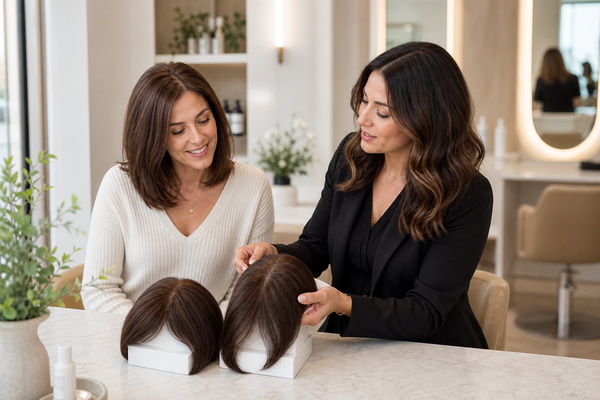
I never treat the price alone as a quality certificate. I first ask what the topper is made from, how much coverage it gives, how it was built, and what service comes with it.
How Much Does a Real Hair Topper Cost?
Real-hair toppers range from modest crown pieces to luxury systems. Without a clear comparison, a low price can look safer than it really is.
A real hair topper commonly costs about $300–$2,000 in ready-to-wear ranges. I usually see small or simple pieces near $300–$600, good mid-range toppers near $600–$1,500, and premium branded pieces above $1,500. Luxury European-hair designs can exceed $4,000.
A useful price range is better than a false average
I cannot give one honest “average cost” for every human hair topper because the category includes very different products. A 3-by-4-inch piece with short hair does not use the same materials or labor as a long, large-base topper with a realistic front. Current retail listings1 show human hair examples from the high-$200s to roughly $1,100. A larger branded premium example2 carries a list price above $2,000, although promotional prices can change. So I use $500–$1,500 as a practical shopping range for a good ready-to-wear human hair topper, not as an official industry average. I also compare the regular price, not only a temporary sale price.
| Market level | Approximate price | What I expect to inspect |
|---|---|---|
| Small or entry human hair piece | $300–$600 | Limited base area, shorter length, simpler finish |
| Good ready-to-wear topper | $500–$1,500 | Reliable human hair, usable parting, balanced density, secure base |
| Premium branded topper | $1,500–$3,500 | Larger coverage, refined front or top, better finishing, broader service |
| Luxury or custom topper | $3,000–$6,000+ | Rare hair, detailed handwork, special color, measurements, and fitting |
How much should a good high-quality human hair topper cost?
I would budget about $700–$1,500 for a strong mid-range choice, then move higher only when the extra features solve a real need. Published European-hair prices3 run from about $1,500 to more than $6,000 across sizes, lengths, colors, and constructions. That range shows why “high quality” is not one price point. I expect clean workmanship, a believable part, appropriate density, and hair that can be matched to the wearer. I also expect clear specifications and a realistic return or adjustment process. If a seller cannot explain the base, hair type, density, length, and color policy, I do not let a premium label justify a premium price.
Why Are Hair Toppers So Expensive—and Why Can One Cost More Than a Wig?
A topper uses less hair than a wig, so buyers expect it to cost less. That logic misses the precision needed for a small piece to disappear.
Hair toppers can be expensive because natural blending requires selected hair, a realistic base, careful knotting or ventilation, color work, and skilled finishing. A topper may cost more than a wig when it uses finer hair and more handwork, even though it covers less area.
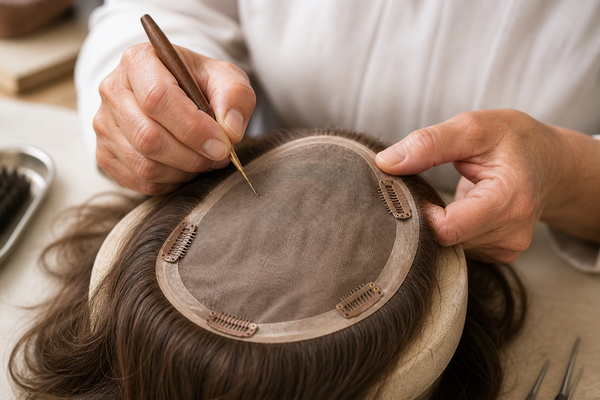
Small coverage can demand greater precision
I think of a topper as an integration product. A full wig can replace the entire visible head of hair, but a topper must meet the wearer’s own hair at every exposed edge. The color, root depth, texture, density, length, and movement all need to agree. That makes a small mismatch easy to see. The base also has to create a convincing scalp or part without looking bulky. In traditional hand knotting4, a maker attaches only a few strands at a time and controls the direction of the knots. That kind of work adds labor. The highest price still does not guarantee the best result, but fine hair selection and detailed construction can explain why a premium topper costs more than a basic machine-made wig.
| Cost driver | Why it raises the price | What I check |
|---|---|---|
| Hair quality and sorting | Consistent strands require selection and processing control | Feel, tangling, ends, color consistency, and supplier description |
| Base material | Lace, monofilament, silk-style tops, and skin materials create different effects | Part realism, comfort, durability, and repair options |
| Handwork | Fine knotting and finishing take skilled time | Knot visibility, hair direction, edge finish, and shedding |
| Color work | Dimensional shades need controlled blending or salon customization | Root, highlights, undertone, and match in natural light |
| Coverage and length | Larger bases and longer hair require more material | Whether the extra area or length is actually needed |
Human hair processing also affects value
I look beyond the label “100% human hair.” Hair can be bleached, dyed, straightened, coated, or mixed before it reaches a finished topper. Research on hair damage5 explains that chemical, thermal, and mechanical stress can harm the cuticle and weaken the fiber. That evidence does not grade a specific topper, but it explains why processing history matters. I prefer hair that looks good after gentle washing, not only under showroom coating. I also ask whether the piece can be colored, whether light shades were heavily processed, and what care temperature the maker recommends. A good supplier should give practical limits instead of promising that every human hair topper behaves like untouched biological hair.
Are Hair Toppers Worth the Money?
A topper can be beautiful and still become an expensive drawer item. I judge value by successful wear, not by the excitement of opening the box.
Hair toppers are worth the money when they provide the right coverage, stay comfortable, blend naturally, and fit the wearer’s daily routine. I would not buy one only because it is human hair or expensive; I would buy it because the total result works repeatedly.

I measure cost per successful wear
I use a simple test. I divide the total usable cost by the number of times I realistically expect the topper to be worn. The total should include the piece, shipping, tax, cutting, color work, and any future repair. A $1,200 topper worn 200 times costs $6 per wear before care costs. A $400 topper worn twice because the color and base are wrong costs $200 per wear. This method does not predict lifespan, because care, frequency, climate, processing, and construction all vary. It does expose the false economy of buying only by sticker price. I also count time. If the piece needs forty minutes of blending every morning, it may not suit a busy wearer even if the hair is excellent. Comfort and ease are part of value.
| Value question | A promising answer | A warning sign |
|---|---|---|
| Does the base cover the thinning area? | It extends slightly beyond the area into supportive hair | Clips sit on fragile hair or the base misses the area |
| Does the density blend? | The volume matches the wearer’s lengths and lifestyle | The top looks much fuller than the sides and ends |
| Can the color be matched safely? | The seller offers clear shades, samples, or professional help | The buyer must bleach a dark finished piece to make it work |
| Is the piece easy to wear? | Application feels secure and repeatable | The piece pulls, shifts, or needs constant adjustment |
| Is the purchase protected? | Terms explain returns, customization, and final-sale limits | The policy is vague or appears only after payment |
When I would spend more—and when I would not
I would spend more for a larger base when the wearer truly needs more coverage. I would also pay more for a natural front if the hairline will be exposed, or for expert color work when the biological hair has complex tones. I would not pay more for extreme length that will be cut off, dense hair that must be thinned heavily, or a branded feature that does not improve the wearer’s result. I also avoid treating a topper as medical treatment. It is a cosmetic hair solution. If the wearer has sudden hair loss, scalp pain, or rapidly changing thinning, I would separate the health question from the shopping decision and seek qualified medical advice first.
What Affects the Price of a Custom Hair Topper?
Custom pricing can feel unclear because several small decisions appear on one quote. I break the quote into materials, construction, finishing, and service.
A custom hair topper’s price depends on hair origin and length, base size and material, density, knotting method, color work, texture, measurements, fitting, and after-sales service. I expect every costly upgrade to connect to a visible, wearable, or service benefit.
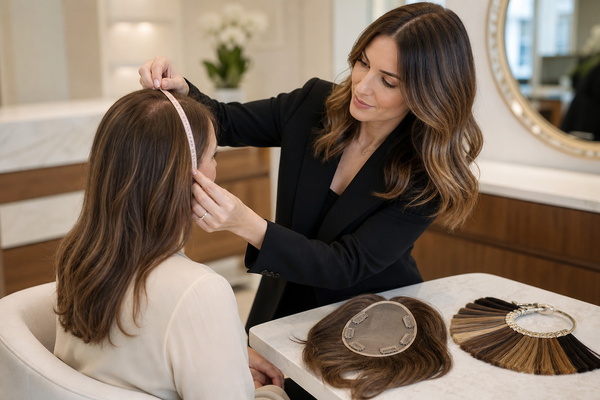
The base specification should follow the wearer
I start with coverage because it controls many later costs. A larger base uses more material and hair, but it can also distribute weight across a wider area. A small base can be lighter, yet it may fail if it clips inside the thinning zone. Manufacturer charts show that topper designs vary widely in base dimensions6, fiber, attachment, and coverage stage. I use that kind of specification as a starting point, not as a substitute for fitting. I then choose the front, parting area, perimeter, and attachment method. I want clips positioned on supportive natural hair and hidden beneath the finished topper. If clips are unsuitable, I ask a trained provider about alternatives rather than improvising adhesive use.
| Custom choice | Typical effect on price | Question I ask before approving it |
|---|---|---|
| Longer hair | Uses longer, scarcer strands and more finishing time | Will I keep this length after cutting and blending? |
| Larger base | Uses more base material, hair, and labor | Does my coverage area require it? |
| Lower or graduated density | Can require more controlled ventilation and design | Will it blend with my own side and back density? |
| Lace or realistic front | Adds delicate construction and detailed knot work | Will I expose the front hairline? |
| Dimensional custom color | Adds formulation, testing, and stylist time | Can a stock shade or gentle deposit-only adjustment work? |
| Curl or texture matching | Adds processing or custom selection | Will the texture stay compatible after washing? |
| Rush production | Compresses workshop scheduling | Is the deadline worth the surcharge? |
A custom quote should be specific enough to compare
I ask for the final base measurements, hair length, density, color, texture, parting design, front construction, attachment method, production time, and remake policy in writing. I also ask which changes are included after delivery. A lower quote may exclude cutting, blending, color correction, shipping, or future repairs. A higher quote may include those services and become the better total purchase. I never compare two custom prices until the specifications match. I also ask what happens if the color differs from the approved sample or the base differs from the confirmed measurements. Clear tolerances and approval steps protect both the buyer and the maker. Good customization should reduce uncertainty. It should not turn every basic specification into an unexplained surcharge.
Conclusion
I would expect a good human hair topper to cost about $500–$1,500, with premium and custom options rising much higher. The best value comes from correct coverage, believable blending, sound construction, and clear service—not the lowest or highest price.
References
Findingdream lists current human hair topper prices and specifications across several base types. ↩
Wigs.com lists the price and construction of a branded Remy human hair topper. ↩
Follea lists European-hair topper prices by size, length, color, and construction. ↩
Wikipedia explains hand-knotting hair to a lace foundation a few strands at a time. ↩
PMC reviews hair-fiber structure and damage from chemical, thermal, and mechanical stress. ↩
Jon Renau compares topper base sizes, fibers, attachment options, and coverage stages. ↩