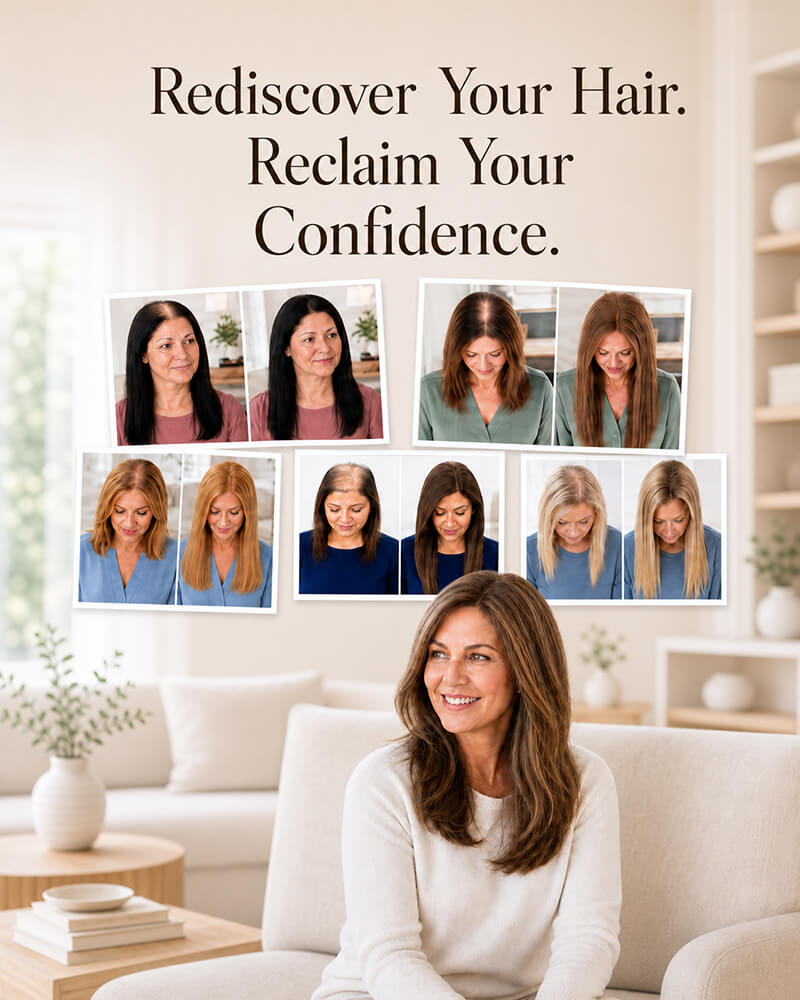

A wedding hairstyle must look natural from every angle, but the wrong topper can feel bulky, expose its edge, or shift during a long celebration.
A wedding hair topper should cover the thinning area, match the bride’s hair color and density, and support the chosen hairstyle without visible edges or uncomfortable tension. I recommend selecting the topper before the final hairstyle and completing a full trial with the veil and accessories.
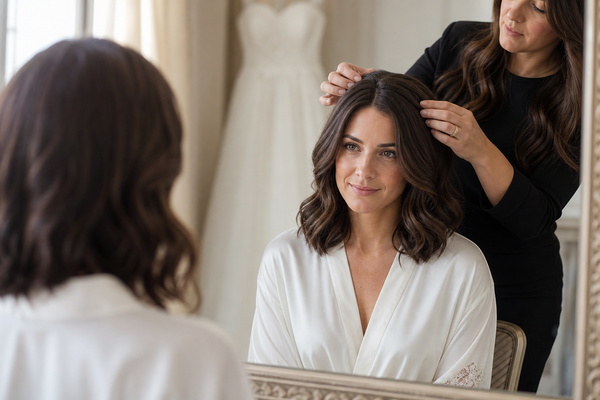
I believe a bride should be able to forget about her topper once the ceremony begins. That confidence comes from planning, not from adding more pins at the last minute. I first decide what area needs coverage. Then I match the base, hair length, density, color, and attachment method to the bridal style. The final step is a realistic rehearsal that includes movement, photographs, accessories, and enough wear time to reveal any pressure points.
How Do I Choose the Right Hair Topper for My Wedding?
A beautiful topper can still disappoint if its base misses the thinning area or its density looks different from the bride’s natural hair.
The right wedding hair topper fully covers the thinning zone, reaches stable attachment hair, and matches the bride’s root color, lengths, texture, and natural density. I also choose a base and hair type that can support the planned part, waves, veil, and accessories.
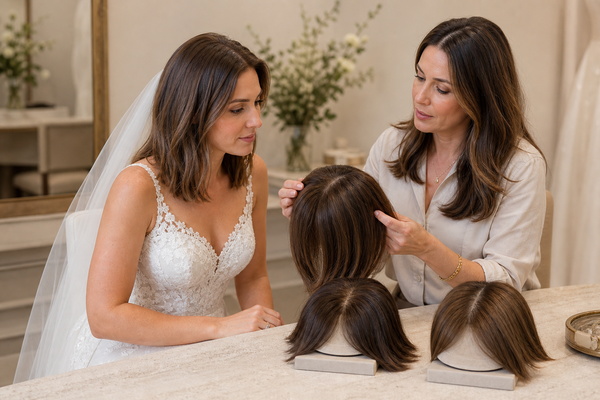
I start with coverage and stable attachment hair
I measure the visible thinning area from front to back and side to side. Then I choose a base that extends beyond that area into stronger hair. A topper that is exactly the size of the sparse patch may force every clip to grip fragile strands. A very large topper can add unnecessary weight and may limit the hairstyle. Dermatology guidance describes hairpieces1 as partial additions that can be attached to existing hair or the skin to create a fuller appearance. For a wedding, I also check the front edge, because a piece that begins behind the natural hairline works differently from a front-coverage topper. I look down at the part, view both profiles, and photograph the crown under daylight before approving the size.
I match roots first, then lengths, density, and texture
I match the topper where it begins, not only at the ends. Root color matters because the topper sits beside the bride’s natural part and crown. If the lengths are highlighted, balayaged, or warmer than the roots, I compare all three zones. I also avoid choosing more density than the hairstyle needs. Bridal curls can expand the visual volume, so an overly dense topper may become heavy or look separate after curling. Texture matters too. A straight topper can be waved, but the finished curl pattern should move with the natural hair. When someone searches for a “wedding hair topper for girls,” I use the same fitting process I use for any adult bride: I choose by coverage, attachment hair, color, texture, and style—not by an age label or a generic product name.
| Selection point | What I check | Wedding-day reason |
|---|---|---|
| Base coverage | The base extends beyond the thinning area | Prevents visible gaps around the crown or part |
| Attachment zone | Clips reach stable hair, not the weakest strands | Improves comfort and security |
| Root color | The topper root matches the natural part in daylight | Keeps the blend believable from above |
| Density | Added hair matches the bride’s natural fullness | Prevents a bulky or wig-like finish |
| Length and texture | The topper blends into the planned waves or updo | Makes the hairstyle read as one head of hair |
Can a Silk Hair Topper Work for a Wedding or Special Event?
Silk tops can create a convincing part, but choosing one only because it sounds premium may produce more thickness than the hairstyle needs.
A silk hair topper can work beautifully for a wedding when its scalp-like part, base size, color, and density suit the bride. Silk bases are usually more opaque and structured than fine lace, so I test the profile and edge carefully before choosing one for a sleek bridal style.
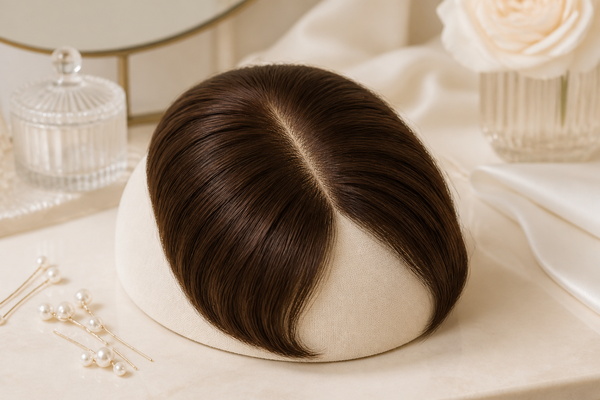
Silk refers to the base construction, not the hair fiber
I separate the base from the hair attached to it. A silk top may carry human hair or another fiber, so the words “silk topper” do not automatically tell me how the hair can be curled. A clinical review describes a silk base2 as a two-layer structure with silk over thicker lace. Its opaque surface can hide knots and imitate scalp, but the added thickness may create more height than a delicate lace base. The review also explains that monofilament construction supports flexible parting and that human-hair prostheses offer styling versatility. For a wedding, I compare the actual piece rather than relying on the material name. I check whether the part looks realistic, whether the edge disappears, and whether the base remains comfortable for several hours.
I choose the fiber according to the planned styling
I prefer a quality human-hair topper when the bride wants custom waves, smooth bends, or detailed bridal shaping because it usually offers more styling flexibility. I still use heat protectant and the lowest effective temperature, and I test a hidden strand first. A synthetic topper may be a good choice when its preset style already matches the bridal look, but I never assume it can take heat. The American Cancer Society advises against using heated tools unless a wig is heat-resistant3. I follow the manufacturer’s care instructions for the specific topper, and I ask the supplier before applying heat when the fiber or previous color treatment is unclear.
| Topper option | Bridal advantage | What I test before choosing |
|---|---|---|
| Silk top | Opaque, scalp-like part with hidden knots | Base thickness, edge visibility, scalp-tone match |
| Monofilament top | Flexible parting and natural hair movement | Parting area, knot visibility, density |
| Lace top | Fine, lightweight appearance | Delicacy, edge placement, handling needs |
| Human hair | Greater freedom for custom bridal styling | Color history, heat response, curl hold |
| Heat-safe synthetic | Preset style with lower styling demand | Confirmed heat rating and manufacturer instructions |
What Type of Topper Works Best With Bridal Hairstyles?
A topper may look perfect when worn down but reveal its perimeter when the hair is swept back, braided, or lifted for the ceremony.
The best topper for a bridal hairstyle has a base small enough to leave usable natural hair around its perimeter, but large enough to cover the thinning area. The hair length and density should support the chosen down style, half-up look, braid, or low updo.
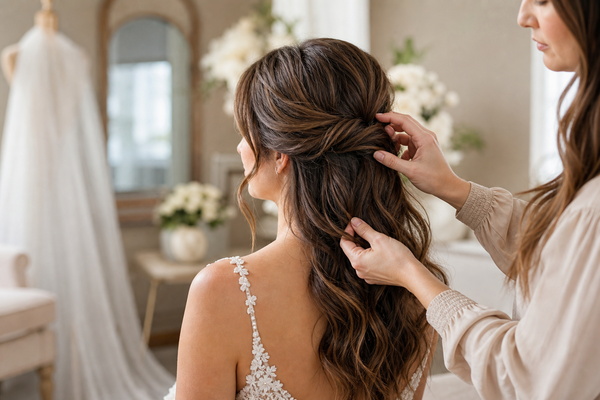
I choose the topper and hairstyle as one system
I do not select the topper first and ask the stylist to make every inspiration photo work afterward. I bring the hairstyle reference into the fitting. For loose waves, I want enough topper length to disappear into the natural hair without a shelf. For a half-up style, I need flexible hair at the crown and enough natural perimeter hair to soften the base edge. For a side part, the topper must offer usable parting in the correct direction. For a braid or textured twist, I check whether the topper hair can be divided without exposing the base. Veil placement also matters. A comb should enter a secure section of styled hair, not press directly into a delicate base or pull against one clip. I plan decorative pins, crowns, and headbands at the same time so they support the look without hiding a fitting problem.
I keep the finished density believable from every angle
Wedding styling often includes curl, backcombing, padding, and accessories. Each step can make the topper look fuller, so I begin with realistic density. I ask the stylist to photograph the finished look from the front, both sides, the back, and directly above. I also use phone flash because flash can reveal a color difference, an overly straight part, or visible lace that soft salon light hides. If the topper looks tall, I do not flatten it by tightening the clips. I reassess the base, ventilation direction, or amount of hair. A topper that blends naturally in motion is more convincing than one that looks perfect only in a still front-facing photograph. I also check how face-framing pieces connect to the topper so the bride can move, hug guests, and turn her head comfortably.
| Bridal hairstyle | Topper feature I prioritize | Common fitting issue |
|---|---|---|
| Loose waves | Matching length, texture, and moderate density | Topper ends form a visible shelf |
| Half-up style | Flexible crown hair and natural perimeter hair | Base edge appears when hair is lifted |
| Side-swept style | Parting freedom and secure side blend | Forced part exposes knots or base material |
| Textured braid | Enough length with controlled density | Dividing hair reveals the topper base |
| Low chignon | Strong lower blend and flexible perimeter | Pulling too tightly concentrates tension |
Can a Hair Topper Be Styled Into a Bridal Updo?
A dramatic updo can expose the base or pull against the clips if the topper was designed mainly for loose, downward styling.
A hair topper can be styled into many bridal updos, especially low buns, chignons, French twists, and soft half-up styles. I avoid forcing a topper into a very high or tight updo unless its base, ventilation direction, attachment points, and perimeter blend were designed and tested for it.
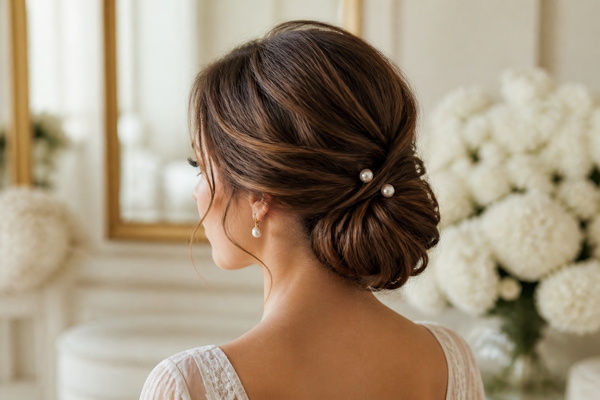
Low and softly structured updos are usually easier
I usually begin with a low chignon, soft twist, or textured bun because these styles follow the natural downward direction of most topper hair. The stylist can blend the topper lengths with the natural hair and build the shape near the nape without lifting every perimeter strand. A half-up style is another useful option because it creates bridal detail while leaving enough hair down to conceal the base. I prefer pins placed into the combined styled hair rather than through a delicate lace or silk area. If extra padding is needed, I keep it below the topper and distribute it through stronger natural hair. I also avoid cutting short layers solely for one updo unless the bride will still like the topper afterward. A wedding style should not reduce the piece’s value for future wear.
I never trade comfort for a tighter-looking finish
I test the updo with the bride turning, bending, sitting, and gently shaking her head. If the style shifts, I correct the structure instead of pulling the hair tighter. The American Academy of Dermatology explains that repeated pulling can cause traction alopecia4 and lists tightly pulled buns and updos among the styles that can create damaging tension. Pain, stinging, scalp tenting, or a headache means I stop and loosen the style. Decorative combs should not press into the scalp or act as the main anchor for the topper. I want several gentle support points, a balanced hairstyle, and a secure fit that does not depend on one tight section of fragile hair.
| Updo type | Suitability for many toppers | My fitting priority |
|---|---|---|
| Low chignon | Often suitable | Keep the base perimeter covered and tension low |
| Soft French twist | Often suitable | Blend topper and natural lengths before pinning |
| Half-up twist | Very versatile | Leave enough perimeter hair to soften the base |
| High bun | Depends on topper construction | Check upward hair direction and exposed edges |
| Sleek, tight updo | Higher-risk choice | Avoid concentrated pulling and visible base lines |
How Do I Secure a Hair Topper for an All-Day Wedding?
A topper that feels secure for ten minutes may create pressure, slipping, or exposed edges after hours of photos, dancing, and accessory changes.
I secure a wedding topper by fitting it to stable hair, balancing the attachment points, and testing the complete style for several hours before the wedding. The topper should survive gentle movement without pain. I also rehearse the veil, headpiece, weather plan, and removal method.
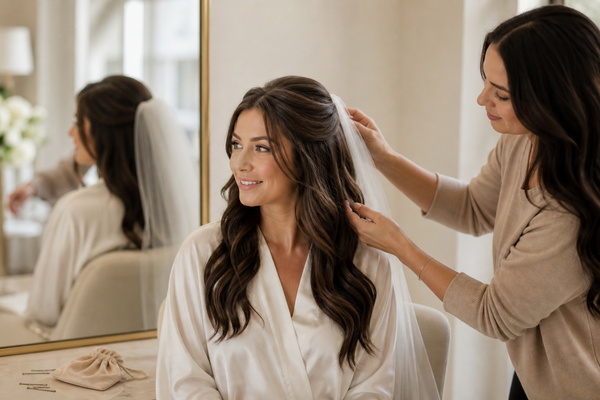
I build security through fit instead of extra force
I begin with clean, dry anchor hair and a topper base that reaches beyond the sparse zone. I close each clip onto a small, stable section without pulling the surrounding hair tight. I do not stack veil combs, decorative pins, and topper clips on the same weak area. Macmillan Cancer Support explains that a well-fitting piece should stay in place and notes that clips may secure a hairpiece when suitable natural hair is available. It also suggests a gentle bend-and-shake check for a secure fit5. I use that as one test, not as permission to shake aggressively. If clips are unsuitable because the anchor hair is too fine, I ask a qualified topper specialist to recommend a compatible alternative rather than improvising with strong glue or excessive pins.
I schedule a realistic trial before the wedding
I recommend the first full topper and hairstyle trial about six to ten weeks before the wedding. I schedule it earlier when the topper needs custom color, cutting, a replacement base, or international delivery. The bride should bring her veil, headpiece, earrings, and hairstyle references. I photograph the result in daylight, indoor light, and flash. I also ask her to wear the style for several hours, turn her head, bend, hug, and walk briskly. A final short rehearsal one or two weeks before the wedding can confirm the part, curl pattern, accessory placement, and clip map. On the wedding day, I keep a small kit with matching pins, a wide-tooth comb, a travel-size approved finishing product, and the topper specialist’s removal instructions. I never introduce a new adhesive or attachment method that morning.
| Trial step | What I test | What a problem may reveal |
|---|---|---|
| Initial fitting | Coverage, base size, clip locations | The topper is too small, heavy, or poorly positioned |
| Full styling | Curl hold, updo structure, perimeter blend | The chosen style conflicts with the base |
| Veil and accessories | Comb pressure and removal sequence | Accessories overload one attachment point |
| Movement test | Turning, bending, hugging, gentle shaking | The fit shifts or the hairstyle exposes an edge |
| Extended wear | Comfort after several hours | A clip or pin creates concentrated pressure |
| Photo test | Daylight, indoor light, and flash | Color, density, lace, or parting looks inconsistent |
Conclusion
A wedding topper works best when planned as part of the complete bridal style.
I prioritize coverage, comfort, natural density, and balanced attachment. Then I test the topper with the hairstyle, veil, accessories, photographs, movement, and extended wear so the bride can enjoy her wedding without monitoring the piece.
References
DermNet describes partial hair additions and the ways they may attach to existing hair or skin, which supports choosing coverage and attachment according to the wearer’s available hair. ↩
Wiley reviews silk and monofilament foundations plus hair fibers, noting silk’s thicker scalp-like structure, monofilament’s parting flexibility, and human hair’s styling versatility. ↩
American Cancer Society advises avoiding dryers and curling irons unless the hairpiece is heat-resistant, which is an important check before styling synthetic fibers. ↩
AAD explains that repeatedly tight buns and updos can cause traction alopecia and identifies pain, stinging, scalp tenting, and broken hairs as warning signs. ↩
Macmillan explains that a well-fitting hairpiece should remain secure and suggests suitable clips plus a gentle bend-and-shake check when natural anchor hair is available. ↩