

A human hair topper can turn dry, tangled, or loose at the base when I wash it like ordinary hair. A gentle routine protects the investment.
I wash a human hair topper off the head with cool water, topper-safe shampoo, and conditioner kept away from the base. I detangle from the ends upward, blot instead of wringing, follow the maker’s drying instructions, and store the topper only when it is completely dry.
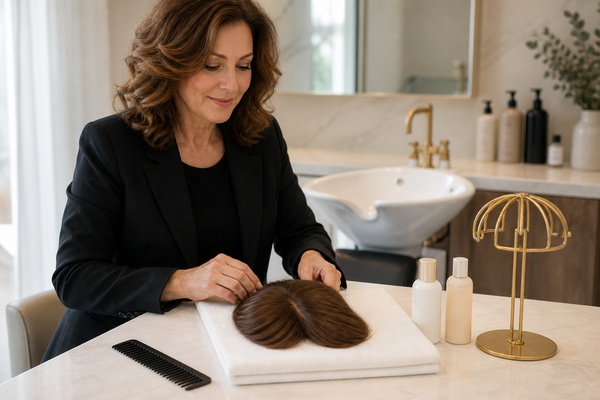
I treat the hair, base, knots, and clips as one delicate system. The correct routine cleans the strands without trading softness for unnecessary shedding or base damage.
How Do You Wash a Human Hair Topper?
Rubbing, twisting, or washing in random directions can create tangles before the topper is clean. I use an orderly process that keeps every movement controlled.
I remove the topper, close its clips, detangle it dry, and rinse from base to ends with cool water. I smooth a small amount of shampoo downward, rinse completely, condition only the mid-lengths and ends, rinse again, blot with a towel, and dry it according to its manufacturer’s instructions.
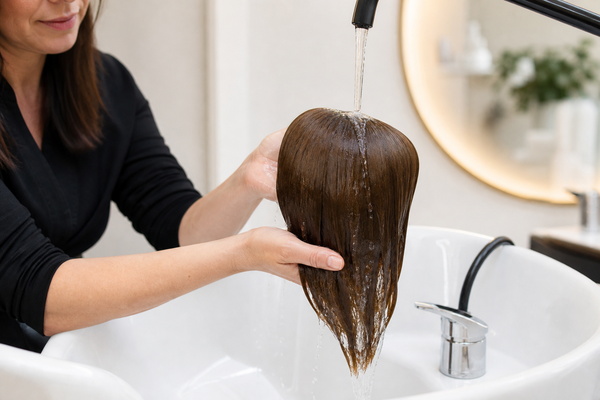
My controlled washing sequence
I begin by checking the care label because washing instructions can vary by brand and base construction. Some makers require cool running water and specifically warn against soaking. I place one hand beneath the base, keep the hair flowing in one direction, and use the other hand to smooth water and product down the strands. The The hair cuticle1 is the fiber’s protective outer layer and consists of overlapping scale-like cells. is the fiber’s protective outer layer and is formed by overlapping cells that point toward the tip. That structure is why I keep water and product moving downward instead of roughing the scales in opposing directions. I never scrub the hair into the base or pile the lengths on top. I rinse until the water is clear because leftover product can make the hair heavy or dull. I press out water with my palms, lay the topper on a clean towel, and blot it. I also inspect the clips, perimeter, and knots while the piece is clean, but I do not pull or scratch at hand-tied areas.
| Step | What I do | What I avoid |
|---|---|---|
| Prepare | Close clips and detangle dry | Washing while the hair is knotted |
| Wet | Direct cool water from base to ends | Hot water or random swishing |
| Cleanse | Smooth shampoo downward | Scrubbing, rubbing, or twisting |
| Condition | Apply to mid-lengths and ends | Coating the base or knots |
| Finish | Rinse, press, and towel-blot | Wringing the topper |
Can I Wash a Hair Topper?
Many first-time wearers fear that water will ruin their topper. Avoiding washing completely, however, allows oil and styling residue to keep building.
Yes, I can wash a washable human hair topper after removing it from my head. I first read the product instructions because hand-tied, silk, lace, monofilament, polyurethane, bonded, and semi-permanent systems may need different handling. I send an attached or professionally bonded system to its maintenance provider.
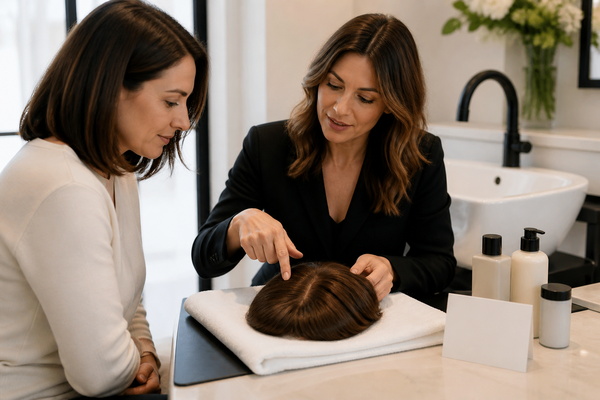
I identify the system before adding water
I separate a removable clip-in topper from a bonded hair system. A removable topper is normally washed away from the scalp. A semi-permanent system can involve adhesives, tapes, sewn attachments, or a service schedule, so I follow the installer’s instructions instead of removing or soaking it at home. I identify the base before the first wash. The National Alopecia Areata Foundation explains that in hand-tied construction2, individual hairs are tied throughout the cap; it also distinguishes this construction from monofilament and wefted designs. I keep the receipt and care card nearby during that first wash. If a new topper suddenly mats, releases excessive color, sheds heavily, stretches, or changes at the base, I stop and contact the retailer before experimenting with more products. Water itself is not the main problem. The greater risks are using the wrong method, ignoring the construction, and continuing after an unusual reaction appears.
| Topper situation | My decision | Next action |
|---|---|---|
| Removable human hair topper | Wash off the head | Follow its care label |
| New topper, first wash | Use extra caution | Watch for unusual matting or shedding |
| Bonded or sewn-in system | Do not remove casually | Follow the installer’s service plan |
| Unknown fiber or base | Pause before washing | Ask the seller or manufacturer |
How Often Should I Wash My Human Hair Topper?
Washing too often can add wear, while waiting too long allows oil and product residue to collect. I use condition and wear habits as my guide.
I usually wash a human hair topper every 6–8 wears, then adjust for scalp oil, sweat, odor, smoke, styling-product buildup, and the manufacturer’s instructions. I wash sooner when the hair feels coated or the base needs cleaning, but I do not wash automatically after every wear.
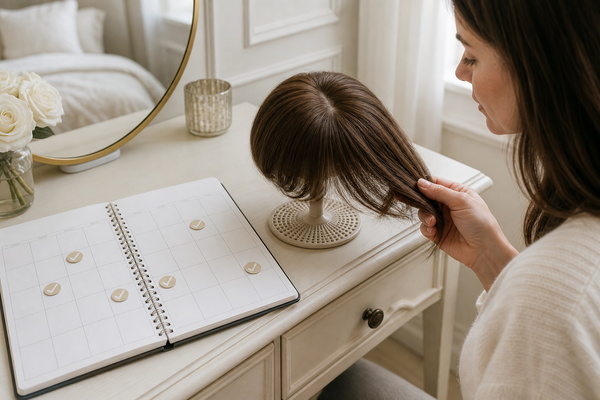
I watch the topper instead of only counting days
Six to eight wears is a practical starting point, not a rule that overrides the product card. My actual schedule changes with the wearer. A topper worn for long summer days may collect more perspiration and oil than one worn for a few hours in a cool office. Heavy root spray, dry shampoo, hairspray, or silicone serum can also shorten the interval. Microscopic hair-surface research documents surface deposits3 from sebum, shampoos, conditioners, and styling products, which helps explain why feel and visible buildup matter more than a fixed calendar. I wash when the hair no longer moves freely, the base feels oily, the style will not refresh, or the topper has absorbed an odor. I do not use more dry shampoo to hide unlimited buildup because every added layer must eventually be removed. Between washes, I handle the topper with clean hands, use only a small amount of product, and keep the wearer’s scalp and natural hair clean. These habits can reduce unnecessary washing without neglecting hygiene.
| Wear condition | Likely wash timing | My reasoning |
|---|---|---|
| Light indoor wear | Around 6–8 wears | Normal starting interval |
| Hot weather or exercise | Earlier as needed | Sweat and oil collect faster |
| Heavy styling products | Earlier as needed | Buildup affects movement and shine |
| Occasional short wear | Later if still clean | Avoid washing only by calendar |
What Shampoo Should I Use on a Hair Topper?
A strong household shampoo may remove buildup, but it can also leave processed topper hair rough. I choose a cleanser for alternative or color-treated human hair.
I use the shampoo named by the topper manufacturer or a gentle, moisturizing shampoo made for alternative human hair. A sulfate-free, color-safe formula is often suitable when the maker approves it. I avoid harsh clarifying, medicated, volumizing, and heavy residue-producing formulas unless a topper specialist recommends them.
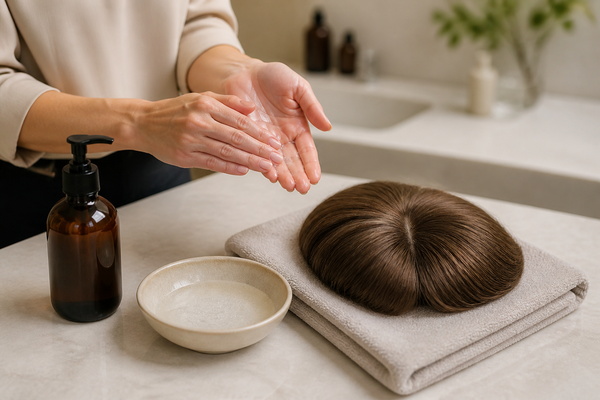
I choose compatibility before marketing claims
Human hair in a topper may have been lightened, colored, sorted, and attached to a delicate base. I therefore do not assume that the shampoo used on the wearer’s growing hair is automatically suitable. Shampoos clean mainly through surfactants4, molecules with oil-attracting and water-attracting regions that help lift sebum and residue into the rinse water. Different surfactant systems can cleanse with different levels of strength, so “sulfate-free” alone does not prove that a formula suits every topper. I check the exact topper instructions because the maker’s tested system is the safest reference. I look for a mild cleanser that supports processed or color-treated human hair and rinses clean with a small amount. I do not pour concentrated shampoo directly onto one spot of the base. I emulsify it in my hands first and smooth it through the hair. I use a clarifying shampoo only with professional guidance because aggressive cleansing can change the feel or color. Purple shampoo also needs a strand test because porous blonde hair may absorb tone unevenly. The right bottle matters, but gentle technique matters just as much.
| Shampoo type | My usual choice | Caution |
|---|---|---|
| Manufacturer’s human-hair shampoo | First choice | Follow the stated amount and method |
| Gentle color-safe shampoo | Possible alternative | Confirm base and color compatibility |
| Purple shampoo | Only when needed | Strand-test porous blonde hair |
| Clarifying or medicated shampoo | Usually avoid | May be too aggressive for processed hair |
Can I Use Regular Conditioner on a Hair Topper?
Conditioner can soften dry lengths, but slippery product at the base may affect knots or attachment materials. Placement is more important than using a large amount.
I can use a lightweight, color-safe conditioner only when the topper manufacturer permits it. I apply a small amount from the mid-lengths to the ends and keep it away from the base, knots, clips, lace, silk, and polyurethane. A dedicated alternative-hair conditioner remains my safest choice.
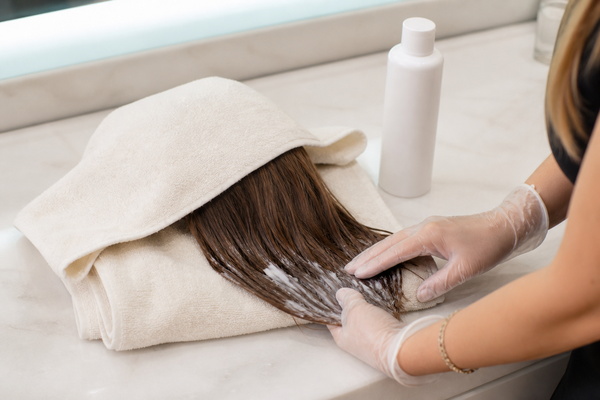
I condition the hair without coating the construction
I read the ingredient and care instructions instead of treating every conditioner as interchangeable. A rich mask may make biological hair feel soft, but it can weigh down fine topper hair or leave residue that attracts dirt. Many cationic conditioners5 deposit positively charged molecules onto negatively charged, damaged hair. This can flatten the cuticle, reduce static, and improve smoothness, but it does not make base placement irrelevant. I use my fingers to distribute a modest amount through the mid-lengths and ends and keep a clear safety zone around knots, clips, lace, silk, and polyurethane. I follow the product’s processing time and rinse completely. I do not leave an ordinary rinse-out conditioner on as a leave-in product. If the ends remain dry, I use a tiny amount of approved leave-in care after towel-blotting rather than coating the topper again. I also separate protein treatments from moisture care. Too much protein can leave some processed hair stiff, so I reserve restorative treatments for the schedule recommended by the topper maker or specialist.
| Product | Where I apply it | My rule |
|---|---|---|
| Rinse-out conditioner | Mid-lengths and ends | Keep away from the base |
| Deep conditioner | Dry lower lengths | Use only at the recommended interval |
| Leave-in conditioner | Lightly on lower hair | Avoid buildup and roots |
| Oil or shine serum | Tiny amount on ends | Never saturate knots or clips |
Should I Air-Dry or Blow-Dry a Hair Topper?
Air-drying seems gentler, but some human-hair systems look better after controlled blow-drying. The base construction and maker’s directions decide the safest order.
I let the base dry as its manufacturer directs, often flat on a colorfast towel or on a ventilated stand. I air-dry for a relaxed texture when approved. For a polished finish, I use heat protectant and controlled blow-drying on small sections, keeping direct heat away from the base.
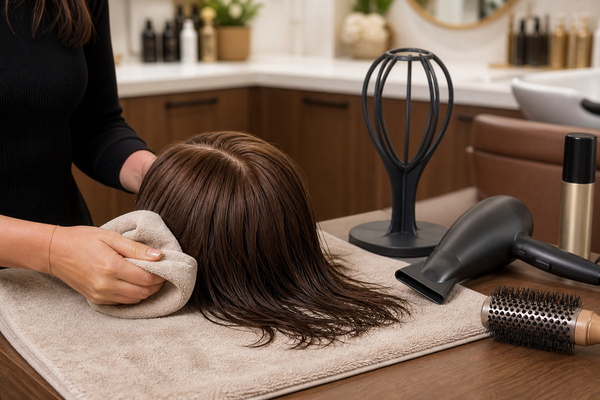
I separate base drying from hair styling
I first blot the topper with a towel and support its shape without stretching it. A delicate hand-tied hairpiece may need to dry flat, while another topper may be approved for a ventilated stand. I avoid placing a wet, flexible base under tension on a solid mannequin unless the maker specifically allows it. Research on thermal damage6 shows that excessive heat can alter both the cuticle and the inner cortex of human hair. When I blow-dry, I therefore use heat protectant, a nozzle, small sections, and the lowest effective setting. I direct airflow down the hair shaft and keep the dryer moving. I do not concentrate heat on lace, silk material, polyurethane, clips, or knots. I also make sure the topper is fully dry before storage because trapped moisture can create odor and distort the style.
| Drying goal | My method | Important caution |
|---|---|---|
| Protect a delicate wet base | Dry flat or as directed | Do not stretch it on a solid form |
| Keep a relaxed texture | Air-dry when approved | Support the topper and allow airflow |
| Create a polished finish | Controlled blow-dry | Use heat protectant and small sections |
| Prepare for storage | Dry completely | Never store damp hair or base material |
How Do I Store a Hair Topper When Not Wearing It?
A clean topper can still develop bends, dust, tangles, or stretched material in poor storage. I put it away only after it is dry and detangled.
I store a completely dry human hair topper on a topper stand, in a satin bag, or flat in a box according to its construction. I close the clips, arrange the hair smoothly, protect the part and front edge, and keep it away from sunlight, humidity, heat, pets, and dust.
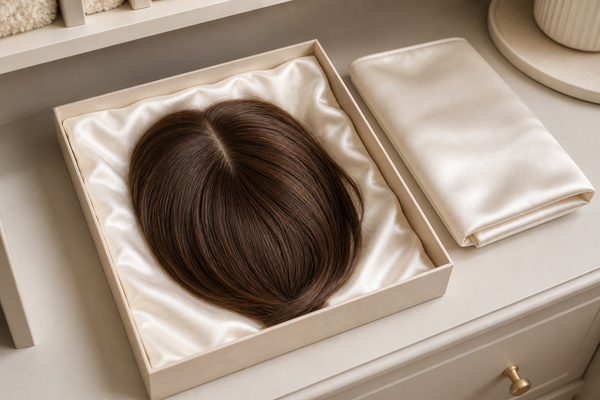
I protect the shape without stretching the base
I choose storage based on the topper’s size and base flexibility. A small topper can sit on a purpose-made topper stand, rest flat in a shallow box, or lie in a satin bag for travel. Human hair undergoes moisture sorption7, meaning the fiber takes up and releases water in response to its environment. That is one reason I let a topper dry completely before enclosed storage. I avoid forcing a petite base over a large mannequin because constant tension may change its shape. Before storage, I detangle the ends, arrange the part, close every snap clip, and make sure no hair is caught in the teeth. I place tissue inside or around the piece only when it supports the style without pressing the hairline. I never seal a damp topper inside plastic. For long-term storage, I use a clean, dry, dark area and check the piece occasionally. I also keep the topper away from perfume spray, kitchen grease, cigarette smoke, direct sun, and curious pets.
| Storage option | Best use | What I check |
|---|---|---|
| Topper stand | Daily access | Correct size and no base stretching |
| Satin bag | Travel or compact storage | Hair is dry and clips are closed |
| Flat box | Delicate or long-term storage | No pressure on the front or part |
| Open bathroom shelf | Not recommended | Humidity, dust, and product spray |
How Do I Detangle a Hair Topper Without Shedding?
Pulling a knot from the root transfers force to the base and hand-tied knots. I remove tangles in small sections while supporting the hair above them.
I detangle a human hair topper from the ends upward with my fingers, a wide-tooth comb, or the brush approved by its maker. I hold each section above the tangle, use short gentle strokes, avoid scraping the base, and stop when a knot needs detangler or professional help.
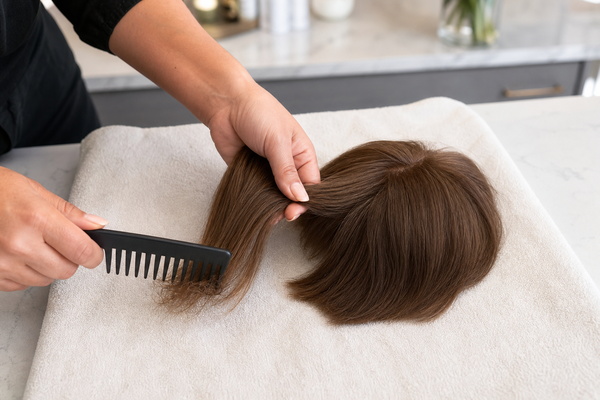
I reduce tension instead of pulling harder
I place the topper on a clean surface or support it securely without stretching the base. I divide long hair into sections and hold one section several inches above the ends. Then I release the smallest tangles first. Controlled studies of combing breakage8 show that knots, repeated comb strokes, conditioning, bleaching, and whether hair is wet or dry can affect how strands break. I therefore use short strokes and move higher only after the lower section is smooth. I do not rake a brush from the part to the ends in one pass. On damp hair, I follow the maker’s tool rule because some brands specify a wide-tooth comb instead of a brush. I add a small amount of approved detangler to the lower lengths when needed, but I keep it away from the base. I also inspect the nape and shoulder area after each wear because friction can create small tangles that become difficult later. No routine can promise zero shedding, but gentle support and early detangling reduce avoidable pulling.
| Detangling action | Why I use it | What I avoid |
|---|---|---|
| Divide into small sections | Keeps tension controlled | Handling all the hair at once |
| Start at the ends | Releases knots gradually | Pulling from the root downward |
| Hold above the tangle | Protects the base and knots | Letting force reach hand-tied areas |
| Use approved detangler | Adds slip where needed | Spraying the base or soaking the hair |
Conclusion
I keep a human hair topper clean with cool water, compatible products, gentle downward movements, careful drying, and protected storage. I follow the maker whenever methods differ. Small habits—especially keeping conditioner off the base and detangling from the ends—help prevent avoidable damage.
References
Wikipedia defines the hair cuticle as the hair shaft’s protective outer layer. ↩
The National Alopecia Areata Foundation explains hand-tied, monofilament, lace-front, and wefted cap construction. I include this professional organization’s guide to define hand-tied construction before discussing washing differences. ↩
Hair Surface Quality, indexed by the U.S. National Library of Medicine, examines deposits from sebum and hair-care products on the hair surface. I include it to define the buildup that can influence wash timing. ↩
Shampoo and Conditioners: What a Dermatologist Should Know, archived by the U.S. National Library of Medicine, defines surfactants and describes their cleansing action. I include it to explain the shampoo term rather than endorse a commercial formula. ↩
On Hair Care Physicochemistry classifies cationic conditioners and explains how their positive charge interacts with damaged hair. I include it to define the conditioner type and its function on the hair surface. ↩
Thermal Induced Changes in Cuticle and Cortex, a scientific article archived by the U.S. National Library of Medicine, examines heat-related structural changes in human hair. I include it to explain thermal damage. ↩
Learning from Hair Moisture Sorption and Hysteresis, indexed by the U.S. National Library of Medicine, analyzes how human hair takes up and releases moisture. I include it to define moisture sorption and support fully drying a topper before enclosed storage. ↩
Hair Breakage During Combing, indexed by the U.S. National Library of Medicine, examines wet and dry combing, repeated strokes, knots, bleaching, and conditioning. I include it to explain combing breakage and the value of controlled detangling. ↩