

Many hair extension systems solve a large problem. We kept meeting women who needed a thoughtful answer for a much smaller, easily overlooked area.
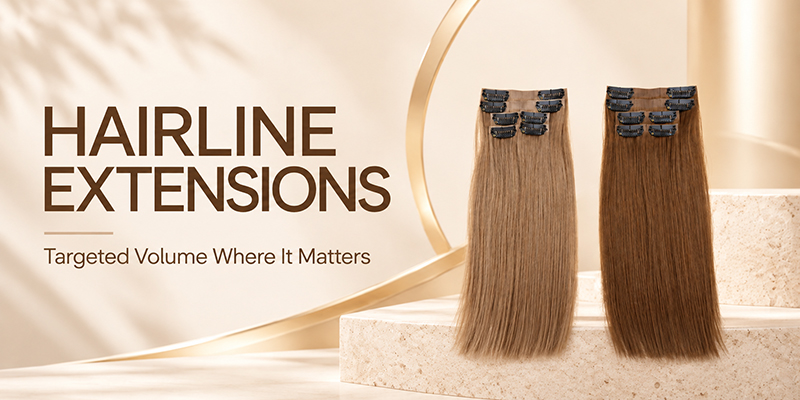
Findingdream created Hairline Extensions to add targeted fullness around the front, temples, and sides without requiring a full extension set. We built the product around a simple idea: use smaller, lighter pieces where conventional extensions can feel excessive or difficult to conceal.
This is not only the story of a new product. It is the story of how we listen, define a narrow need, and turn that need into a practical design.
What Gap Did We See in the Hair Extension Market?
When only the temples or front sides look less full, a large extension system can add more hair, weight, and complexity than the wearer wants.
We saw a gap between traditional clip-in extensions and larger hairpieces. Our customers needed local fullness near the face, but many available products were designed for overall length, broad volume, or top coverage rather than a small hairline area.
We saw a small problem being answered with large products
At Findingdream, we work with hair toppers, wigs, and several types of hair extensions. Each category has a clear purpose. A topper can provide broader coverage across the part or crown. A traditional clip-in set can add length and volume through the sides and back. But neither product automatically becomes the best answer when our customer only wants to improve the visual balance around her temples.
We kept returning to the same question: why should a small area require a full system? If our customer wants only a little more density near her face, adding several wide wefts may create unnecessary bulk. Wider pieces can also be harder to conceal when the natural hair in that area is fine. A larger hairpiece may provide more coverage than she wants. The problem was not a lack of products. The problem was a lack of proportion between the product and the area it needed to serve.
That observation changed our starting point. We stopped asking how to adapt a conventional extension set. We began asking what we would design if the front hairline and temples were the starting point from the very beginning.
How Did We Turn That Gap into a Design Brief?
A product can look promising on a display and still feel wrong in daily life. We needed clear priorities before we considered length, color, or presentation.
We built our design brief around four priorities: targeted placement, low visual bulk, flexible piece selection, and simple daily removal. Every feature had to help the product serve a small area without behaving like a full-head extension system.
We designed around location, visibility, and control
We first defined where the product would sit. The front sides, temples, and areas above the ears behave differently from the back of the head. These areas are more visible, the natural cover hair may be finer, and even a small mismatch in density can look obvious. So we could not simply reduce the length of an ordinary wide weft and call the job finished.
We wanted each wearer to control both placement and quantity. One customer may need a small piece behind each temple. Another may want more balance along the sides. A fixed one-piece format would limit that control, while a conventional full set could bring back the same excess we were trying to remove. We therefore treated the product as a set of small tools rather than one dramatic transformation.
Our design decisions followed this logic:
| What we observed | Our design response | The experience we wanted |
|---|---|---|
| The concern is often limited to a small area | Use narrow, targeted pieces | Add hair only where it is useful |
| Fine cover hair can reveal a bulky edge | Keep the attachment profile discreet | Create a smoother blend near the face |
| Both temples and longer side areas may need support | Include more than one piece width | Let the wearer adapt placement |
| Daily needs can change | Make each piece removable and repositionable | Give the wearer control over each use |
| Too much density can look less natural | Let the wearer begin with fewer pieces | Build fullness gradually |
This design brief gave us a useful rule: the product should never need to look dramatic in order to feel valuable. Its value should come from solving the correct problem with less material and more precision.
Why Did We Choose a Six-Piece System?
One large piece would be simple to package, but it would not reflect the different shapes and needs found around the hairline.
We chose six separate pieces so the wearer can build a personal arrangement. Four 1-inch pieces support smaller front or temple areas, while two 4-inch pieces can add longer sections of fullness along the sides.
We wanted a toolkit, not one fixed formula
The six-piece format is central to the product story because it turns placement into a choice. Our current Hairline Extensions collection includes four 1-inch pieces and two 4-inch pieces in 12-inch and 14-inch options. We did not create that combination because we expect every customer to wear all six pieces at once. We created it because faces, hairlines, partings, and areas of lower density are not identical.
The smaller pieces can help address narrow areas without introducing a wide band of hair. The longer pieces can support the side profile when a little more continuity is needed above the ears. The wearer can test one piece, look at the balance from several angles, and add another only if it improves the result. She can also use a different combination when she changes her part or hairstyle.
This flexibility matters to us. We do not want the product to dictate one universal pattern. We want the product to offer a considered starting system that can respond to the individual. In our view, thoughtful design gives the wearer enough options while still making those options easy to understand.
Why Did We Focus So Closely on the Edge Design?
Near the face, a visible edge can undermine the entire result. Adding more natural hair on top is not always a practical answer for fine hair.
We focused on a low-profile, dual-edge construction because concealment is part of the product’s function. The standard-width inner edge supports the piece, while the narrower outer edge helps the extension sit more discreetly beneath fine cover hair.
We treated concealment as a structural issue
Many extension products look convincing when they are photographed under a generous layer of natural hair. Our design challenge was different. Around the temples, the wearer may have less cover hair available, so the attachment edge itself needs careful attention. We did not want concealment to depend only on advanced styling or on using more natural hair than the wearer actually has.
The second-generation PU structure uses two edge widths for two related jobs. The inner area gives the piece a usable foundation. The extra-narrow outer edge reduces unnecessary visual bulk where the extension meets the surrounding hair. This does not make every attachment invisible in every situation. Color, placement, lighting, natural density, and the amount of hair left above the piece still matter. But the structure begins with the real conditions of the target area instead of assuming thick cover hair.
We also selected Remy human hair because movement, texture, color blending, and styling all influence whether a targeted piece feels integrated with the wearer’s own hair. For us, the attachment and the hair fiber cannot be considered separately. A discreet base needs believable hair, and believable hair needs a base that does not draw attention to itself.
What Did Comfort Teach Us About Better Product Design?
A small product can still be used poorly. We did not want visual improvement to come at the cost of avoidable pulling or discomfort.
We learned to treat comfort as a design limit, not an optional benefit. Hairline Extensions should attach only to healthy supporting hair, lie flat, and feel secure without tightness. The smallest effective combination is often the most sensible starting point.
We designed the product to support restraint
We believe a good hair solution should encourage the wearer to use only what she needs. The separate pieces make that possible because she can begin with one small addition instead of committing to the weight of a complete set. She can check the balance, comfort, and concealment before adding more. This approach supports a more natural result, and it reflects our belief that product value should not be measured by how much hair is attached at once.
We are also careful about what the product cannot do. Hairline Extensions are a cosmetic styling option. They are not a treatment for hair loss, and they should not be clipped onto bare, irritated, actively shedding, or severely weakened areas. The British Association of Dermatologists explains that repeated tension can cause traction alopecia and may eventually damage follicles. That guidance reinforces our comfort-first approach. If a piece pulls, pinches, or causes pain, we believe the right response is to remove or reposition it, not to make it tighter.
For a complete fitting explanation, we direct readers to our guide on how to use Hairline Extensions for thinning temples. Keeping that practical guidance separate allows this story to stay focused on why we made the product.
What Does This Product Say About the Findingdream Approach?
Hair products are often marketed through dramatic transformations. We believe many customers are looking for a quieter improvement that still feels meaningful.
Hairline Extensions express our product philosophy: we listen for specific needs, design around real wearing conditions, and prefer an appropriate solution over an oversized one. We want each product category to have a clear job.
We believe precision can be more valuable than excess
Our experience as a factory-direct hair brand gives us access to materials, construction, color development, and production details. But manufacturing capability only becomes useful when it begins with the right question. In this project, the right question was not, “How can we add more hair?” It was, “How can we add the right amount of hair to an area that conventional extensions often miss?”
That change in language influenced the whole product. It led us toward narrow pieces instead of broad coverage, multiple sizes instead of one fixed shape, moderate 12-inch and 14-inch lengths instead of dramatic length, and discreet edges instead of a design that assumes dense cover hair. It also helped us explain the product more honestly. We do not present Hairline Extensions as a replacement for every topper or every extension set. We present them as a distinct option for a distinct location.
For salon professionals and retailers, that clarity can make consultations easier. The conversation can begin with the location and scale of the customer’s concern. If she wants broader crown or part-line coverage, we can discuss a topper. If she wants overall length and volume, we can discuss traditional clip-ins. If she wants subtle fullness around the temples and sides, Hairline Extensions become a more relevant option. Clear product roles help us recommend with more confidence and less pressure.
How Do Hairline Extensions Fit into Our Wider Product Range?
Customers can feel overwhelmed when several hair products promise fullness. We think each recommendation should begin with the area that needs support.
Hairline Extensions fill the space between broad coverage and full-head volume. They complement our toppers, wigs, and traditional extensions by serving the front, temples, and sides as a separate design problem rather than forcing another category to do the job.
We let the location guide the category
We want our product range to work like a set of clearly defined solutions. A wig can create a complete look. A topper can provide coverage across the top, part, or crown. Traditional clip-in extensions can build length and volume through larger areas. Hairline Extensions focus on smaller areas around the face. These products may share human hair, clips, or similar color work, but their roles are not interchangeable.
This distinction also protects the customer from buying more product than she needs. If her concern is limited to the temples, we can begin there. If the thinning reaches across the top, we should not pretend that a few side pieces will provide the correct coverage. Our article What Are Hairline Extensions and How Do They Work? explains the category in detail, while our guide to fine or thin hair suitability helps readers evaluate support hair, concealment, and comfort.
By separating these questions, we can give each reader a clearer path. This brand story explains our thinking. The guides explain selection and use. The collection then presents the available colors, lengths, and individual product options. We see that structure as part of responsible product communication, not only as a content strategy.
What Will Continue to Shape This Product?
A product story should not end when production begins. Real questions from wearers and professionals can reveal the next useful improvement.
Customer and professional feedback will continue to guide our Hairline Extensions. We will keep evaluating color needs, blending challenges, placement habits, construction details, and the information customers need before choosing a targeted hair solution.
We see development as an ongoing conversation
We created Hairline Extensions because we paid attention to a need that did not fit neatly into existing categories. We want to keep that same habit as the product grows. A shade request may reveal an underserved color group. A salon question may show that our placement education needs to be clearer. A customer who uses only two pieces may confirm that flexibility matters more than maximum density. A blending difficulty may lead us to review texture, edge design, or the way we present color comparisons.
We also want feedback that challenges our assumptions. Good product development is not a story in which a brand has every answer from the start. It is a process of observing, testing, explaining, and improving. Our role is to combine manufacturing knowledge with the lived experience of the people who wear and recommend our products.
That is why Hairline Extensions represent more than another item in our catalog. They remind us that innovation can begin with a very small area, a very specific frustration, and a willingness to design around what the customer actually needs.
Conclusion
Findingdream created Hairline Extensions by noticing a narrow need that larger products did not fully serve. The six-piece system, discreet edge design, and targeted placement all reflect one belief: better hair solutions begin with listening, proportion, and a clearly defined purpose.