

You noticed the part widening in a photo. Since then, every mirror check ends the same way. And every search result pushes a different cure.
There is no single best way to hide thinning hair. Match the method to the size of the thinning area, your budget across a full year, and how quickly you need results. Fibers and sprays cover small gaps today, toppers cover larger areas every day, and surgery takes months or years to matter.

The honest version of this guide has no winner. Hair fibers, root sprays, extensions, toppers, medication, and transplantation each solve a different version of the same problem. Pick the wrong one for your situation and you will blame the product. Pick the right one and you will stop thinking about your hair by next month. Here is how each option actually works, what it covers, what it costs over time, and who it fits — compared side by side.
What Are Your Options for Hiding Thinning Hair?
Six paths lead to the same place: a head of hair that looks full in daylight. They differ in almost everything else.
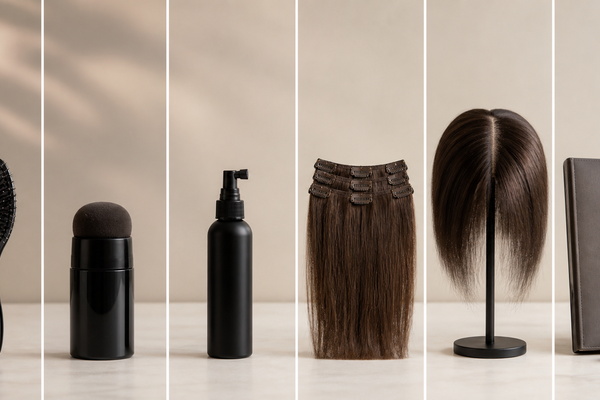
Your options for hiding thinning hair are styling tricks, hair fibers, root touch-up sprays, hair extensions, hair toppers, and — for a permanent change — hair transplantation, sometimes alongside medical treatment. The first five conceal what is there. The last two change what is there.

- Styling tricks. A deeper side part, loose waves, or a strategic cut that builds volume where hair is thin. Free, instant, and the ceiling is low.
- Hair fibers. Keratin or cotton particles that cling to existing strands and visually thicken them. A five-second fix that washes out.
- Root touch-up sprays. Pigmented sprays that darken the scalp so it stops showing through. Same day, same wash-out.
- Hair extensions. Length and volume added to the hair you have. They fill in the sides and back, not the crown.
- Hair toppers. Partial hairpieces that clip onto your own hair and cover the exact thinning zone, most often the top and crown.
- Transplant and medication. Surgical redistribution of your own follicles, and treatments that may slow loss or support regrowth. Slow, medical, and beyond the scope of a beauty routine.
Thinning has many causes, from heredity to hormones to stress, and hair loss[1] patterns differ accordingly. Coverage options do not treat any of them. They simply buy your confidence back while you decide what, if anything, to do next.
How Much Thinning Can Each Option Actually Cover?
The size of the thinning area decides more than any other factor. Every option has a ceiling, and pushing past it is what makes hair "fixes" look fake.
Styling tricks and fibers cover a mildly widened part, sprays cover scalp show-through, extensions cover the sides and lengths, and toppers cover anything from a small part to the full top of the head. Smooth, bare scalp with nothing to attach to points to transplantation, not concealers. Size first, method second.

| Thinning area | Best fit | Poor fit |
|---|---|---|
| Slightly widened part | Fibers, root spray, side part | Transplant for cosmetics alone |
| Visible scalp through the crown | Root spray, small topper | Extensions |
| Defined thinning zone on top | Hair topper | Fibers alone |
| Thinning sides and overall length | Extensions | Toppers |
| Large smooth area, few anchor hairs | Transplant consultation | Every clip-in option |
Two ceilings deserve honesty. Hair fibers need existing strands to cling to — on a smooth patch with nothing to grip, they brush away unevenly. And toppers clip into the hair surrounding a thinning zone, so they need enough healthy hair at the perimeter to hold. When the ground itself has gone bare, concealing reaches its limit, and the conversation moves to medical options. If you already know your method and want placement tactics instead, I cover those zone by zone in a crown, part, and front coverage guide.
How Fast Does Each Option Work—and How Long Does It Last?
Speed matters when the mirror hurts today. A wedding, a reunion, a work photo — some weeks you need results before the weekend.
Fibers, sprays, and styling changes work within minutes and last until your next wash. A topper works the day it arrives and lasts about a year of regular wear. Extensions need a salon visit. Medication takes months to show anything, and transplants take up to a year to fully heal and grow in. Coverage is instant; treatment is not.

The time column is where expectations break. Someone who expects a transplant to solve the mirror by summer often ends up disappointed by the calendar: results build slowly over 6 to 12 months, sometimes longer. Medication moves on the same slow clock. Meanwhile, a topper changes the reflection the morning it arrives, which is why many people wear one while a longer-term plan quietly runs underneath. Coverage and treatment can coexist — one manages today, the other works on tomorrow. For honest numbers on the treatment side, my guide on what regrowth is realistic for thinning hair sets expectations without hype.
What Does Each Option Really Cost Over Time?
Sticker prices mislead. A $30 bottle that runs out monthly costs more over three years than a $400 topper that lasts twelve months.
Count costs per year, not per purchase: fibers and sprays typically run $300 to $500 annually as recurring consumables, a quality human hair topper costs $200 to $600 about once a year, extensions add salon maintenance fees, and transplantation is a one-time $4,000 to $15,000 in the US. The cheapest week is rarely the cheapest year.

| Option | Typical upfront cost | Ongoing cost | Annual total (typical) |
|---|---|---|---|
| Styling tricks | $0–20 | Occasional products | Under $50 |
| Hair fibers | $25–40 | Refill every 4–8 weeks | $200–500 |
| Root spray | $10–25 | Refill monthly | $100–250 |
| Hair extensions | $150–600 | Salon moves every 6–10 weeks | $600–1,500 |
| Human hair topper | $200–600 | Replacement after 9–12 months | $200–600 |
| Hair transplant | $4,000–15,000 | Follow-up care, possible later sessions | Large one-time sum |
Prices vary by region and product grade, so treat these ranges as shapes rather than quotes. The pattern underneath them holds: consumables are cheap per purchase and expensive per year, hardware is the reverse, and surgery spends the most once in exchange for the most permanence. Budget against the version of yourself twelve months out, not the one paying this week.
Which Options Look Natural—and Which Are Fragile?
Naturalness has two tests: the indoor mirror, and weather. Plenty of options pass the first and fail the second.
Styling tricks and toppers hold up in wind, sweat, and rain. Fibers and root sprays look genuinely natural in dry conditions but can streak or run when wet or heavily brushed. If your day includes an unpredictable sky, weigh the weather column heavily.

Fibers at their best are remarkable — a widened part genuinely disappears. Their weakness is commitment: touch-ups after hats, wind, or workouts, and a careful wash at night. A well-matched topper does not care about weather, and a good blend survives a hand run through the hair. Extensions and toppers share one naturalness rule: the match. Wrong color or wrong texture reads as "hairpiece" from across a room, which is why buying from sellers who help with color matching matters more than any other purchase detail. I go deeper on the topper-versus-fibers trade-off in a separate comparison of toppers and hair fibers.
What Are the Risks and Limits of Each Option?
Every option carries a small print section. None of it is frightening, but all of it is real.
Concealers risk clogged pores and buildup if not washed out; extensions and toppers risk tension on the hair that holds them; and persistent or sudden hair loss is a medical question, not a cosmetic one. If thinning came on fast, comes with itching or scarring, or affects eyebrows and lashes, see a doctor before shopping.

Used sensibly, the cosmetic options are gentle: wash fibers and sprays out before bed, move anchor points around so no single strands bear daily load, and take full days off. The boundary worth repeating is the medical one. Hair loss sits at the meeting point of dermatology and hormones, and a proper diagnosis comes from a clinician, not from a comparison chart. The Mayo Clinic overview of hair loss[2] is a sensible starting read before any appointment. Coverage waits for no one — a topper and a diagnosis are not competing choices.
Is Surgery or Medication a Better Path Than Covering Up?
For some people, yes — and for some, no. This decision belongs to a consultation room, but the facts that shape it are plain.
Hair transplantation[3] moves your own follicles from denser areas to thinning ones, works best with stable loss and a good donor supply, and grows in over 6 to 12 months. Medications like minoxidil may slow loss and support regrowth, but results take months of consistent use, as Cleveland Clinic explains in its hair loss treatment overview[4]. Neither is instant, and neither is guaranteed.

The two paths also answer different questions. Surgery and medication change the trajectory of the hair. Concealers change the appearance of it, today, with no recovery time. That is why the real-world answer is so often "both": treat underneath, cover on top, and let each layer do its own job. I walk through the covering side in more depth in my guide on hiding thinning hair without surgery. If transplant-level questions are on your mind, I compare the topper path against surgery in a dedicated guide, including costs, timelines, and who each suits.
Which Option Fits Your Situation Best?
Four situations cover most readers. Find the one that sounds like your week, and the choice makes itself.
Choose by situation: early part widening favors fibers or sprays, event-driven needs favor quick concealers, stable crown thinning favors a topper, and committed long-term change favors a doctor’s assessment. Here is the same idea in table form.

| Your situation | First choice | Why |
|---|---|---|
| Mild widening, want a no-commitment test | Fibers + root spray | Minutes to apply, washes out, under $50 to try |
| Big event in two weeks | Fibers + spray, or a topper | Both work immediately; a topper also covers the months after |
| Stable thinning at the part or crown, daily wear | Human hair topper | All-day, weatherproof, cost-effective across a year |
| Sudden or fast-shedding loss | Doctor first, then cover | Rule out medical causes while staying covered |
| Decided on a permanent change | Consultation for transplant or medication | Changes the hair itself rather than the appearance |
The Full Comparison Table
One table, every option, the four dimensions that actually decide it. Bookmark this one.
| Option | Covers | Works in | Lasts | Annual cost | Weatherproof |
|---|---|---|---|---|---|
| Styling tricks | Mild thinning | Minutes | One style | Under $50 | Yes |
| Hair fibers | Widened part, mild crown | Minutes | Until next wash | $200–500 | Limited |
| Root spray | Scalp show-through | Minutes | Until next wash | $100–250 | Limited |
| Extensions | Length, sides, volume | Salon visit | 6–10 weeks | $600–1,500 | Yes |
| Hair topper | Part to full top | Same day | 9–12 months | $200–600 | Yes |
| Transplant | Donor-dependent | 6–12 months | Permanent | One-time sum | Yes |
Conclusion
No option wins on every column. Fibers buy you a cheap test, sprays dim scalp shine, and styling carries mild thinning a long way. For stable, everyday coverage that ignores the weather and costs about a tank of gas per month across a year, a hair topper earns its place. If you are leaning that way, start with our human hair toppers collection.

References

Wikipedia — Hair loss: causes and patterns overview. ↑ Back
Mayo Clinic — Hair loss symptoms and causes overview. ↑ Back
Wikipedia — Hair transplantation: how follicles are moved and regrow. ↑ Back
Cleveland Clinic — Hair loss treatments: medications, procedures, and realistic timelines. ↑ Back